


Tuck stopped so abruptly that Wade Callahan nearly lost a stirrup. The chestnut gelding stood with his ears pointed into the blowing snow, refusing the turn toward home.
Wade loosened the reins. “What’ve you got?”
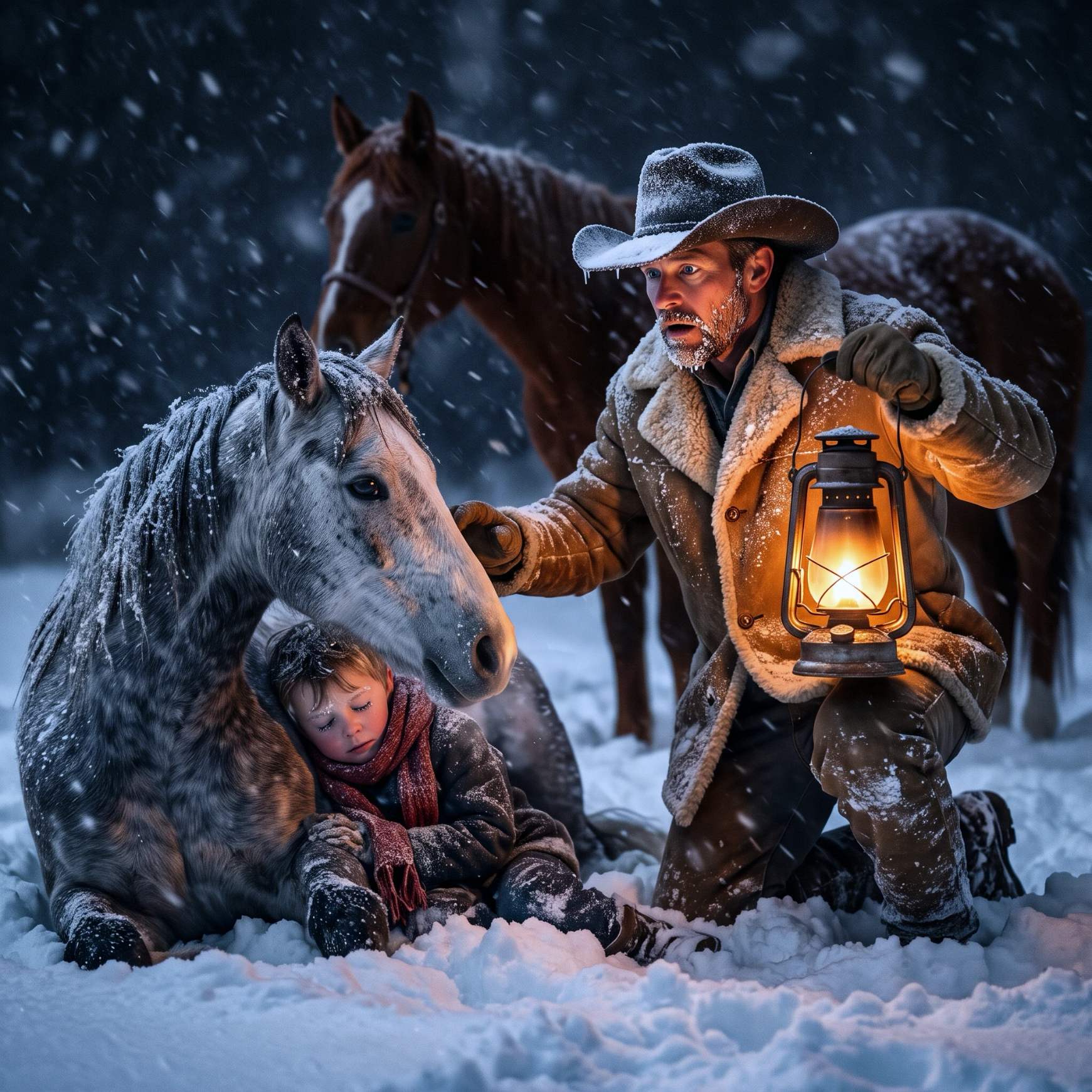
He heard it then, a thin horse cry from somewhere beyond the fence. It lasted less than a second. The next gust filled his collar with snow and left him wondering whether he’d heard anything at all.
He should have been back at the barn already. The south fence had needed checking before dark, but a loose brace had kept him out longer than he’d intended. Now the storm had erased his tracks, and the lantern strapped beside his saddle barely lit Tuck’s shoulder.
Another cry came, weaker than the first.
Wade turned the gelding into the wind.
On a clear day, this part of Montana opened into miles of benchland, scattered pines, and low, grass-covered ridges. Tonight he could see only what passed within reach of the lantern. Snow hissed against his coat. Somewhere below him lay the shallow draw that ran toward his barn. He kept one hand on the reins and watched for the fenceposts that would tell him where he was.
He’d worked cattle in worse country, broken colts for wages, and spent enough years on the rodeo circuit to know the difference between being afraid and paying attention. Since the avalanche that had killed his wife and son two winters earlier, he’d mostly stopped being either. He worked, ate, slept when he could, and answered a raised hand from a passing neighbor with one of his own.
Tuck took another step and blew hard through his nostrils.
A dark curve interrupted the snow near a clump of brush. Wade lifted the lantern, expecting a dead deer. Instead, light showed a gray muzzle and an eye crusted with ice.
He dismounted and let the gelding stand as a windbreak.
The mare lay with her legs tucked awkwardly beneath her, her neck bent toward her belly. Snow had collected along her back. She tried to lift her head when Wade knelt, but the effort ended with her chin in the drift.
“Save your strength,” he said.
He brushed snow away from her nostrils, then laid a glove against her neck. She was trembling. Young, he thought, and too thin beneath that winter coat. A mustang, though she had been near a rope before. Even in the poor light, he could see an old line across her skin.
Something shifted beside her belly.
Wade reached into the sheltered hollow between the mare and the drift. His fingers touched cloth. Beneath it was a small wrist.
He set the lantern down so fast that its handle struck the frozen ground.
The child had curled against the mare’s underside, knees drawn close, one hand tangled in her mane. A blanket covered part of him, but its torn edge had frozen into the snow. He looked about six. His lips had gone dusky, and fine ice held his lashes together.
Wade found the boy’s neck with two fingers. For several terrible seconds, he felt nothing.
Then a beat touched his fingertips.
He stripped off his coat and eased the child out of the hollow, keeping his body as level as he could. The mare watched him. When the boy’s hand slipped free of her mane, she made a low sound in her throat.
“I’ve got him.” Wade wrapped the coat around the child. “You kept him here. I’ve got him now.”
He lifted the boy onto Tuck’s saddle and held him there against his chest. The gelding stood without moving, snow whitening his ears.
Behind them, the mare struggled. She got one foreleg beneath herself, lost it, and tried again.
Wade looked toward the blank stretch where his barn ought to be. Getting the child there was all that mattered. He knew it. Yet his hand had already gone to the lead rope tied behind the saddle.
He made a loose loop and waited until the mare raised her head.
“Nobody stays behind.”
She came up with a lurch that nearly carried her over. Wade steadied her as well as a man could steady a horse, then started walking, one hand keeping the boy secure, the other holding the rope. Tuck followed his shoulder. The gray mare followed Tuck.
They moved from post to post. Twice the mare stopped, her legs spread, and Wade thought she was finished. Each time, when the child stirred against the saddle, she took another step.
By the time the lantern picked out the barn wall, Wade could no longer feel his fingers.
He shoved the door open with his hip, brought Tuck inside, and lifted the boy down onto dry horse blankets. The mare crossed the threshold and sank to her knees. Wade got the door closed before she settled onto her side.
The small stove stood behind a metal guard in the work corner. He fed it split wood, opened the draft, and checked that the stovepipe was drawing. Then he cut away the child’s frozen blanket, removed his wet outer clothes, and wrapped him in dry wool, leaving his face clear.
Wade bent close enough to hear each breath.
“Stay with me, son.”
The word caught him unprepared. He turned to the stove and put on the kettle.
His old radio gave him static. He tried again, holding the microphone so tightly that his hand cramped, but no voice answered. The road to Belvern had been filling when he’d checked it that afternoon. Nobody was getting a truck up it tonight.
He kept the boy near the stove without crowding him against the heat. Then he fetched more blankets for the mare and laid dry bedding around her, working slowly so she wouldn’t waste herself trying to rise.
Tuck stamped in the next stall.
“You’ll get your supper,” Wade told him. “Complain quietly.”
The ordinary sound of his own voice startled him almost as much as the child had.
For a while there was only work. He dried the mare with old towels, breaking ice loose with his fingers rather than pulling it from her hair. Several pale scars crossed the lower part of her neck. One, shorter and deeper, curved beneath her mane. Whoever had put those marks on her had pulled hard and kept pulling.
Wade’s jaw tightened. He carried another armful of hay over and left it where she could reach it.
The boy made a small, frightened noise.
Wade was beside him before his eyes opened.
“Easy. You’re indoors.”
The child’s gaze moved past him, searching the dim barn.
“Where’s the horse?”
Wade shifted so he could see her. “Right there.”
The boy tried to lift his head. When the mare’s ear turned toward him, he let it fall back onto the blanket.
“She stayed,” he whispered.
“Yes.” Wade tucked the wool beneath his shoulder. “She did.”
Later, when the boy was alert enough to swallow, Wade helped him take a few sips of warmed milk. He asked nothing else. The child fell asleep holding the edge of Wade’s sleeve.
Wade sat against the feed chest. His son, Adam, used to do that when thunder woke him. Hold on without looking, certain his father would remain where he’d been put.
He eased his sleeve free only when the kettle began to rattle.
Near dawn, the windows stopped shaking. Wade opened the door a few inches and saw a sky without falling snow. The yard had disappeared beneath smooth drifts. No trail led toward the boy’s hiding place except the broken trough Wade and the horses had made coming home.
When he returned to the stove, the child was watching him.
“Can you tell me your name?” Wade asked.
“Noah.”
“I’m Wade.”
Noah studied the mare, then the door. “Is it still bad?”
“Storm’s passed.”
The boy rubbed the blanket between his fingers. After a while, he said, “Mama told me to run…”
To read the rest of the story – CLICK the NEXT button 👇👇👇