


Tessa Mercer shut off the back trough and listened to the pipe knock itself quiet. There was no sense letting a float valve rattle over an empty basin. The little creek that fed it had quit running, and the cattle would have to use the trough by the house.
She put the wrench in her hip pocket and went to fetch another load of water.
At thirty-eight, Tessa could usually tell which repair could wait by the sound it made. The truck’s transmission had begun whining on the grade. The barn roof clicked loose in a west wind. The pump in the wellhouse still sounded steady, and for the moment that was the noise she trusted.
Veylan ranch occupied 340 acres in the dry southeastern corner of Oregon, in a county where most people measured a place against whatever the Rusk family owned. A house, a barn, a shed, some corrals, and enough grass in an ordinary year to keep a modest herd made Veylan a ranch to Tessa. To the Rusks, whose holdings covered more than 62,000 acres, it was an inconvenient piece missing from a much larger map.
She had spent eleven years there. Her marriage had ended partway through them, leaving her with the land, debts against the land, forty-one cattle, and equipment that required more ingenuity than parts. Her former husband lived in Spokane now. His occasional calls generally concerned another delay in sending money.
When someone in town asked how things stood between them, Tessa tended to study the nearest object until the question wore out.
Her son was better company than most adults. Owen, seventeen, had long arms, a quiet manner, and a habit of putting tools back where they belonged. He fed before the school bus and after practice, and he could hear a bad bearing before Tessa could.
He wanted to learn diesel repair in Ontario. He hadn’t quite said that he didn’t want to take over the ranch. Tessa had understood it during a cattle sale the previous spring, watching him come alive at the sight of a broken-down loader after sitting through two hours of bidding without interest.
She hadn’t made him explain.
By the middle of July, drought had reduced the western creek to gravel that looked dark only in the deepest places. The stock pond had become a shallow oval surrounded by dried mud. Tessa was making three water runs a day with the big tank in the truck, counting gallons and fuel while hay climbed to $255 a ton.
A letter from the bank in Lanton waited beneath the sugar bowl. Its language was polite enough to require reading twice. The bank wanted to reassess the loan.
Owen found her looking at it one evening and set a repaired hose fitting beside her plate.
“It’ll hold now,” he said.
She put the letter facedown. “Good.”
There had been an easier way out, if selling everything she meant to keep could be called easy.
Adrienne Rusk had brought the latest offer in April, her fourth in six years. She was forty-six, with a haircut that never seemed disturbed by wind and a public calendar full of board meetings. Her brother handled cattle and ground; she handled people.
That afternoon, her pale SUV had stopped beside Tessa’s leaning gatepost. A broker remained near the vehicle while Adrienne looked over the house, the shed, and a stretch of fence awaiting staples.
“Keeping a place this size going must take everything you’ve got,” she said. “There comes a point when the acreage can’t justify the work.”
She spoke with the composed concern of someone explaining an unfavorable test result.
Tessa had kept one hand on the gate. “It’s not for sale.”
Adrienne didn’t argue. At the SUV, she lowered the window.
“Keep my number. We can still do this when you’re ready. I can’t promise the same figure.”
Now, in July, Tessa could hear the pump running from the kitchen window and remember the clean soles of Adrienne’s shoes on her porch. She washed her plate, put the bank letter in a drawer, and went out to check the cattle.
Clover stood at the house trough, her torn ear turned toward the sound of approaching boots.
She was a seven-year-old Hereford, deep-bodied and broad, with a bite-shaped notch where wire had caught her ear as a yearling. Nothing about her pedigree would have interested a breeder. Ellis Boone, the veterinarian, maintained that a winter’s hay bill erased any commercial argument in her favor.
But Clover had a use Tessa could not enter on a balance sheet.
When wind opened a gate or winter pushed a fence down, the scattered cattle eventually appeared behind that cow. Clover knew which draw stayed sheltered, where the footing softened, and where the herd belonged at feeding time. Tessa had never had to go looking for her.
The next morning, she counted forty animals.
She drove through them slowly, marking each back in her mind. Then she walked the group. From the low rise beyond the shed, she counted once more.
Owen came out with the feed buckets and saw her standing there.
“Which one?”
“Clover.”
He looked over the herd himself, although she hadn’t asked him to.
Tessa started at the north fence, where most trouble announced itself. The posts she’d reset in May were solid. At the road, the doubled chain still held the gate. She found no torn wire, no disturbed ground, no dark congregation of birds over the wash.
A mountain lion could kill a cow. It couldn’t remove fourteen hundred pounds without leaving Tessa something to read.
She checked the low places, the abandoned foundation south of the pasture, and the culvert beneath the county road. When the four-wheeler’s fuel light came on, she returned to the barn for a can and went back out.
Calls to neighboring outfits produced promises to watch, but no sightings.
By dark, Owen had finished the chores. A supper plate waited in the oven. Tessa pulled the foil off and ate at the counter without taking off her boots. Across the kitchen, her son had left his phone charging with the sound turned up.
The next morning she needed mineral and fencing staples. At the feed store, her name reached her from an aisle before anyone noticed she was there.
A man whose straw hat had never seen much weather was saying that a person ought to be able to keep track of something as large as a cow.
Lyle Pruitt, who managed one of the Rusk cattle outfits, lifted his coffee from the counter.
“Maybe she’s the first one on that place smart enough to move out.”
The laughter was brief. Tessa had to walk through it to pay.
The young cashier concentrated hard on the register. Tessa carried both sacks herself, put them in the truck, and sat behind the wheel until she could trust her foot on the accelerator.
She searched west that afternoon. An old stock trail crossed that country, older than the present fences, and she had run out of more likely directions.
A hoofprint showed beneath a shelf of rock where spring runoff had once left mud. She stopped the four-wheeler and crouched beside it. A cow had pushed off hard there, leaving the front edge deep.
Farther along, she found two more.
The country was familiar in pieces, less familiar at that distance from home. She unfolded the map on the seat and traced her way back with a dusty finger. Nearly ten miles. Clover had walked into the worst heat of the summer as though she had an appointment somewhere beyond it.
Tessa called Ellis before she lost service.
He arrived late that afternoon, driving a truck that carried the permanent smells of disinfectant, leather, and reheated coffee. Sixty-one years old and spare through the shoulders, he had spent thirty-one years working that end of the county. He took a long time getting out, then an even longer time looking at the ground.
“What?” Tessa finally asked.
He pointed beyond her boot.
Horse tracks filled the drainage. Large hooves, narrow ones, the small round impressions of foals. They crossed Clover’s prints and covered the softer ground farther west.
“Somebody moving saddle horses?”
Ellis lowered himself onto one knee. “No shoe marks. Not anywhere I can see.”
They followed the tracks another mile or so. Then a fence stopped them.
The posts were new steel. The upper wire shone; older barbed strands had been worked into the lower runs. It climbed the slope in both directions, far heavier than the weathered fencing Tessa remembered out there.
A sign carried one word in large letters: RUSKEN. Beneath it was a warning against entry.
The horse tracks crowded the wire, turned, overlapped, and crowded it again.
Ellis rested a hand on a post but didn’t test it.
“We’re losing light.”
Tessa took a last look at the churned dirt. There was no opening she could see.
On the ride home, she watched the country for the red and white shape she had been certain would eventually appear. By the time her own roof came into view, she had begun doing the miserable arithmetic of losing Clover as well as everything else that summer had taken.
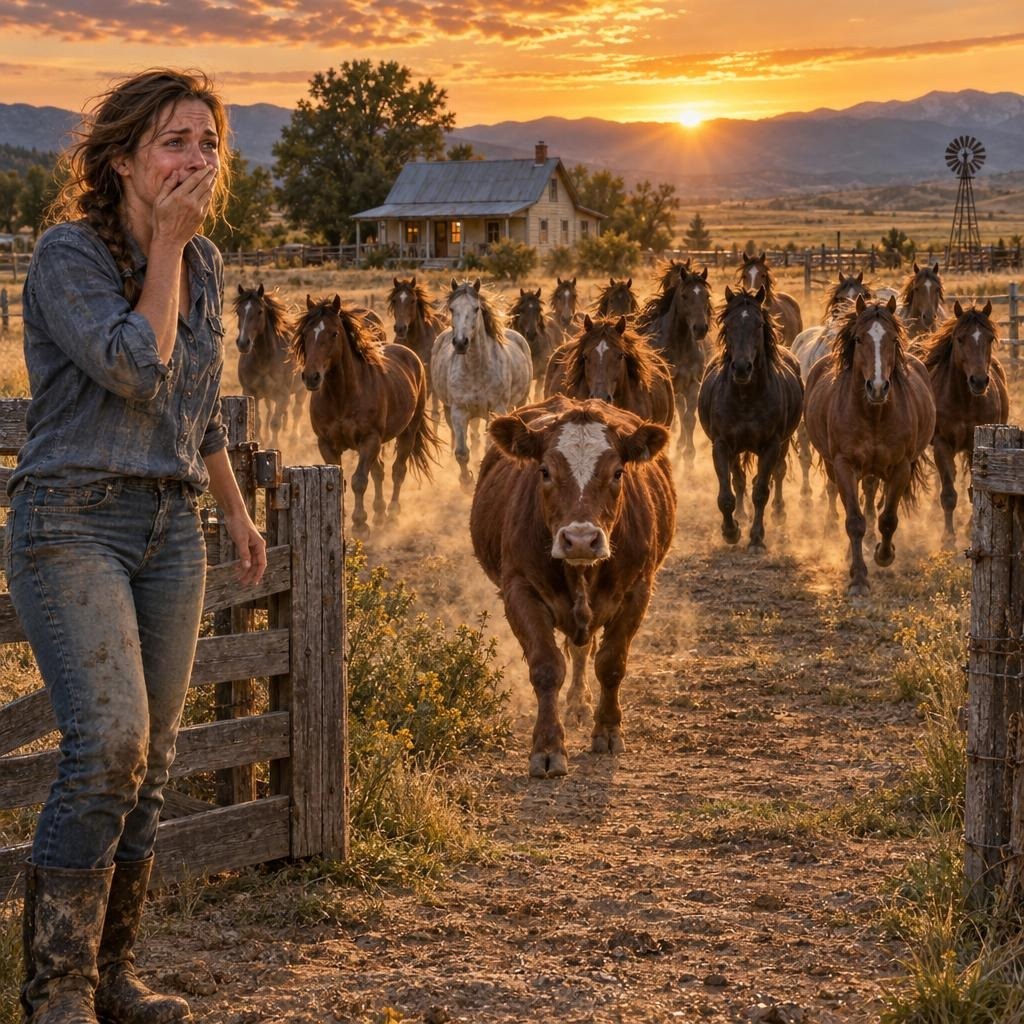
She woke before dawn to a familiar bawl.
For a moment she lay still, afraid to move and discover she had dreamed it. Then the cow called again.
Tessa crossed the yard in her sleep shirt and untied boots. Clover stood outside the pipe gate, dirty enough to look a different color. There was a scraped patch on one knee and another low on her chest. Her notched ear flicked at a fly.
“You fool,” Tessa whispered, fumbling the chain.
Clover walked past her toward the trough.
Beyond the dip in the road, another set of hooves sounded. Then several more began striking the hard ground together…
To read the rest of the story – CLICK the NEXT button 👇👇👇