


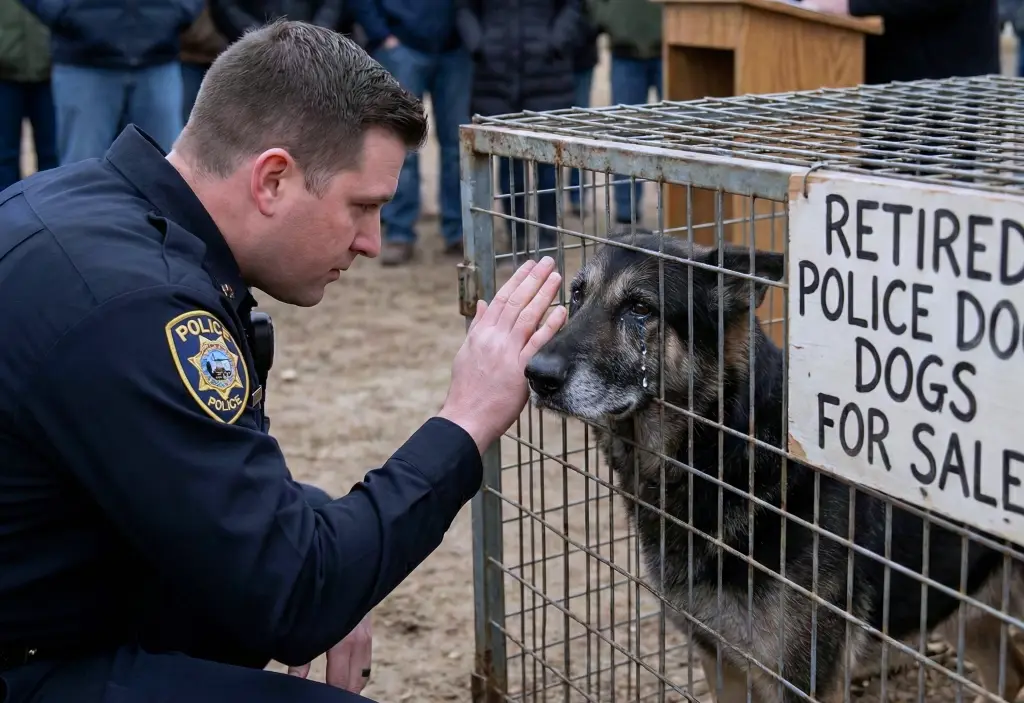
The dusty wooden sign creaked on its hinges, swaying slightly in the dry, stagnant air. The painted letters were faded, peeling under the relentless sun, but the message remained cruelly legible: “Retired Police Dogs for Sale.” It was the day of the Annual K-9 Retirement Auction, an event that usually took place with little fanfare—a place where old service animals were quietly offloaded to strangers. Most of the public had seen police dogs in action, muscles coiling as they sprinted toward danger, but very few had ever witnessed the heartbreaking reality of what happened after their years of service came to an unceremonious end.
People had gathered in the auction yard, a motley collection of ranchers, breeders, and bargain hunters. Their eyes locked onto the row of metal cages lined up in front of the old, weathered auction house, assessing the living creatures inside with cold calculation. Inside those cramped enclosures sat trembling German Shepherds. The buyers circled like vultures, their gazes stripping away the animals’ dignity. Some were looking for cheap guard dogs to chain up in a scrapyard; others were scouting for breeding stock to squeeze a few more dollars out of a tired bloodline. But as they peered through the wire mesh, it became clear that no one wanted these broken, retired police dogs.
To the murmuring crowd, they were just damaged goods—depreciated assets to be haggled over. But once, these animals had been the shield between order and chaos. They had been officers. Now, however, they were being sold to strangers like old, discarded lawn equipment.
Their fur was dusted with gray, their muzzles showing the passage of time, and their eyes were tired, yet they still held a flicker of undying loyalty. Every single one of them seemed to be waiting, believing with heartbreaking naivety that their handler would return for them. They watched the gate, ears twitching at every footstep, but the familiar heavy tread of their partners never came.
One German Shepherd, a large male with a coat that had lost its luster, slowly lifted his head. Tears—actual, glistening tears—streaked down his muzzle, dampening the gray fur as if he understood exactly what was happening. The atmosphere in the yard was heavy, suffocating, but everything shifted the moment Officer Cole Bennett entered the auction.
The sun hung low over the dusty Sheriff’s yard, casting long, distorted shadows across the worn wooden buildings. It was supposed to be a simple event—routine, predictable, and ultimately forgettable. But the moment Officer Bennett stepped through the gates, a silent heaviness settled over the place, a spectral weight that made the air feel colder despite the warm afternoon light bathing the scene.
Cole’s boots crunched over the gravel, the sound loud in the sudden hush. He paused at the entrance, his eyes narrowing as he took in the rows of metal cages lining both sides of the yard. Each one housed a German Shepherd with slumped shoulders and breath that came slow and defeated. These dogs, who had once sprinted through danger without a second of hesitation, now sat behind bars, reduced to inventory. A few pressed their cold noses against the metal, inhaling the scent of the crowd, still expecting their handlers to walk through the crowd and unclip the latch. But no familiar footsteps came.
Passersby murmured as they walked past the cages, whispering judgments that cut through the quiet like dull knives.
“This one looks strong enough,” a man in a greasy cap muttered, poking a finger toward the wire.
“Nah, this one is too old,” his companion replied, dismissing a hero with a wave of his hand. “Probably has behavioral issues.”
Inside one of the cages, the weeping dog lifted his head again. His deep brown eyes were filled with a kind of sorrow that language could barely encompass. He followed every passerby with desperate hope, only to lower his head when he realized they were strangers. Beside him, another dog let out a soft, heartbroken whine, nudging the bars with a heavy paw.
A man in a faded vest leaned toward the auctioneer, looking unsettled. “Never seen dogs cry like that,” he muttered, shifting his weight uncomfortably.
The auctioneer, a man with a face as hard as the gravel beneath his feet, barely glanced at him. “They’ll be fine once they’re bought,” he said dismissively. “People get too sentimental about these animals.” But even he didn’t sound entirely convinced.
Across the yard, the old wooden sign creaked again in a sudden gust of wind. Beneath it, officers from surrounding towns stood with their arms crossed, their faces unreadable masks. Some looked physically uncomfortable, shifting on their feet, while others avoided eye contact entirely, staring at the ground or the horizon. No one wanted to acknowledge the ugly truth hanging in the air: these dogs weren’t just retired. They were being discarded.
The auctioneer stepped onto the platform, checking his watch. He tapped his clipboard loudly with a pen, the sharp sound echoing off the wooden siding. “Alright, folks, we’ll start the bidding in just a few minutes,” he announced, his voice booming. “Please look over the dogs and decide which ones you’re interested in. Once they’re sold, they are your responsibility.”
A hush settled over the yard—a painful, expectant silence. Suddenly, one of the dogs barked. It was a sharp, desperate sound that startled several people near the front row. The dog didn’t care about their reaction; he pushed his face between the bars, scanning the crowd for someone—anyone—that he recognized. When he found no one, he let out a low, trembling cry that made even the auctioneer hesitate for a split second.