


Daniel Mercer was testing a roll of woven wire with his thumbnail when the auctioneer’s helper began herding people toward the barn. The wire was heavier than he’d expected. If the bidding stayed sensible, he could replace the sagging stretch beside his orchard before the ground froze.
That was all he’d come for.
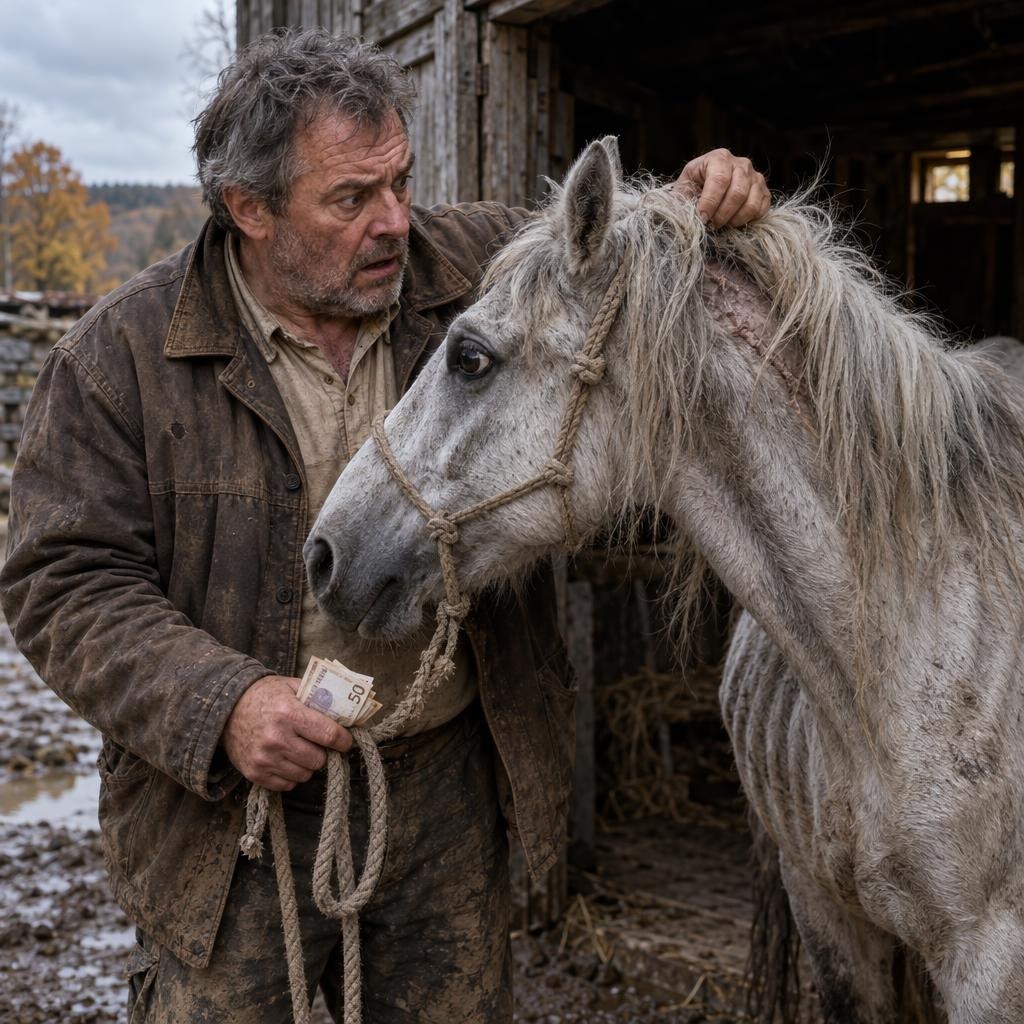
Owen Pruitt had mentioned the sale at the co-op, between a complaint about fertilizer prices and a question about the apple crop. The Kesslers were selling everything. There were unopened fencing supplies, a tractor that might be worth fixing, and assorted tools. Daniel had hitched his stock trailer that morning because the wire rolls wouldn’t fit safely in the pickup bed.
He’d spent forty-five minutes getting there and less than five deciding against the tractor. Someone had wiped the engine clean without fixing the leak underneath it. A coffee tin sat beneath the oil pan.
The rest of the place looked less carefully disguised. Rain had swollen the bottom of the barn doors, and a strip of roofing lifted whenever the wind came over the rise. Beyond the machinery stood a farmhouse with bare curtain rods visible through the front windows.
Daniel knew the look of a farm being emptied. There was always something left hanging where a person had meant to use it again.
He bought a cup of coffee from a woman beneath a canopy and wandered around the side of the barn. That was where he found the horses.
Two moved along the paddock fence, following the activity with hopeful noses. The third remained beside a wooden post, so still that Daniel first took the pale mane for a rag caught on the rails.
Then an ear turned toward him.
The horse was a bay, though age and poor condition had dulled the reddish coat. Four pale stockings showed above worn hooves. His back had settled, his hips stood out more than they should, and the muscle over his hindquarters had thinned. When he shifted, he spared the left hind leg before setting it square again.
The mane had silvered almost completely. A few dark strands remained underneath, but the wind lifted a pale fringe along his neck.
Daniel stopped with his coffee halfway to his mouth.
He’d been around enough livestock to recognize an animal that had learned not to expect much. Usually there was a withdrawal in the eyes, a watchfulness directed toward whatever might come next. This horse watched Daniel himself.
The younger pair jostled behind him. He didn’t turn.
Daniel stepped farther along the fence. The old horse followed him with his eyes, keeping his head level.
“You won’t get much out of me,” Daniel said.
The horse blinked.
Someone called for the fencing lot. Daniel went back around the barn, found a place near the rear of the gathering, and bought the wire for less than he’d allowed himself. He arranged to collect it after the remaining lots and was reaching for his keys when the auctioneer announced the horses.
There were perhaps two dozen people left. The younger animals brought prompt bids from buyers who seemed to have come specifically for them. Money was agreed upon, hands shook, and the horses were led away.
A boy in a canvas jacket brought out the old bay. He held the rope well below the halter and kept checking his phone with his free hand.
The auctioneer consulted a sheet clipped to his board.
“Gelding. Quarter horse cross. Estimated twenty-eight. Papers haven’t come through with him. Suitable on level footing, some stiffness behind. Been here two years. Came from a place over in Bedford County.”
Daniel looked at the horse’s feet while the man asked for sixty dollars.
No bid came.
A woman near the loading chute drew her husband away by the sleeve. Two men who’d been talking over the earlier sales stopped talking long enough to look, then resumed.
The auctioneer tried fifty, then forty.
The boy shifted from one boot to the other. The horse waited beside him, the slack rope brushing his chest.
Daniel had nearly reached the edge of the crowd when the bay turned his head. There were several people between them, but the horse found him through the gap beside a woman’s shoulder.
Daniel lowered the coffee to a fence rail.
“Eighty,” he said.
The auctioneer looked up sharply, then pointed. “Eighty offered. Anyone else?”
A man behind Daniel gave a small snort. Daniel kept his hand raised until the auctioneer nodded to him.
Nobody challenged it.
At the payment table, he counted out the bills and signed beneath the Kesslers’ name. The sale clerk stapled a health sheet to the transfer form and pushed the papers back across the plywood.
Outside, the boy surrendered the rope without asking whether Daniel needed help loading. The bay moved close enough that Daniel could feel heat through his jacket sleeve.
He folded the paperwork slowly. Buying an old horse was one thing. Getting him through a Pennsylvania winter would require feed, bedding, a veterinarian, and a reason better than the one he’d given himself while his hand was in the air.
“You know how old he is?” a woman asked.
Beth Rourke stood beside a mud-spattered pickup, finishing paperwork on the hood. Daniel recognized the veterinarian from the feed store in Dunmere and from a vaccination visit at the farm next to his.
“I was standing there when they said it.”
“That isn’t always the same as hearing.”
He looked at her. Her pen rested against the page, waiting.
“I heard.”
Beth studied the horse, taking in the hollow behind the shoulder and the way he’d planted his hind feet. She stepped over, let him smell her hand, then ran two fingers beneath the halter strap.
“What job are you buying him for?”
Daniel had no answer prepared. Across the yard, a load of kitchen chairs rattled into the bed of a truck.
“None that I know of.”
Beth glanced at him, then back at the horse. She didn’t deliver the warning Daniel could see she was considering. Instead, she took a card from her pocket.
“Have me out before you change his feed much.”
He accepted it. “I will.”
The bay loaded carefully, pausing once on the ramp to place his left hind foot. Daniel waited without pulling. Once inside, the horse settled with a long breath through his nostrils.
Daniel latched the trailer and checked the pin twice.
From behind the wheel, he could see the auction canopy in his side mirror. A man was taking down the sale sign. The old horse’s empty paddock lay beyond it, its gate hanging open.
Daniel started the truck.
The drive home carried him through the folded hills of southwestern Pennsylvania, past stubble fields and small orchards with their last fruit still hanging. Clouds had closed over the afternoon. On the shaded bends, leaves lay wet against the pavement.
He told himself the purchase hadn’t been complicated. There’d been a horse nobody wanted, and he’d had room.
At his own gate, he stopped to open it, then sat a moment looking up the lane.
Fifty-four acres of apples rose along the northern slope. Behind the barn lay the hayfield, recently cut, and along the lower boundary a creek showed through the thinning brush. His grandfather, Emmett Mercer, had built the clapboard house in 1936. The barn had already been standing then.
Daniel kept both buildings weather-tight. He replaced what broke, painted what required protection, and postponed nearly everything that could be postponed without consequence. Since Evelyn’s death, there were rooms in the house he entered only to check for leaks.
The main horse stalls had stood empty since 2003.
He backed to the barn and lowered the ramp. The bay came down without urging, stopped in the yard, and lifted his nose.
Daniel gave him the length of the rope.
The horse turned an ear toward the creek, another toward the house. He looked up the orchard rows, then toward the dark opening of the barn. His nostrils widened. A leaf scraped over the gravel behind him, and he didn’t startle.
“All right,” Daniel said. “Take your time.”
After a while, the horse went forward.
Daniel followed him inside and pulled the light cord. The bulb above the aisle came on with a faint buzz. There was clean straw stacked near the entrance, hay farther back, and the dry, familiar scent of boards warmed through many summers.
He expected the horse to pause at the first open stall. Instead, the bay continued down the aisle. Daniel had to lengthen his stride to keep slack in the rope.
Past the first stall. Past the second.
At the far end, the horse turned left and stopped before a closed door. He lowered his muzzle to the top rail, breathed along it, then raised his head toward the boarded window inside.
Daniel’s fingers tightened around the rope.
There were six stalls in that barn. He hadn’t steered the horse toward any of them.
The bay had chosen Timber’s…
To read the rest of the story – CLICK the NEXT button 👇👇👇