


The fourth name wouldn’t come until Dean Hollis had lowered his chest another inch. He held himself above the beach, elbows trembling, while wet sand cooled the heels of his hands.
Behind him came a dragging sound, followed by a small thump.
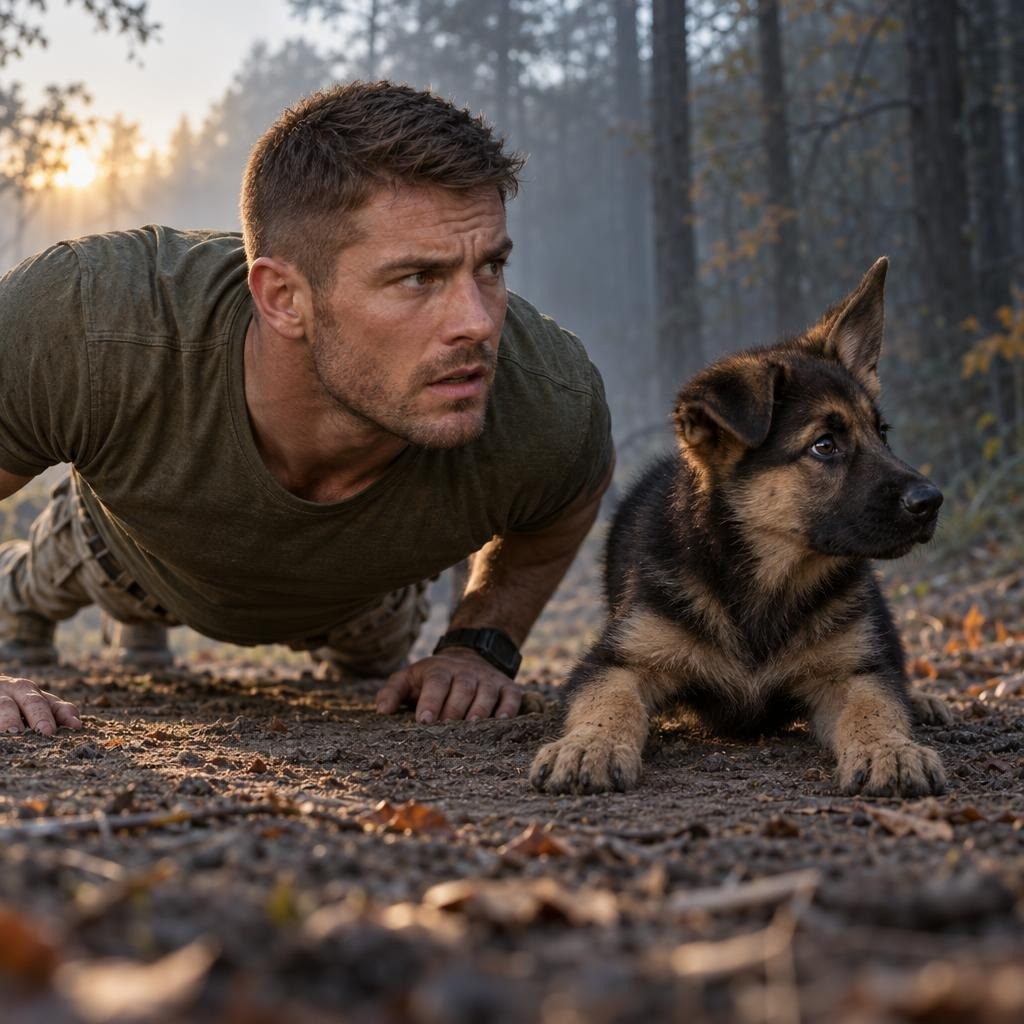
Dean turned his head. A German Shepherd puppy was standing beside his folded jacket, staring at him with the solemn interest of a foreman inspecting bad work. One ear pointed up. The other had collapsed sideways.
For a moment, Dean stayed where he was. His morning had followed the same order for four years, and interruptions usually consisted of a gull investigating his water bottle or somebody asking whether the fishing was any good. This interruption had enormous feet and a loop of fishing line around one of them.
“Hold on,” he said.
He brought one knee under himself and reached slowly. The puppy leaned forward, sniffed his fingers, and tried to take his thumb into his mouth.
“No equipment checks yet.”
The line had collected sand and a strand of marsh grass. Dean eased it over the little toes, then felt along the paw. No swelling, no broken skin that he could see. The puppy stood patiently through the inspection, except for another attempt at Dean’s thumb.
He couldn’t have been more than eight weeks old. Black fur covered his back, with tan legs and cheeks, a pale spot under his chin, and a narrow amber brushstroke beneath one eye. His belly looked round, but under Dean’s fingertips the rest of him felt slight.
Dean looked toward the path through the dunes. Nobody was coming. Beyond the grass lay the sleeping cottages of Marden, South Carolina, their porch lights fading as daylight strengthened. He listened for a whistle, a worried voice, the rattle of a leash clip.
The puppy sneezed against his wrist.
“Well, that answers nothing.”
Dean poured water into the cup from his bottle. The puppy drank, paused to examine his reflection, and planted a front foot in the cup. Water ran over Dean’s boot.
“Right. Shore landing complete.”
He heard the faint amusement in his own voice and went quiet.
At forty, Dean still looked like a man who could put a shoulder under a stalled vehicle and improve its circumstances. Sixteen years as a Navy SEAL had left him broad through the chest, economical in his movements, and attentive to sounds most people never noticed. His dark hair was clipped short. Gray had begun along his beard before he left the service.
That morning he wore an old green T-shirt, faded camouflage trousers, and boots worn smooth at the toes. His identification tags hung beneath his shirt. He had left his field jacket beside the bottle because the sun, finally lifting above the water, promised a warm day.
There would be eleven sets of push-ups. There were always eleven.
The men represented by the first ten had died at different points during his service. One had taught him how to sleep sitting up without wrecking his neck. Another had remembered everybody’s children’s birthdays. A third could improve a miserable watch simply by complaining about it in sufficient detail.
Owen Beckett was the eleventh.
Owen had possessed an infuriating ability to read Dean’s face. He could distinguish anger from hunger when Dean himself wasn’t entirely certain which one he felt. Once, during a long deployment, Owen had argued that instant coffee improved if you stirred it in the opposite direction. He’d defended this theory with such confidence that Dean had tried it.
Four years ago, the order came to pull out of their last operation. Dean obeyed. Owen didn’t come home.
The review had cleared Dean of wrongdoing. He kept a copy of the findings in a drawer he never opened. Nothing in that drawer could answer the questions that arrived after midnight or explain why obedience had left him standing in his own kitchen while Ruth Beckett lived without her husband.
So he came to the beach. Eleven sets, whatever the weather, whatever his shoulders said. He told no one what the exercise was for.
Several blocks inland, his small house contained clean counters, polished boots, and almost no reason to stay awake after dinner. Three mornings a week he repaired marine equipment at Arthur Dobbins’s boat shop. Arthur, seventy-four and stubborn enough to argue with machinery, kept offering breakfast. Dean generally had an excuse.
After bills, much of Dean’s remaining income went quietly to families of men he’d served with. He made the transfers without messages. Gratitude would have made them harder to send.
The puppy bumped his knee.
Dean glanced down. “You’ve got places to be?”
Apparently not. The little dog sat on the corner of his jacket.
Dean ought to gather his things and get him to a veterinarian. The puppy was alert and standing easily, but his coat felt gritty, and there was a faint roughness to his breathing. Dean set the cup out of reach and lowered himself to the sand, intending to finish the interrupted repetition before packing up.
The puppy stretched his front legs forward.
Dean paused.
A small chest went down. A round rear end stayed up. The tail began moving.
When Dean pushed upward, the puppy bounced onto all four feet.
He tried it again, slower.
Down went the little chest.
“You serious?”
The puppy gave a thin bark, as though Dean had failed to understand a perfectly clear instruction.
“All right. Together.”
Dean bent his elbows. Beside him, the puppy committed himself to the exercise with more enthusiasm than traction. One paw skidded. His nose struck sand, his hindquarters swung around, and he landed on his back, feet paddling above his belly.
He lay there looking offended. Then he sneezed so hard his ears flapped.
A laugh escaped Dean before he could swallow it. He sat back, pressed a hand over his mouth, and failed completely. The puppy scrambled upright while Dean bent over his knees, laughing with a force that hurt muscles no workout had reached in years.
“Washout,” he managed. “Before breakfast, too.”
The puppy wagged at him.
“And you’d steal the instructor’s boots.”
“Only if they tasted good.”
A woman in a purple running jacket had stopped several yards away. Her silver hair was cropped close, and she held a phone loosely in one hand. Lydia Sloane, sixty-three, had spent thirty-five years teaching children and still looked at every unexpected occurrence as though it might improve the day’s lesson.
“I caught a little of that,” she said, lifting the phone. “He’s very committed to your program.”
“He needs a different program.”
“Is he yours?”
Dean shook his head. “He walked up just now.”
Lydia scanned the empty beach. The only movement near the dunes was a gull tugging something out of the wrack.
The puppy put both front feet on Dean’s forearm and washed the back of his hand with a sandy tongue. Dean let him. He could feel each small toe against his skin.
“You can’t enlist,” he told him. “You’re still a rookie.”
The puppy tilted his head.
Dean rubbed the folded ear. “Rookie. That’ll do until somebody tells us otherwise.”
Lydia smiled but didn’t add anything.
Owen had loved dogs. Dean could picture him crouching here, making an absurd fuss over these paws, asking the puppy whether Dean had already issued a schedule. The memory arrived without the usual image that followed it. For a few breaths, Owen was simply there in Dean’s mind, alive and laughing at him.
Dean looked away toward the water.
“There’s a clinic that takes found animals,” Lydia said gently. “Dr. Rosner’s.”
“I know where it is.”
He lifted Rookie. Beneath all the fur and disproportionate feet was a surprisingly light body. Dean wrapped the field jacket around him, leaving his face clear. The puppy burrowed against the warm fabric.
“I could come along,” Lydia offered.
His answer nearly came out automatically. He stopped, checked his grip, and looked at her.
“Thank you. I can get him there.”
“Then I’ll let you.” She tucked the phone away. “Good luck, Rookie.”
Dean started toward the parking lot. He hadn’t finished the fourth set, much less the eleventh. Halfway up the path, that omission caught at him hard enough to shorten his stride.
A paw slipped out of the jacket and rested against his chest.
He kept going.
The clinic had barely opened when he arrived. A receptionist found a towel, took his information, and helped arrange an examination between scheduled patients. Rookie slept on Dean’s lap while sand dried along the seams of his boots.
At home, Lydia made coffee and replayed her recording. She watched the puppy’s disastrous landing twice, then listened again to the laughter that followed. She posted the clip with a brief note about an unexpected exercise partner, not stopping to consider how far it might travel.
Dean knew nothing about the video. He was watching the rise and fall of a small towel when Dr. Celia Rosner came into the examination room.
Celia was fifty-four, with silver threaded through dark hair and the steady hands of somebody who’d learned that frightened owners often needed instructions as badly as their animals did. She set her notes down and listened to Rookie’s chest again.
“He’s mildly dehydrated, and there’s a respiratory infection starting,” she said. “We’ll treat that and watch him closely. He needs to stay apart from other dogs.”
Dean’s hand closed around his notebook. “How bad?”
“You got him here early. That helps a great deal.”
She checked his mouth, felt his abdomen, and lifted the folded ear. Her fingers stopped.
Dean straightened. “What did you find?”
Celia moved the lamp closer. Inside the ear, small dark characters showed against the skin.
“VLR-32-206,” she read.
“A tattoo?”
“Yes.” She looked from the marking to Dean. “Tell me again about the beach. There was absolutely nobody with him?”
To read the rest of the story – CLICK the NEXT button 👇👇👇