


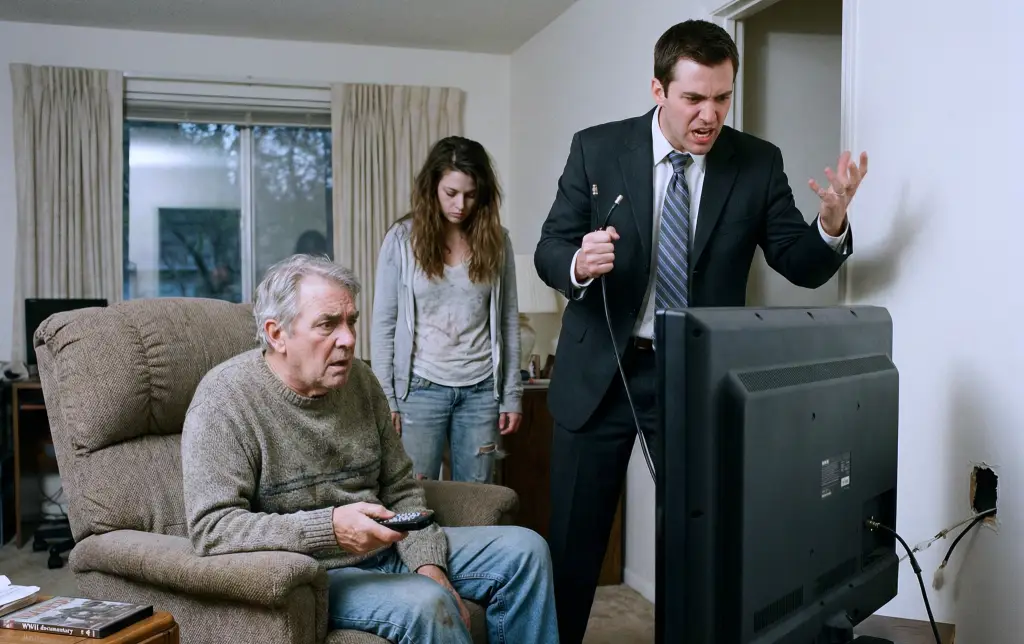
I was sitting on my sofa watching a quiet documentary when my son-in-law stormed in and ripped the cable out of the TV.
“Enough of this trash,” he declared. “In this house, we watch intelligent things.”
What hurt more wasn’t his words. It was my daughter standing behind him. After eighteen months of living under my roof, she didn’t defend me. She avoided my eyes and nodded in agreement with her husband.
I said nothing. I quietly went upstairs. That night, I made a decision. The next morning, when they went to work, I called someone to my house—someone who would change everything. When they came back, they screamed and pounded on the door without stopping.
The black cable hanging from the wall was the end of my patience and the beginning of my reckoning. It was October 2025, a Friday afternoon that felt like any other until it wasn’t.
I’m Joe Brennan, 67 years old, a retired investigative journalist, and according to the deed in my filing cabinet, the sole owner of these four walls. Though you wouldn’t know it from the way I’d been living, I’d become a ghost in my own home. Seen but not heard, present but not acknowledged. A piece of furniture that people stepped around on their way to more important things.
Catherine, my wife, had been gone five years. With her went the last person who’d made this house feel like a home. My daughter, Kinsley, moved in eighteen months ago with her husband, Jason, after they lost their apartment.
I’d opened my door because that’s what fathers do. We protect our children, even when they’re thirty-eight and married to men we don’t particularly like.
That Friday afternoon, I was settled in my leather recliner, the one Catherine and I bought back in ’98, watching a documentary about World War II campaigns in the Pacific. The autumn light slanted through the windows at that perfect golden angle. I was learning about the Battle of Guadalcanal when I heard the footsteps.
Jason’s footsteps. Heavy, aggressive, announcing his presence before he appeared. He filled the doorway at 4:30 like a storm cloud.
Jason Caldwell, 40 years old, allegedly a real estate agent, though I’d never seen evidence of a single sale. He wore one of those expensive shirts that cost more than my weekly grocery budget.
“Enough of this garbage,” he announced, not asked. “This house needs to raise its standards.”
I looked up from the screen. “Excuse me?”
“This trash you watch all day,” he gestured dismissively at the television. “It’s bringing down the intellectual energy of the entire house. We need to be better than this, Joe.”
Notice he called me Joe. Not Dad. Not Mr. Brennan. Just Joe, like we were buddies. Like he had any right to march into my living room and make demands.
“It’s a documentary about World War II,” I said quietly. Forty-two years of journalism had taught me to keep my voice level when I wanted to shout. “Educational programming.”
“It’s old men talking about old wars.” He crossed the room in three strides. “We’re cultivating a more elevated atmosphere here. More refined.”
I should have seen it coming. I should have recognized the look in his eyes, that blend of contempt and entitlement I’d seen in dozens of criminals I’d exposed during my career. But this was my home, my sanctuary.
Jason reached behind the television and yanked the cable out with one sharp pull. The plastic connector cracked. The screen dissolved into static, then darkness. The documentary narrator’s voice, mid-sentence about Marine sacrifices, was cut off as abruptly as if I’d been the one to die.
“Whoa there,” he said, holding up the severed cable like a trophy. “That’s better. Now maybe you can spend your time on something worthwhile instead of rotting your brain.”
I sat frozen, the remote still in my hand. Useless now. A piece of plastic pointing at a dead screen.
“We’ll discuss more appropriate entertainment options at dinner,” he called over his shoulder, already walking away. “Kinsley and I have some ideas about bringing this household into the 21st century.”
The front door opened at 6:15. Kinsley’s car, her footsteps on the porch—tired, careful, like someone who’d spent twelve hours on her feet at the hospital. She was a nurse. A good one.
I heard her bag hit the floor. Heard her greeting to Jason in the kitchen. Heard the low murmur of his voice, undoubtedly spinning the cable incident to make himself the hero.
She appeared in the doorway five minutes later, still in her scrubs.
“Hey, Dad.” The words felt mechanical. A social obligation rather than a connection.
“Hi, sweetheart,” I replied, and I meant it.
Despite everything, she looked at the dark television, at the severed cable on the table, then at me. I waited. Waited for her to ask what happened. Waited for her to defend me. Waited for some sign that the girl I’d raised, the one who’d stood up to bullies in third grade, was still in there.
“Dad,” she said, disappointment heavy in her voice. “Mom would be ashamed of how you spend your time. Jason’s right about the intellectual energy in this house. We all need to do better.”
She walked away without waiting for a response. Probably went to congratulate her husband on being brave enough to discipline the old man.
I sat there as the autumn light faded to dusk. Sat there as streetlights flickered on. Sat there holding that severed cable in my hands, feeling the broken plastic edges dig into my palm.
Seven o’clock came and went. The house filled with sounds of Jason and Kinsley making dinner together, laughing at something on their phones, living their life in my home as if I was already gone. As if I was just another piece of old furniture waiting to be hauled away.
I looked at the cable—black, dead, useless in my hands. Then I looked at the walls around me. The walls Catherine and I had painted. The floor we’d refinished. The windows we’d chosen. The life we’d built.
That’s when I felt it. A shift inside my chest. Like a lock turning. Like something that had been sleeping for eighteen months finally waking up.
I’d spent four decades as an investigative journalist. I’d exposed corrupt politicians, fraudulent corporations, and con artists who thought they were smarter than everyone else. I’d built a career on patience, documentation, and evidence. On knowing when to watch, when to wait, and when to act.
For eighteen months, I’d been watching and waiting. Watching Jason take over my home. Watching Kinsley drift away. Watching myself disappear one small humiliation at a time.
The watching was over.
I stood slowly, my knees protesting but holding. I walked to my bedroom, the one room they hadn’t claimed, and pulled out a yellow legal pad from my desk drawer. The kind I’d used for every investigation I’d ever conducted.
At the top of the page, I wrote: October 18th, 2025. The Cable.
Below it, I began listing everything I’d noticed but been too tired, too sad, too passive to act on. The credit card bills with unfamiliar charges. The whispered phone calls. The way Jason’s eyes calculated the value of everything in my house when he thought I wasn’t looking.
I didn’t sleep that night. How could I? Every time I closed my eyes, I saw the cable falling, heard Kinsley’s voice defending him.
By 11:00, I stopped pretending rest was possible. I lay staring at the ceiling, listening to the house breathe and settle, until a thought cut through the fog with brutal clarity: Stop being a victim. Start being a journalist.
The shift felt physical, like flipping a switch that had been untouched for years. Maybe since Catherine died and grief softened me, made me passive, grateful for scraps of attention from my daughter. Somewhere along the way, I’d traded self-respect for proximity. Tonight, that ended.
At 11:30, voices drifted through the wall. Jason and Kinsley’s bedroom shared it with mine, an arrangement that felt more invasive each day. I couldn’t hear words, only the low cadence of his voice and her occasional replies.
They were planning something. Probably about me. Probably how to manage the “old man” now that lines had been drawn. Let them talk. While they planned, I’d move.
At midnight, I decided. I slipped from bed, pulled on the flannel robe Catherine gave me our last Christmas, and moved into the hallway in socked feet. The house was dark except for the thin bar of light beneath their door. I paused, listening. Silence. Either asleep or occupied in ways I refused to imagine.
I moved like I hadn’t in years. Slow and deliberate, rediscovering instincts forged on stakeouts and late-night investigations. Weight balanced. Floorboards memorized. Patience overriding urgency. Funny how the body remembers.
My old study, now Jason’s office, sat at the end of the hall. The door wasn’t locked. Why would it be? In Jason’s world, I was harmless. A pensioner who watched television and complained quietly. Someone you could sideline while absorbing his life, his home, his authority.
I turned the handle at one in the morning. The room no longer smelled like books and polish. It stank of cologne and energy drinks. My desk was buried under fast-food wrappers and scattered papers.
There, faintly glowing in sleep mode, sat his laptop. I sat in my chair and touched the trackpad. The screen lit instantly.
No password. No hesitation. I almost laughed. For forty-two years, I’d been an investigative journalist. I’d exposed corruption, fraud, and men who mistook power for immunity. I’d done it with discipline and evidence.
And here sat Jason Caldwell, convinced I was too broken to notice anything. How had I missed it? Grief. Loneliness. Fear of losing my daughter. I’d swallowed indignities to keep family close. I’d paid with my dignity. That debt came due tonight.
I began with browser history. Luxury brands. Restaurants I couldn’t afford. Then email. Everything logged in. Banking apps. Texts synced. The arrogance was staggering.
I took out my phone and photographed everything methodically. My hands were steady. This wasn’t anger. It was clarity. Muscle memory.
At two in the morning, I found the credit card statements. My credit card. The one I hadn’t used in months. The one meant for emergencies, buried in my wallet.
According to these statements, I’d been living extravagantly. Nine-hundred-dollar dinners. Three-thousand-dollar shopping sprees. Spa charges labeled “Luxury Wellness.” Electronics I’d never seen. A weekend resort bill I couldn’t pronounce.
The charges spanned six months. Statement after statement. Each signature close to mine, but wrong. Close enough for a glance. Not close enough to fool a man who’d signed his name for sixty-seven years.
Forty-seven thousand dollars. In half a year, my son-in-law had stolen $47,000, and he’d documented it all.
I photographed every page. Every forged signature. Every absurd charge. Forty-three images in total. Forty-three quiet clicks sealing his fate.
At 2:20, my blood iced. A door opened. Footsteps. Jason heading to the bathroom.
I closed everything. Returned the desktop exactly as I found it. Eased the laptop into sleep mode.
The footsteps approached. I pressed myself against the wall, heart hammering. The bathroom door shut. Water ran.
I slipped into the hall and back to my room, moving fast but silent. Behind me, the bathroom door opened again. Jason padded past. I closed my door and sat on the bed.
At 2:30, phone clenched, adrenaline finally catching up. I waited until I was certain he’d gone back to sleep. My hands shook now, but the evidence was safe.
The fraud wasn’t the worst thing on that laptop. I’d glimpsed emails with subject lines that turned my stomach. Those would wait. I’d risked enough.
I scrolled through the photos once more. Clear, legible, damning. For decades, I’d chased truth. Tonight, the truth had come to me.
I should have slept. The credit card evidence was enough. But at 2:30 in the morning, sitting on my bed with my phone, my thumb kept scrolling through the photographs.
That’s when I saw it. An email thread I’d captured almost by accident. Subject line: Re: Joseph Brennan, long-term care options.
My stomach dropped. I enlarged the image. The exchange was between Jason and someone named Susan Whitfield, Senior Living Consultant at Sunrise Meadows Memory Care Facility.
Memory care. They thought I needed memory care.