


The first frost of October hadn’t just settled on the valley; it had claimed it. It laid a thin, crystalline veil across the Montana landscape, shimmering faintly under the fragile, pale light of dawn. The Bitterroot Range stretched out endlessly, its ridgelines dark and jagged against the brightening sky, looking for all the world like they had been carved by a patient, giant hand centuries ago. Cold air drifted down from the peaks, sliding into the hollows like liquid glass, carrying with it the sharp, clean scent of pine, damp stone, and distant snow.
In the middle of that lonely vastness stood a solitary log cabin, its chimney coughing a thin ribbon of pale smoke into the waking sky. To anyone passing on the old, rutted timber road, the place might have looked idyllic—a rugged retreat carved out of the wilderness. But to Gabriel Harlow, the man who called it home, it was less a sanctuary and more a fortress of silence. It was a structure built plank by hand-hewn plank to keep the noise of the world at bay.
Gabriel was forty-two, though life had etched him deeper, carving lines that made him appear older. His frame was lean but roped with tough muscle, the kind earned from years of military service followed by months of chopping wood, hauling water buckets, and navigating miles of unforgiving terrain. His face bore the unmistakable look of a soldier who had seen too much and, consequently, spoken too little.
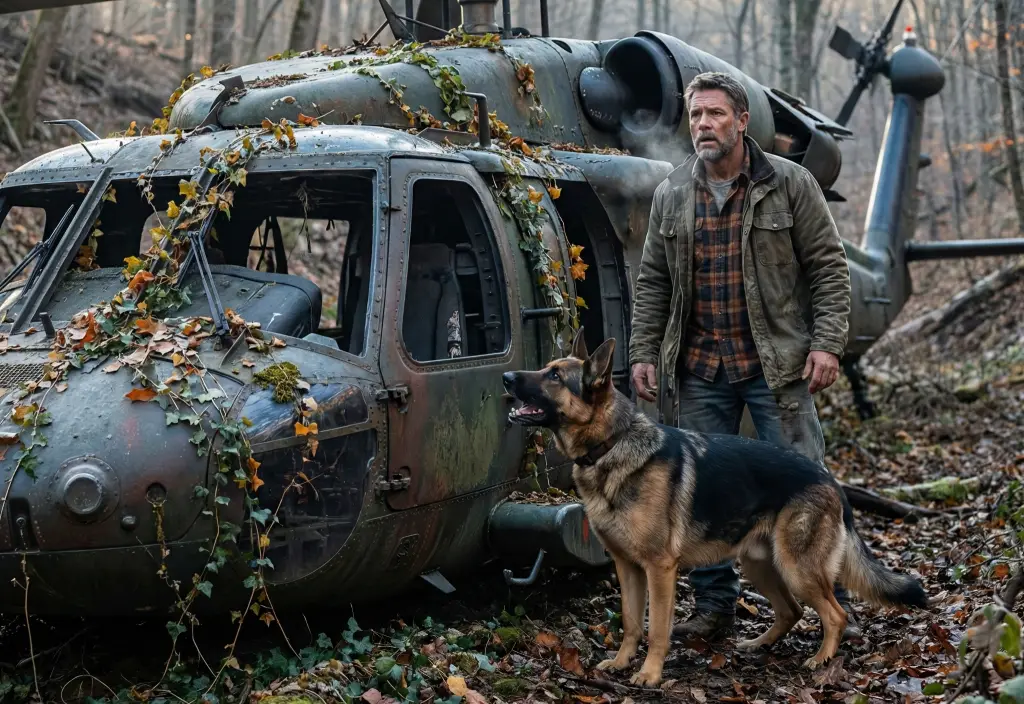
He had a square jaw dusted with rough stubble and crow’s feet fanning out from the edges of storm-gray eyes—eyes that had once scanned scorching deserts for ambushes and now scanned peaceful tree lines for deer. His short brown hair, already touched with the silver of early gray, clung close to his scalp, as though even his hair understood the concept of discipline. He wore a plaid flannel shirt, softened by countless washes, denim jeans faded from years of wear, and boots that were scarred by both Middle Eastern sand and Montana snow.
He was a man of habit. A man of ghosts.
Standing on the porch, Gabriel lifted a chipped enamel mug of coffee to his lips, the steam curling into the chill morning air. He stared at the tree line, but he wasn’t really seeing the pines. In his mind’s eye, the horizon was always superimposed: the lush ridges of Montana overlaid with the arid, dust-choked ridges of Afghanistan.
Memories intruded without mercy. The crack of distant gunfire seemed to hide in the snap of burning logs in his hearth; the phantom tremor of helicopter blades echoed in the sudden gust of mountain wind. He clenched his jaw, the muscles bunching, and tightened his grip on the warm mug until his knuckles turned white. He exhaled slowly, forcing the past back into its box.
At his feet lay Rook.
The German Shepherd was four years old, his coat a striking blend of black and silver that looked like smoke and steel. His eyes were a molten amber, reflecting not only the forest before them but the inner turmoil of the man standing above him. Muscular yet lithe, Rook carried himself with the precision of a trained guardian, though no drill sergeant had ever commanded him. Gabriel had plucked him from a local shelter years ago—a gangly, uncertain pup who had grown into a creature of quiet, formidable strength.
Now, Rook thumped his tail softly against the wooden floorboards of the porch. He sensed the weight in Gabriel’s silence, offering his presence rather than an intrusion.
“You feel it too, don’t you?” Gabriel murmured.
His voice was low, a gravelly timbre, sounding as though each word had been dragged through sand before being spoken. Rook tilted his head, ears twitching like radar dishes. Gabriel reached down, pressing his calloused hand into the dog’s thick ruff, grounding himself.
The warmth of living fur steadied him, as it always did. For all his self-imposed exile, Gabriel was not immune to the pull of routine. Each week, he and Rook vanished into the forest for hunting trips that served less for filling the freezer and more for therapy. Out there, Gabriel could lose himself in the purity of survival—tracking signs, reading the wind, testing his instincts against nature. Out there, the ghosts sometimes grew quieter.
As the sun began to spill orange light across the peaks, Gabriel set down his mug and stretched, his joints cracking in protest against the cold.
“Come on, boy,” he said, turning toward the door. “Time to see what the woods have for us.”
Rook leapt to his feet, tail wagging with a sudden burst of anticipation. Inside, the cabin was modest. It was a single room dominated by a stone hearth, shelves of neatly stacked provisions, and a bedroll that never looked slept in, only endured. Gabriel moved with soldierly precision. He checked his bolt-action rifle with the reverence of a man for whom a weapon was both a lifeline and a burden.
He packed rations, a compass, a water filter, and an old topographic map that was creased white at the edges. Rook watched every move, occasionally nudging Gabriel’s hand with a wet nose, as if urging him to hurry up. By mid-morning, they left the safety of the clearing, stepping into the cathedral of trees.