


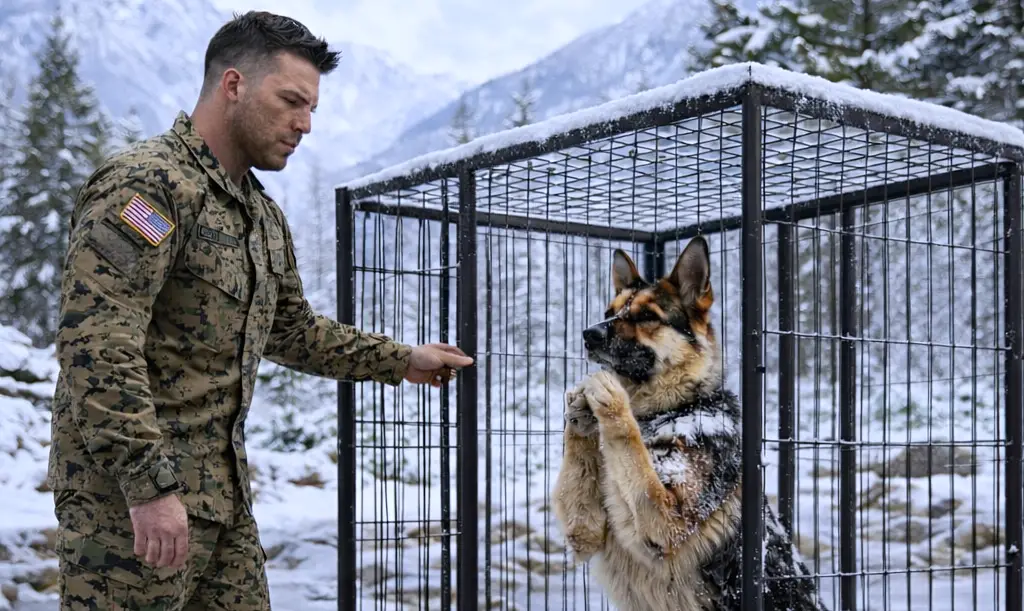
The forest lay entombed under a shroud of white, the trees stripped to their skeletons, life itself seemingly paused in the iron grip of winter. In the heart of that crushing silence, a German Shepherd stood trapped inside a steel cage, abandoned to the biting open cold. His strength was fading fast, every breath a battle against the frost, his body burning through the last reserves of its will as he waited for a miracle that had no business happening here.
There were no cries for help, no witnesses to the crime—only the slow, ticking passage of time in the freezing air, hired to finish what human cruelty had started. Then, a Navy SEAL stepped into the clearing. He didn’t turn away. It was as if fate itself had grabbed him by the shoulder and led him there. In that suspended moment, it wasn’t just a life hanging in the balance; a truth was buried beneath the snow, waiting to claw its way to the surface.
The winter morning in the far reaches of the northern United States was so clear it felt brittle, like it might snap if you spoke too loud. Snow draped the mountain slopes in an unbroken sheet, catching the pale, watery sunlight and throwing it back with the glare of shattered glass. The air was clean but razor-sharp, the kind of cold that slid into your lungs and set up shop, a constant reminder that survival out here was a privilege, not a guarantee.
Cade Merritt navigated the forest service road with a slow, deliberate rhythm, his hands resting steady on the steering wheel. His posture was upright without trying, the discipline of decades settled deep into his bones. At forty, he moved with the contained, quiet energy of a man who trained not to look strong, but to be ready for when things went sideways.
His shoulders filled out the long-sleeved camouflage top, the fabric clinging to a torso built by work, and the tactical belt at his waist sat naturally, like an extension of his body. His dark hair featured a clean undercut, kept neat despite the isolation of his life. His blue-gray eyes remained in motion, scanning tree lines and snowbanks with a habit formed long before he ever drove this mountain road.
Cade hadn’t come up here to take in the view. Sheriff Nolan Briggs had called him the night before, his voice sounding like gravel churning in a mixer, tired and worn. Nolan had asked if Cade would take a look at a specific stretch of forest where locals had reported hearing “off-rhythm chainsaws”—the jagged, hurried sound that didn’t belong to legal logging crews. Nolan was a stocky man in his mid-fifties, with graying hair and a practical streak that ran deeper than the uniform he wore.
He trusted Cade because Cade didn’t deal in exaggeration and never used ten words when two would do. Cade had agreed without a second thought. He lived a quiet life near the town of Pineville, keeping to himself and avoiding messy entanglements, but he had never learned how to ignore a wrong sound in the woods.
As the truck climbed higher, the thinning trees gave way to exposed knuckles of rock and wind-scoured snow. Cade slowed instinctively, the hairs on the back of his neck rising. He sensed something off before he could put a name to it. Then, the shape resolved itself against the white.
Just beyond the tree line, where the mountain leveled out into a narrow, windswept ridge, stood a structure that was an insult to the landscape. It was a metal cage raised on rough, hasty wooden supports, its iron bars rimed with thick frost. It was bolted together with old, scavenging wire and secured by a corroded padlock that looked like it had seen better days.
A thin metal pipe rose from one corner, trailing a pathetic thread of gray smoke that drifted uselessly into the vast open air. The setup looked deliberate, almost careful, but in a twisted way—like someone had gone out of their way to make the suffering last longer. Cade threw the truck into park and stepped out, his boots crunching loudly against the packed snow.
The cold bit immediately, sinking its teeth in, but his breathing didn’t hitch. He approached slowly, his right hand hovering near his belt out of muscle memory, though the only visible threat was the biting wind. Inside the cage stood the dog—a German Shepherd, full-grown, large, and powerfully built, even in its diminished state.
Snow clung to his thick black and tan coat, matting the fur, especially along the dark saddle of his back. His ears were upright but trembling with a fine vibration, and his amber eyes tracked Cade’s movement with a laser-like focus. The look wasn’t wild. It wasn’t pleading. It was alert in the way of a soldier who had learned that vigilance was the only thing keeping him alive.