


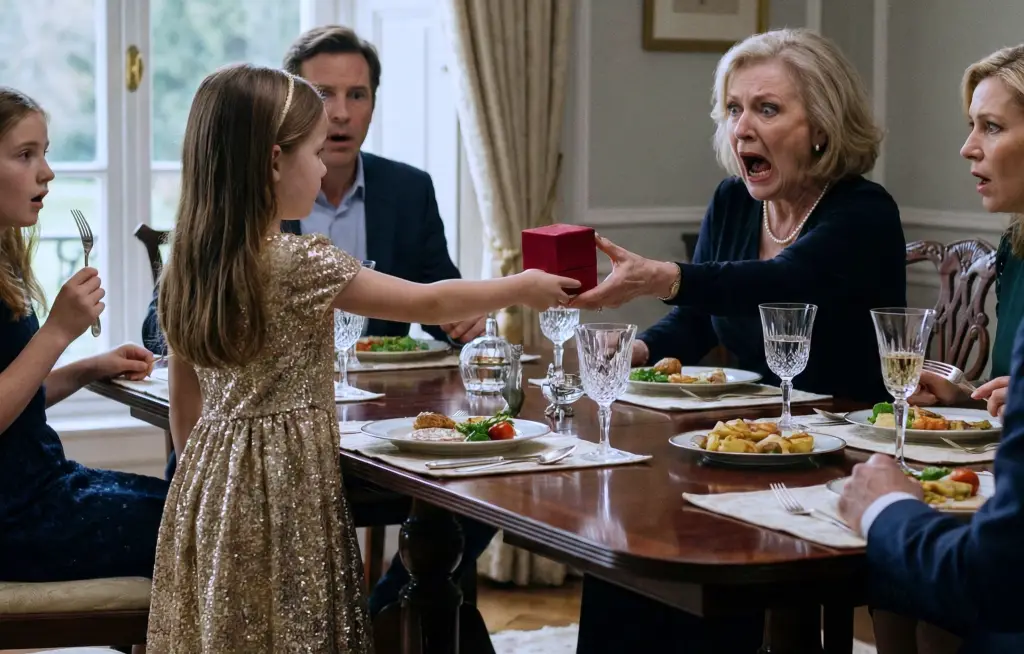
My seven-year-old daughter stood before the crowded banquet table, a small, resolute figure in the sparkly gold dress she had insisted on picking out herself. Her little fingers were white-knuckled around a small gift box. Around her, the room was a cacophony of adult laughter, clinking crystal, and the hum of holiday jazz, everyone too drunk on festive spirit to notice her. Everyone, that is, except me.
I was watching. I saw her lock eyes with her grandmother. I saw her lift the box just an inch, her chin held high.
“Grandma,” she said, her voice cutting through the din like a bell. “Dad told me to give this to you if you ever ignored me again.”
The effect was instantaneous. Everything stopped. Forks froze mid-air, dripping gravy. The music seemed to fade into a hollow buzzing. Her grandmother—my husband’s mother—offered a tight, confused smile, the kind you wear when you think a child has told a joke you don’t quite understand.
But when she opened the box, the smile didn’t just fade; it disintegrated. She didn’t laugh. She screamed.
It was a sharp, guttural sound that tore through the room, louder than the Christmas carols, louder than the collective gasp of the guests, and infinitely louder than the suffocating silence that followed. People rushed over, necks craning to see what kind of horror could be inside such a small package.
But I didn’t need to look. I already knew. My husband, Travis, had packed that box months ago. He told me it was a contingency plan, a nuclear option for the day his mother finally went too far.
That day was today.
To understand how a seven-year-old became the demolition crew for a decades-old family dynasty, you have to understand how we got here. You have to understand how my daughter became invisible in a room full of gifts, and how that small cardboard box shattered every fake smile that had held this family together for years.
When I first married Travis, I thought I was marrying into a massive, warm, chaotic embrace. They were a loud, close-knit clan, the type always organizing backyard cookouts, competitive game nights, and sprawling holiday parties. And Lorraine, his mother, was the sun they all orbited.
She possessed a voice that could silence a crowded room and an opinion on absolutely everything, from the proper way to roast a chicken to how to raise children. I initially mistook her overbearing nature for strength. I respected her. I desperately wanted her to like me.
In the beginning, she played the part well. She smiled during Sunday dinners, complimented my pot roast, and hugged me goodbye. But it didn’t take long for the cracks to show. It started with the “forgetfulness.” She would accidentally leave me off the family group texts. She would make offhand comments about how “different” I was from the other women in the family, insinuating I didn’t grow up with the same “values.”
It was always subtle—plausible deniability is a toxic mother-in-law’s best weapon. It was just enough to make me question my own sanity.
Then Ziya came along.
Ziya is my daughter from my first marriage. She was two years old when Travis walked into our lives. He didn’t hesitate. He didn’t flinch. He stepped in with patience, love, and every ounce of protective instinct a father should possess. When we got married, he adopted her legally. We banned the word “step” from our house. She was his daughter in every way that mattered.
And he was her dad.
But Lorraine? Lorraine never accepted the math. At first, she pretended. She’d mail a generic birthday card or bring a token trinket on holidays. But the divide was palpable. Ziya never got the invite to the cousin sleepovers. She was never included in the matching Christmas pajama photos. She would sit quietly on the periphery of family events while the “real” grandkids were paraded around like trophies.
Lorraine would coo over Maddie, calling her “my little princess,” and buy Jonah top-tier sports gear, and then hand Ziya a dollar-store plastic toy or a book that was three years below her reading level.
Ziya noticed. Kids always do; they are emotional Geiger counters.
I tried to explain it away, smoothing over the rough edges of reality. I told Ziya that Grandma was just forgetful, that she loved her in her own special way. But every year, the lies tasted more like ash in my mouth.
At Thanksgiving, Lorraine unveiled a set of personalized porcelain plates, each grandchild’s name painted in elegant gold script. Ziya’s seat was set with a chipped spare from the back of the dustiest cabinet.
That night, Ziya whispered to me, “Maybe she thinks I’m just visiting.”
I didn’t know how to answer that without breaking my own heart. Travis heard it, too. He didn’t speak, but I saw the muscles in his jaw bunch and tighten. That was the first time I thought, Maybe he sees it. Maybe he’s finally waking up.
Still, we kept showing up. I told myself it was for the bigger picture. For family unity. For tradition. I wanted Ziya to have cousins and holiday memories. I convinced myself that love didn’t need to be proven with material things or matching flannel.
But deep down? I was a coward. I was staying quiet because I didn’t want to be the “difficult” wife. I didn’t want to force Travis to choose between his mother and me. I swallowed my hurt, convincing myself I was being the “bigger person.” I didn’t realize that by teaching Ziya to accept crumbs, I was teaching her that she didn’t deserve the whole loaf.
Travis and I argued about it, usually in hushed, exhausted whispers after Ziya had drifted off to sleep. He would admit he saw it but felt paralyzed. He didn’t want to hurt his mom.
“What about Ziya?” I would ask, the frustration rising in my throat.
He would nod, promise to talk to her “eventually,” and then retreat into silence.
By the time this particular Christmas rolled around, I was emotionally threadbare. I had packed the matching outfits. I baked three dozen cookies to share. I wrapped thoughtful, expensive gifts for everyone in his family. I told myself this year might be different. But something inside me had calcified. I was no longer hoping for approval. I was watching. Waiting. I was preparing for the moment when silence would no longer be an option.
And that moment arrived with brutal speed.
It happened during the gift exchange on Christmas Eve. It was in the way Lorraine beamed as she handed Maddie a brand-new, sealed iPad. It was how she kissed Jonah’s cheek before slipping him a thick, heavy envelope of cash.
Then, she turned to Ziya. She handed her a single lavender candle.
“Didn’t want you to feel completely left out,” Lorraine said breezily.
That was it. That was the moment. I looked at Travis. He didn’t speak. He didn’t blink. But something in his face shifted, like a tectonic plate snapping into a new formation.
And that’s when I knew he hadn’t forgotten what he told Ziya months ago. He hadn’t forgotten the box.
And neither had she.