


My name is Irene Ouellette, and I’m 32 years old. Five years ago, my sister told my parents I dropped out of medical school. She lied, and that single lie cost me my entire family.
They cut me off, they blocked my number, and they skipped my residency graduation. They weren’t at my wedding. For five years, I was no one’s daughter.
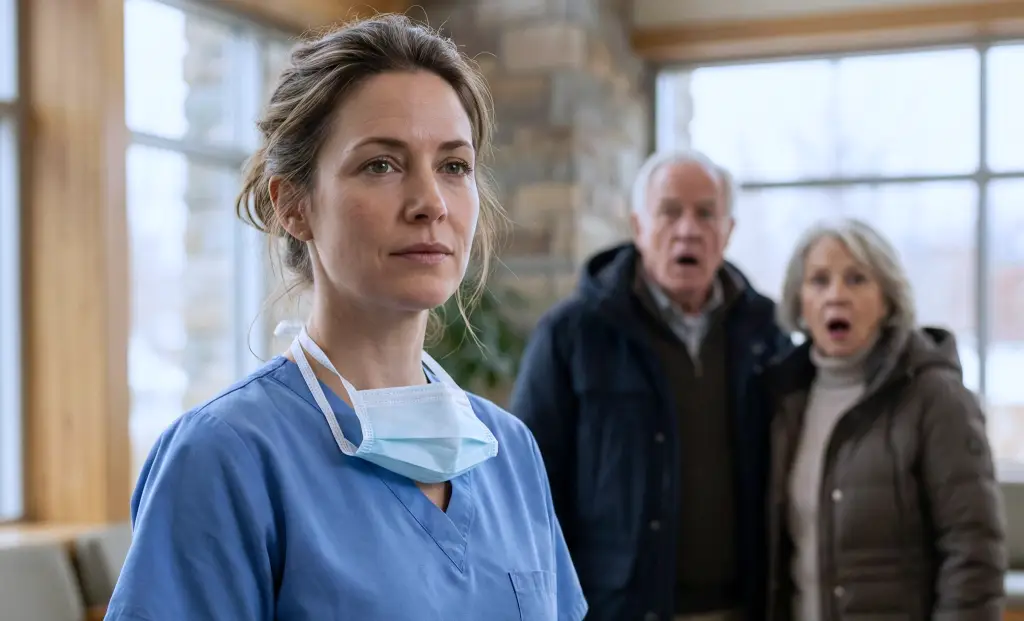
Then, last month, my sister was rushed into the emergency room, bleeding, unconscious, and dying. The trauma team paged the chief surgeon. The doors opened, and when my mother saw the name on the white coat walking toward her daughter’s stretcher, she grabbed my father’s arms so hard it left bruises.
I want to take you back to the fall of 2019, to a kitchen table in Hartford, Connecticut, and the last time my father ever looked at me with pride. Growing up, there were two daughters in the Ouellette house, but only one who mattered.
My sister, Monica, is three years older. She came out of the womb performing: school plays, student council, the girl who could talk to any adult at any dinner party and make them laugh. My parents, Jerry and Diane Ouellette—salt-of-the-earth middle class from Hartford, Connecticut—adored her for it.
Dad managed a manufacturing plant. Mom did part-time bookkeeping. They valued two things above all else: appearances and obedience. Monica delivered both, flawlessly, every single day.
I was the quiet one. I was the one with her nose in a biology textbook at Thanksgiving while Monica held court at the table. I wasn’t rebellious. I wasn’t difficult. I was simply invisible.
There’s a difference between being forgotten and never being seen in the first place. Here’s a small example. In eighth grade, I made it to the state science fair, the only kid from our school. The same weekend, Monica had a community theater performance.
You can guess where my parents went. When I came home with a second-place ribbon, Dad glanced at it.
“That’s nice, Renie,” he said.
He didn’t ask what my project was about. He never did. I told myself it didn’t hurt. I told myself I didn’t need the attention.
I poured everything into my grades, my AP classes, and my applications. I figured if I couldn’t be the daughter they noticed, I’d be the daughter they couldn’t ignore. And for one brief, shining moment, I was.
The day I got accepted into Oregon Health and Science University’s medical program, 3,000 miles from Hartford, something shifted. For the first time in my life, my father looked at me—really looked at me—and said five words I’d waited eighteen years to hear.
But I’ll get to that. First, you need to understand what Monica did when she realized the spotlight was moving. The acceptance letter came on a Tuesday in April. I remember because Monica was visiting for the weekend.
She was twenty-two, working as a marketing coordinator at a mid-level firm in Stamford. Fine job, fine life. “Fine” was Monica’s ceiling, though she’d never admit it.
Dad read the letter at the kitchen table. His eyebrows went up.
“Oregon Health and Science,” he said slowly, like he was tasting the words. “That’s a real medical school.”
Then he looked at me. “Maybe you’ll make something of yourself after all, Renie.”
It wasn’t a compliment, not really. But it was the closest thing to one I’d ever gotten from him, and I held onto it like oxygen. Mom called Aunt Ruth that night. She called her sister. She called two neighbors.
“Irene got into medical school. Can you believe it?”
Her voice had a pitch I’d never heard before: pride. Genuine, undiluted pride, directed at me.