


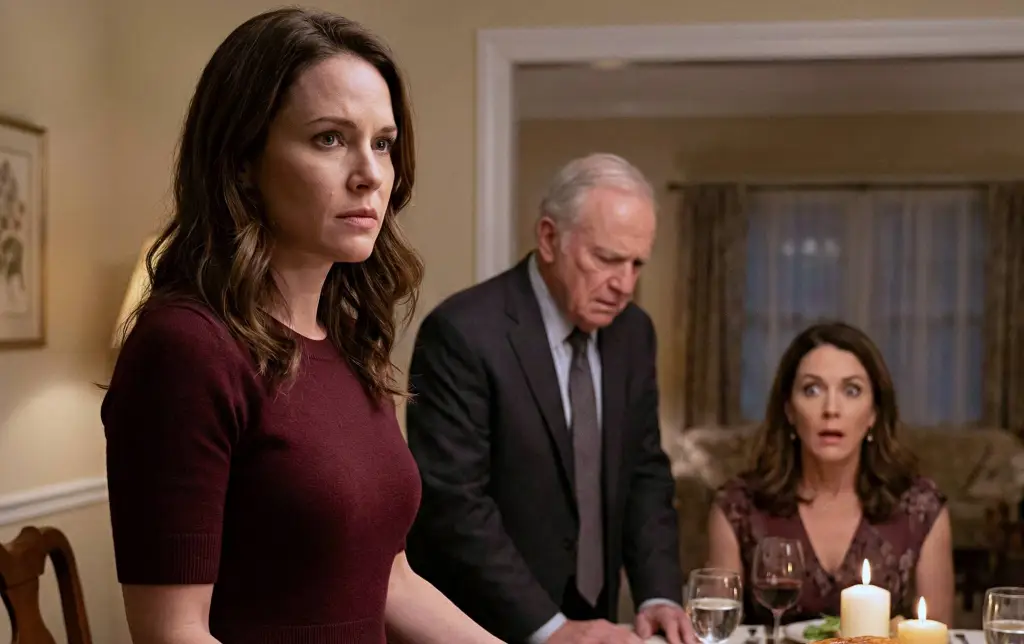
My name is Stella Frost. I’m thirty-two years old.
“She’s independent because she’s not really part of this family,” my father muttered into his whiskey glass.
When my uncle asked what he meant, he looked straight at me and said it louder.
“I’m done pretending. She’s not my daughter.”
Thirty-one guests. Thanksgiving dinner. My grandmother’s house. That was last November.
My stepmother was already holding a tissue before he even opened his mouth. I didn’t notice that detail until later. What I noticed was the silence.
And then the chaos. A fork dropping. My seven-year-old cousin asking, “Why is Uncle Richard yelling?” Two aunts standing up to clear plates because they didn’t know what else to do.
But what none of them knew—what my stepmother had spent two years making sure no one would ever find—was sitting inside a dusty shoebox in the hallway closet, ten feet from where I sat.
My grandmother had put it there before she died. She told me once, “Don’t go looking for trouble. But if trouble comes to you, that’s where your answer is.”
To understand how we got there, I have to take you back nineteen years. To the week my mother was buried, and the first time everything started to change.
I was thirteen when we buried my mother. Ovarian cancer. Eight months from diagnosis to funeral.
I remember standing at the edge of the casket in a black dress my mother had picked out for my eighth-grade dance because nobody thought to buy me something for a funeral.
My father stood three feet to my left. He didn’t reach for my hand. He didn’t look at me. He stared at the coffin like it owed him something.
My grandmother Eleanor was the one who held me. She pressed my head into her wool coat and whispered, “Breathe sweetheart, just breathe.” Her hands smelled like lavender and cold cream.
I held on to her until the cemetery workers told us it was time to leave.
Four months later, my father brought a woman home.
“This is Diane,” he said. “A friend from work.”
Diane had a daughter, Lauren. She was nine years old, with blonde curls and front teeth still coming in. She smiled at me like we were going to be best friends.
My father picked Lauren up and carried her to the car. He hadn’t carried me since I was eight.
Within six weeks, Diane moved in. Within eight, my bedroom on the second floor—the one with the window that looked out over the maple tree my mother planted—became Lauren’s.
“She’s younger,” Diane explained, folding Lauren’s pink comforter onto my old bed. “She needs the sunlight.”
I moved to the basement. Concrete walls, one window at ceiling height. I taped my honor roll certificate next to the light switch because there was nowhere else to put it.
My grandmother came to visit that October. She walked through the house slowly, looking at everything.
When she saw the basement, she stood in the doorway for a long time. Then she looked at me and said, very quietly, “Remember, this is my house. Nobody’s pushing you out of it.”
I didn’t understand what she meant. Not then.
I was fifteen the first time I heard the whispers. Late on a Tuesday, a school project kept me up past eleven.
I padded upstairs for water and stopped at the kitchen doorway because the light was on. Diane’s voice was low, careful—the voice she used when she wanted something.
“Have you ever really looked at her, Richard?”
My father was sitting at the table, a beer in front of him, his tie still on.
“She doesn’t have your jaw,” Diane said softly. “She doesn’t have your eyes.”
Silence. Just the refrigerator humming.
“Margaret was lonely those years you traveled for work,” Diane continued. “You were gone three, four weeks at a time. A woman gets lonely, Richard.”
My mother’s name in Diane’s mouth sounded wrong, like a stranger wearing her clothes.
My father said nothing. He didn’t defend my mother. He didn’t defend me. He just sat there, peeling the label off his beer, letting the insinuations settle into him like rain into dry soil.
From that night on, he stopped looking me in the eyes.