


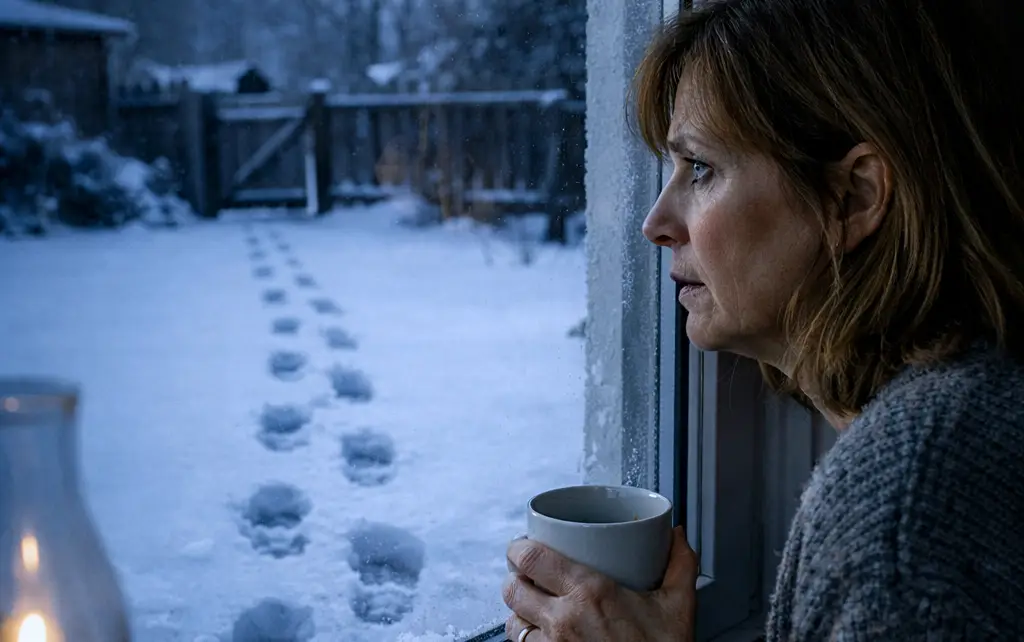
“When your husband leaves, don’t touch the snow in your yard.”
Those words, whispered in a voice that sounded like dry leaves skittering over pavement, would haunt me. After I’d paid for the elderly woman’s groceries, she leaned in, her breath hitching, and delivered that strange command.
At the time, I laughed it off—a nervous, polite chuckle meant to bridge the gap between sanity and superstition. But later, standing in the biting cold, I decided to listen. I didn’t shovel the driveway. And when I stepped out onto the porch the next morning, the breath was knocked right out of my lungs by what I saw.
But before the fear set in, there was just the mundane exhaustion of a Tuesday in December.
I was standing in line at the checkout of our local grocery store, clutching my worn-out canvas tote bag to my chest like a shield. Beyond the plate-glass windows, a blizzard was tearing through the streets, turning the world into a blur of gray and white. December had turned out to be especially vicious this year, burying the city under layer after layer of ice.
Fifty-eight is that peculiar age where you stop chasing coupons across town to save a few cents and start gravitating toward the familiar little market near your house. It is the kind of place where the clerks actually know your name.
Ahead of me, right at the register, a hunched-over elderly woman wrapped in a faded, moth-eaten shawl was fumbling around. She upended a tattered wallet onto the conveyor belt, pouring out a sad little mountain of loose change. Her trembling fingers picked through the nickels and dimes, counting them out with agonizing slowness.
On the black rubber belt lay her purchases: a single loaf of bread, a carton of milk, three potatoes, and one small, lonely onion.
“Ma’am, you’re coming up short,” the cashier said. It was Candace, a young woman with tired eyes who looked like she’d been on her feet for ten hours straight. Her voice was weary, stripped of any pretense of patience. “You’re short about a dollar.”
“How can that be, baby?” the old woman muttered, confusion clouding her voice. She began sorting through the coins again, her hands shaking harder now. “I counted at home. I swear, I counted everything.”
Behind me, someone let out a heavy, annoyed sigh. The line was growing, snake-like, and people were itching to get home before the roads became impassable.
I looked at the shrunken figure of the old woman, at her knuckles, raw and red from the biting cold, and then at her meager pile of cheap groceries. Something tugged sharply inside my chest—a pang of recognition, or perhaps just empathy.
How many times had I walked past someone else’s grief, pretending to be fascinated by a display of canned peas? How many times had I turned away to avoid the discomfort of witnessing someone else’s need? But today, the blizzard or the holidays or just the sheer weariness of life made me step forward.
“Candace, ring it up with mine,” I said, my voice cutting through the murmurs of the crowd. I leaned past the old woman and handed Candace a twenty-dollar bill. “I’ll pay for it.”
The old woman spun around, her face a mask of shock. “Oh, honey, really? You don’t have to,” she flustered, her hands fluttering like nervous birds. “I’ll just put something back. Maybe the milk…”
“Don’t worry about it, ma’am,” I smiled, trying to infuse as much warmth as I could into the gesture. “It’s nothing. Not even worth mentioning.”
The old woman raised her eyes to meet mine, and I involuntarily shuddered. It wasn’t a shiver of cold, but something deeper. Her gaze was strange—piercing, intense. Her eyes weren’t old at all.
They were clear, impossibly deep, as if they were stripping away my coat and skin to look straight into my soul. She was small and fragile, her face a topographical map of deep wrinkles, but in those eyes shone an unusual power, an ancient sort of wisdom that felt out of place in a checkout line.
“Thank you, daughter,” she said softly.
She scooped her purchases into a worn plaid bag, her voice trembling now with genuine gratitude. “Your kindness will not be forgotten. It will come back to you. The universe keeps score.”
I shrugged, turning my attention to paying for my own load—chicken for a stew, root vegetables, bread, and a couple of cans of goods.
“Vernon is leaving this evening,” I thought, the mental checklist already running. He was heading out for another long-haul run—a week, maybe ten days. I had to cook for him for the road, and also stock up on everything necessary for myself while he was gone.
Married thirty-two years, and my life had become a cycle of seeing him off, waiting for his return, cooking, washing, and cleaning. Life flowed in a well-worn groove, monotonous and predictable as a dripping faucet.
I had already picked up my bags, intending to head for the door, when I felt an unexpectedly strong grip clamp onto the sleeve of my old coat.
The old woman stood beside me, clutching the fabric with wiry fingers that possessed a shocking amount of strength. I tried to pull away, but she held fast.
“Listen to me carefully, daughter,” she whispered, leaning in so close that I could feel the warmth of her breath against my frozen cheek. She smelled of mothballs, dried herbs, and something else—something elusive and ancient, like dust in a closed room. “When your husband leaves for the night, do not touch the snow in the yard.”
“Do you hear me?” Her intensity was frightening. “No matter what he tells you, do not shovel until morning. Let the white lie untouched.”
“What?” I blinked in confusion, my brain struggling to process the bizarre instruction. “What snow?”