


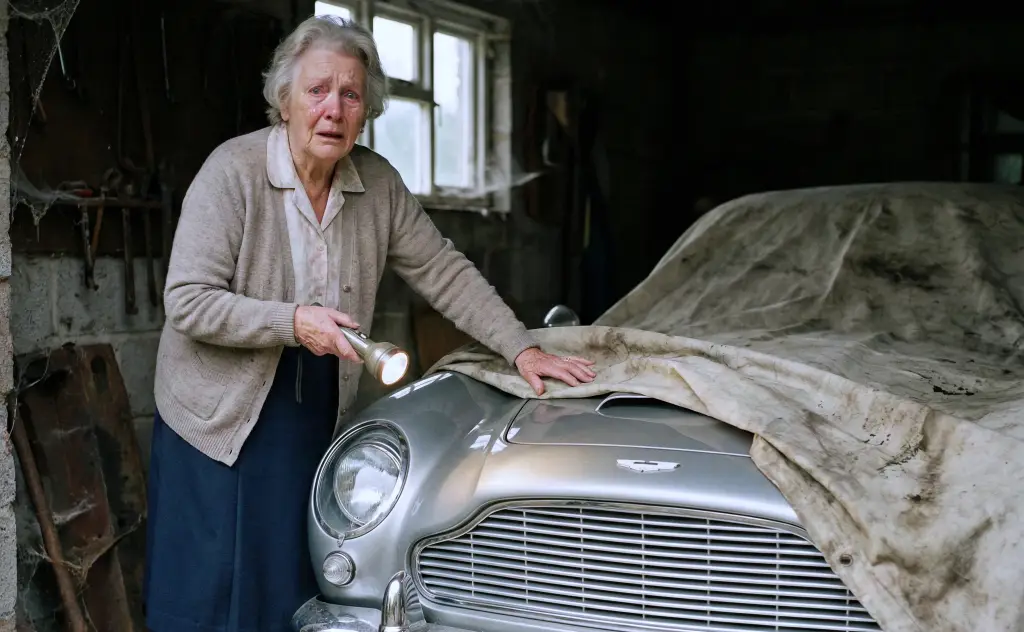
I never expected to spend the night of my sixty-eighth birthday shivering in an abandoned garage. My senses were assaulted by the pungent cocktail of stale motor oil and decades of undisturbed dust.
Yet, there I was, fumbling with a jagged, unfamiliar key in the pitch black. Hot tears blurred my vision as my son’s final words ricocheted through my mind like a physical blow.
“You’re just a useless old woman, Mom. What would you even do with a real inheritance? Dad knew that.”
My hand trembled violently, the metal clicking uselessly against the faceplate until I finally managed to slide the key into the rusted lock. The ancient mechanism yielded with a heavy thunk.
The door groaned in protest as I shoved it open. I clicked on my flashlight, the weak beam slicing through the gloom to reveal a cavernous, silent emptiness.
Or so I thought.
I froze in the doorway, my breath hitching in my throat. As the light swept across the interior, my heart skipped a beat. This wasn’t possible. This couldn’t be what Robert had meant when he left me nothing but a “garage” in his will.
But before I can explain the absurdity of what stood before me, I need to rewind. You need to understand how I ended up here, homeless on my birthday, clutching a battered suitcase that contained the wreckage of my forty-two-year marriage.
The nightmare had begun earlier that day, standing beside my son in the plush, mahogany-paneled office of our family attorney. Jonathan looked every inch the corporate shark in his perfectly tailored Italian suit.
I stood shrinking in the black dress I’d worn to Robert’s funeral just three weeks prior. Mr. Hoffman, who had managed our family’s affairs for decades, seemed uncharacteristically fidgety as he prepared to read the last will and testament.
“Before I begin,” Hoffman said, adjusting his wire-rimmed glasses and refusing to meet my eyes, “I want to assure you both that everything here is legally binding and drafted precisely according to Mr. Campbell’s explicit instructions.”
Looking back, I should have recognized that disclaimer for the red flag it was. The reading itself passed in a surreal blur of legalese, but certain phrases cut through the fog with devastating clarity.
“To my son, Jonathan Campbell, I leave our penthouse residence in Los Angeles and my primary investment portfolio…”
And then, almost as a cruel afterthought:
“…and to my beloved wife, Susan Campbell, I leave the property located at 1420 Industrial Parkway—the garage and its contents.”
A garage. After forty-two years of building a life together, nursing him through sickness, and raising his son, my husband had left me a garage.
Jonathan’s face had transformed instantly. The mask of solemn grief slipped away, replaced by a look of barely suppressed triumph. I remember the weight of his hand on my shoulder, squeezing just a fraction too hard as he leaned down, his breath warm against my ear.
“Don’t worry, Mom,” he whispered, his tone dripping with condescension. “I’ll make sure you’re taken care of.”
I had been too stunned to respond, too paralyzed by confusion to ask why. Why would Robert do this? Where was I supposed to live?
The answers arrived with brutal efficiency that evening. Jonathan drove me back to the penthouse overlooking the city—the place I still naively thought of as home, the sanctuary Robert and I had shared for the last fifteen years.
I had barely stepped into the marble foyer when Jonathan set my suitcase down with a definitive thud.
“I think it would be best if you found somewhere else to stay, Mom.”
I stared at him, my brain refusing to process the words. “What do you mean?”
“The penthouse is mine now,” he said, checking his watch. “It’s in the will.”
His voice had taken on that rehearsed, glossy quality he used in boardroom negotiations. “I’m having some colleagues over tomorrow to discuss turning Dad’s study into a home office. I need to start making changes immediately.”
“But… where am I supposed to go?” The question came out small, pathetic, like a lost child.
Jonathan shrugged, a gesture of casual dismissal that shattered my heart. “You could stay with Aunt Helen for a while. Or,” he chuckled, a sound with a cruel, serrated edge I’d never heard before, “there’s always that garage Dad left you.”
“Though why he left you that dump is beyond me,” he added, sneering. “What are you going to do with it? Open a mechanic shop at your age?”
Something inside me snapped. A foundational pillar of my reality crumbled. “Jonathan, this is my home. Your father and I—”
“It’s not your home anymore,” he cut me off, his voice hardening into stone. “It’s mine. Dad made that perfectly clear.”
I reached for the back of a velvet armchair to steady myself, the room spinning. “I need time to find a place. Surely you don’t expect me to leave tonight.”
That’s when he said it. The words that would fuel the engine of my drive across the city, leading me aimlessly through streets I didn’t recognize until I found myself in the industrial district, staring at a dilapidated structure with a padlock on the door.
“You’re just a useless old woman, Mom. What would you even do with a real inheritance? Dad knew that.”
The cruelty was so unexpected, so completely at odds with the boy I thought I had raised, that I couldn’t even summon a defense. I had simply taken my purse, my suitcase, and the single brass key Mr. Hoffman had pressed into my palm, and walked out.
So, here I was. Standing in the gaping maw of a forgotten garage, my flashlight beam cutting through the darkness. But the interior wasn’t filled with rusted tools or piles of junk as I had feared.
The space before me contained three vehicles. They were arranged with military precision, each draped in a custom-fitted cloth cover.
But it was the gleaming object partially peeking out from the front of the line that stopped my heart cold—the unmistakable silver grille of a vintage Aston Martin. Its polished chrome caught the light of my flashlight, shining like a beacon in the abyss.
What was this? Why on earth had Robert kept this a secret from me?
I stepped forward, pulled by a magnetic mix of confusion and curiosity, completely unaware that I was about to discover just how profoundly I had misunderstood my husband’s final gift.
My fingers trembled as I gripped the fabric covering the first car. I pulled it back, the soft material sliding away like silk.
It was a 1964 DB5 in pristine Silver Birch—identical to the one Sean Connery drove in the James Bond films Robert had obsessed over. The car gleamed under my flashlight beam, looking as if it had just rolled off the factory floor in Newport Pagnell, not rotting in an obscure garage for God knows how long.
“Robert,” I whispered into the stillness, my voice cracking. “What on earth were you doing?”