


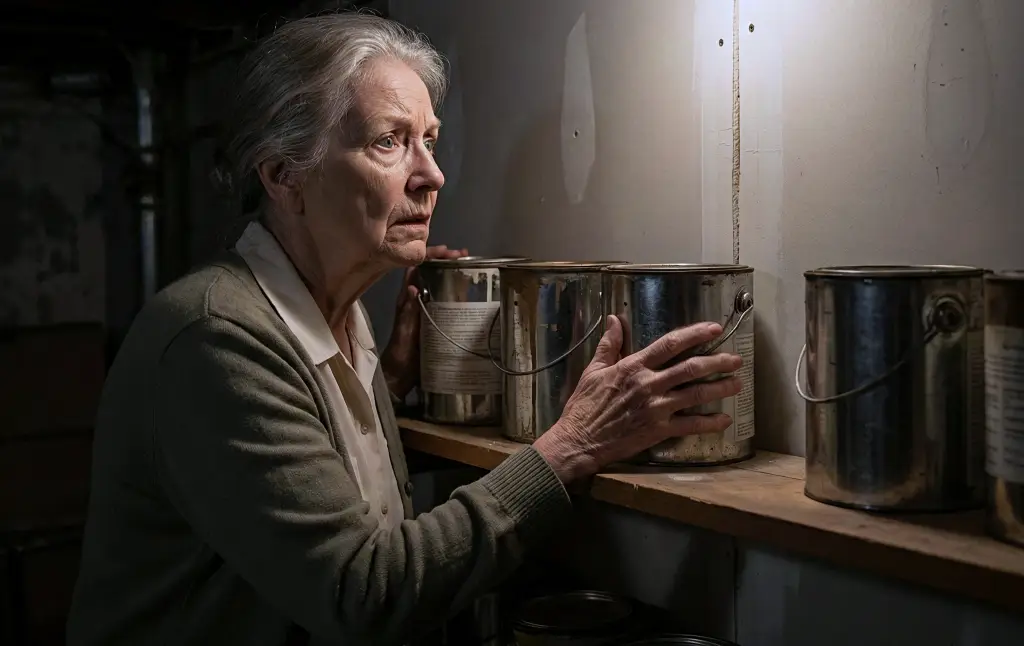
My late husband left a letter with strict instructions to open it five years after his death. Yesterday was exactly five years. With trembling hands, I took the envelope and broke the seal. Inside was a single index card written in his cramped, careful handwriting. My death was not an accident. Under the house, there is a room.
My name is Dorothy Callahan, and I am 73 years old. I live—or rather, I lived until five years ago—in the same white clapboard house on Elm Creek Road where I raised my children, buried my roses every fall, and made Sunday pot roast for thirty-eight years. It is a quiet house in a quiet town in central Ohio. It is the kind of place where people wave from their porches and your neighbor still brings casseroles when you are sick.
I was happy there. I was truly happy, the way you can only be when you do not yet know what is hiding beneath your feet.
My husband, Gerald, died on a Tuesday in March. The death certificate said cardiac arrest. He was sixty-nine, slightly overweight, and had been told twice by his doctor to watch his sodium. Everyone said it made sense.
His son, Daryl—Gerald’s boy from his first marriage—flew in from Atlanta. He gave a short speech at the funeral about what a good man his father was, and then spent three days going through the filing cabinets in the study. I was too numb to think much of it at the time. Grief has a way of making even the obvious invisible.
What I remember most about those first weeks was the silence. Gerald had been a loud man, not in an unpleasant way, but in the way of someone who filled a room simply by existing in it. He hummed while he made coffee. He laughed too hard at his own jokes. He left every cabinet door open and denied it every single time.
When he was gone, the house became a place I barely recognized. I moved through it like a guest. The first warning sign came three months after the funeral, though I did not name it that at the time. Daryl called to say he and his wife, Carla, were coming for a visit.
There was nothing unusual in that. But when they arrived, Carla walked straight to the basement door without asking and tried the handle. It was locked. I had locked it myself out of habit, because Gerald had kept his tools and old tax records down there and asked me never to let anyone rummage through without him present.
When the handle did not turn, Carla smiled brightly. “Oh, silly me, wrong door,” she said. And nothing more was said.
But I noticed. You notice it the way you notice a smell you cannot quite name. Over the next year, there were other small things. There was Daryl asking twice whether Gerald had ever mentioned updating his will. There was Carla complimenting the house in that particular way people do when they are imagining it empty of you.
Then there was a phone call I overheard. Daryl was in the kitchen speaking low and fast into his cell phone. “Not yet,” he said. “And she doesn’t know.” When I walked in, he immediately changed the subject to baseball.
I am 73. I am not deaf, and I am not foolish. But I also had no proof of anything. I only had the slow accumulation of unease that settles in the stomach of a woman who has lived long enough to know when something is wrong.
And then there was the envelope. Gerald had handed it to me himself two weeks before he died. He pressed it into my hands after dinner one evening, the television murmuring low in the background.
“Dot, put this somewhere safe and don’t open it for five years,” he said, his eyes locking onto mine. “Promise me.”
I had laughed and asked if he was being dramatic. He did not laugh back. So, I put it in the cedar chest at the foot of our bed, tucked safely under our wedding quilt, and I kept my promise.
Five years to the day, I sat at the kitchen table with my morning coffee going cold and the envelope in front of me. My hands were shaking. I told myself it was just the arthritis.
Inside was that single index card. My death was not an accident. Under the house, there is a room.
I read it three times. Then I sat very still for a long moment, listening to the house around me. I heard the tick of the clock and the hum of the refrigerator. They were the ordinary sounds of an ordinary morning that had just stopped being ordinary.
I got up. I went to the basement door and unlocked it. The stairs were the same wooden stairs I had walked down a hundred times to do laundry. The bare bulb on the pull cord cast the same yellow light.
The washer and dryer stood exactly where they always had. Gerald’s workbench ran along the far wall. Nothing had changed, and nothing looked different. Yet, standing at the bottom of those stairs, I knew something was there.
I could feel it, the way you feel a word on the tip of your tongue. I wasn’t seeing it yet, but I knew it existed. I did not go looking that morning. I went back upstairs, sat down at the kitchen table, and looked at my husband’s handwriting for a very long time.
My death was not an accident. Gerald had been a cautious man, a careful man. He would not have written those words unless he meant them precisely.
The question was not whether I believed him. Of course I believed him. He was my husband of thirty-eight years, and he had never once lied to me. The question was what I was going to do about it.
I sat at that table for two hours. That is not an exaggeration. The coffee went completely cold. The morning light moved across the linoleum the way it always did, slow and indifferent, while I sat there trying to understand what I was holding.