


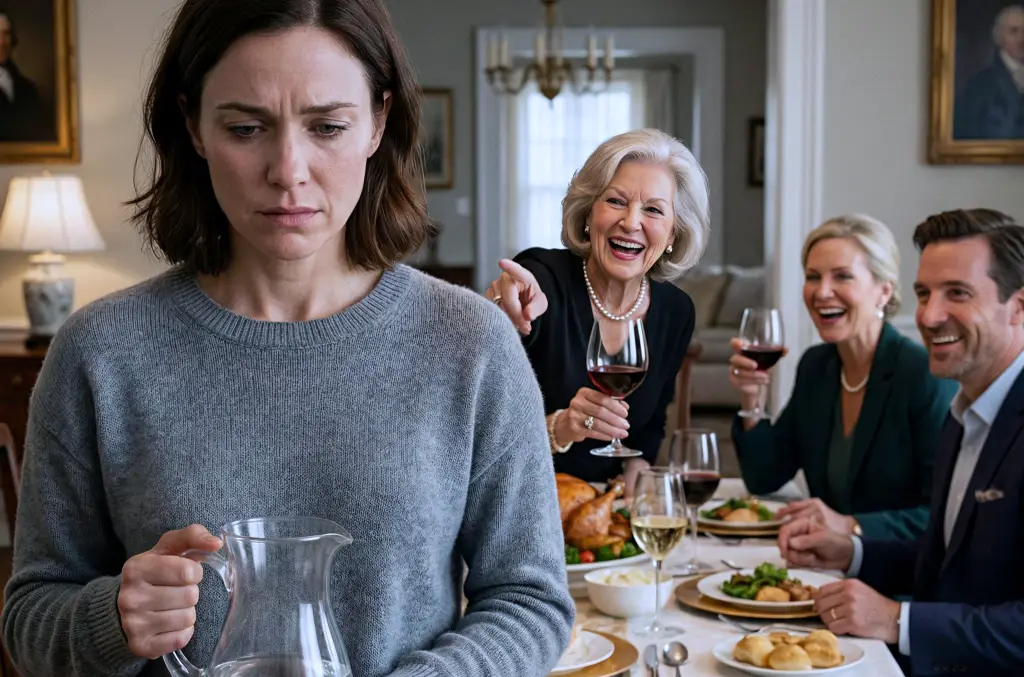
My name is Jasmine Fitzgerald. I am 31 years old. Last Thanksgiving, my mother raised her glass in front of 14 people—family, neighbors, friends from church—and said, “One daughter is a doctor. The other one, well, she cleans houses for a living.”
Everyone laughed. My sister smiled. My father looked down at his plate.
I didn’t say a word. I just kept refilling water glasses, because that is exactly what they expected me to do. What they didn’t know was that three weeks later, they would be sitting in a grand ballroom with 600 people, watching me walk across a stage to accept an award they couldn’t even pronounce.
The company I built, the one they knew absolutely nothing about, had been serving their favorite luxury resort for two years. They just never thought to ask whose name was on the contract. This is that story.
To truly understand what happened at that Thanksgiving table, you need to understand the Fitzgerald family dynamics. We lived in Arcadia, an affluent neighborhood in Phoenix where the lawns were artificially green all year round, and the pristine garages always held two expensive cars. My parents bought that house in 1998, the year I turned four.
It had four bedrooms and a sparkling pool in the backyard. It was the kind of place where you hosted Sunday barbecues and pretended everything was picture-perfect. My mother, Lorraine, was 58 years old. She had been an elementary school teacher for 22 years before retiring.
She believed in three fundamental things: God, public appearances, and her eldest daughter. My father, Gerald, was 62. He had spent his entire career as an accountant at a mid-sized firm in downtown Phoenix.
He was a quiet man. It was the kind of quiet that people often mistake for wisdom, but in his case, it was really just conflict avoidance. His favorite phrase was always, “Your mother just wants what’s best for you, Jasmine. You know how she is.”
That was his standard answer to everything. Every slight, every unfair comparison, every time I was made to feel like an intruder at my own dinner table, he would use that excuse. And then, of course, there was Vivian.
Dr. Vivian Fitzgerald Caldwell was 34 years old, a board-certified dermatologist specializing in high-end cosmetic procedures. She ran a lucrative practice called Scottsdale Dermatology and Aesthetics alongside three other physicians. Her husband, Bradley, was a real estate attorney at his own firm, Caldwell and Associates.
They had two beautiful children, Ethan, who was five, and Lily, who was three. They lived in a sprawling 5,000-square-foot mansion in North Scottsdale, complete with a three-car garage and a custom pool that was heated year-round. My mother posted about Vivian on Facebook an average of four times a week.
Her feed was an endless stream of photos from charity galas, glowing updates about the grandchildren, and humble brags about Vivian’s latest Botox innovation or Bradley’s newest commercial real estate deal. Her Facebook bio simply read: “Proud mother of Dr. Vivian Fitzgerald Caldwell.” That was it. Just Vivian, as if I simply did not exist.
I used to scroll through my mother’s profile late at night, desperately looking for myself. I found exactly one photo of me posted in three years. It was from Easter Sunday in 2023.
I was in the background, slightly out of focus, carrying a heavy casserole dish to the dining table. She hadn’t even tagged me. In the formal living room of my parents’ house, there was a massive display wall.
“The Family Wall,” my mother proudly called it. Twelve custom-framed photographs were arranged in a perfect, symmetrical grid. There was Vivian’s lavish wedding.
There was Vivian’s medical school graduation. Vivian holding baby Ethan for the very first time. Vivian and Bradley at some exclusive charity gala, her in a stunning red dress, him in a tailored tuxedo.
I counted them once. Vivian appeared in eleven of those twelve photos. I was in exactly one.
It was a picture from my high school graduation. I was standing stiffly between my parents, wearing a cheap cap and gown, smiling a strained smile that completely failed to reach my eyes. That singular photo was shoved in the bottom corner, partially hidden by the sprawling leaves of a decorative potted plant.
Growing up, I was always just Vivian’s little sister. Never just Jasmine. Teachers’ faces would light up with expectation when they saw my last name on their class roster.
“Oh, are you related to Vivian Fitzgerald? She was such a wonderful student!” they would gush. And then their faces would fall, just slightly, when they quickly realized I was not going to be wonderful in quite the same way. I was a decent student.
I maintained a solid B-plus average. I made the honor roll occasionally, but I was nowhere near valedictorian. I played softball for two years before quietly quitting.
I joined the drama club but never once landed the lead role. I was fine. I was average.
I was forgettable. And in a family that actively worshipped excellence and status, being forgettable was the exact same thing as being a failure. When Vivian graduated from medical school, my parents threw a massive party for sixty people.
They rented out an entire upscale restaurant. There was a live jazz band. My mother gave a glowing toast that lasted twelve minutes and moved three people to tears.
When I got my Certified Nursing Assistant (CNA) certification at twenty-two, my mother casually looked up from her dinner and said, “That’s nice, honey. Can you pass the salad?” There was no party. There was no speech.
Just the salad. When Vivian bought her first house, my parents happily gifted her thirty thousand dollars for the down payment. When I moved into my first apartment—a cramped one-bedroom in Tempe with iron bars on the windows—my mother merely asked if I really needed to live alone.
“Wouldn’t it be cheaper to just stay home?” she reasoned. When Vivian announced her engagement to Bradley, my mother cried genuine tears of joy for twenty unbroken minutes. When I brought home my first serious boyfriend, she interrogated him about what he did for work, then spent the rest of the agonizing dinner explaining how Bradley had just been made a senior partner.