


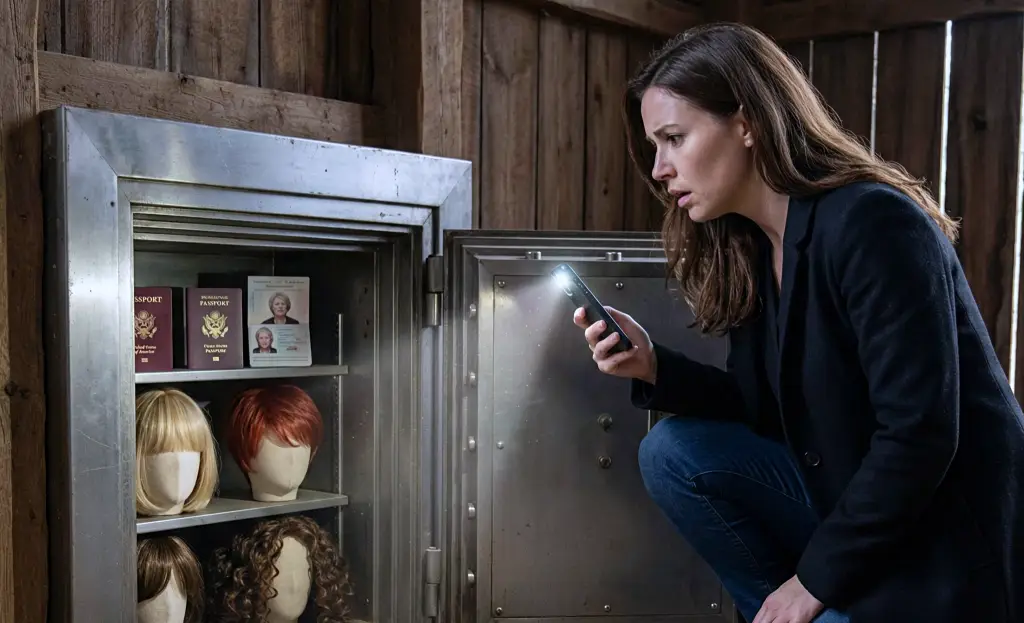
Rust flaked away under Sarah’s thumb, coating her skin in gritty orange dust that smelled of iron and forgotten years. Rain hammered against the tin roof of the barn, drowning out the sound of the wind, yet it couldn’t silence the pounding in her chest. This wasn’t just a dilapidated storage shed.
It was the one place Margaret had strictly forbidden her from entering for thirty years. Now, with Margaret buried in the damp earth of the local cemetery and a rusted key burning a hole in Sarah’s pocket, the prohibition was broken. One turn of the wrist, a groan of heavy metal, and the door swung inward.
Darkness stared back. Sarah didn’t know it yet, but the woman she mourned that morning was a total stranger, and the truth waiting in the shadows was about to put her in profound, unimaginable danger. The funeral service for Margaret Sullivan was as grey and unassuming as the woman’s life had seemingly been.
There were no weeping crowds, no eulogies from long-lost friends, and certainly no press. Just the rhythmic patter of rain on black umbrellas and the murmuring of Father Thomas, who struggled to find personal anecdotes about a woman who had kept the world at arm’s length for three decades. Sarah Sullivan stood by the grave, her heels sinking into the mud of the expansive property just outside of Casper, Wyoming.
She felt a numbness that wasn’t quite grief. It was more like confusion. Who was she crying for? The mother who cooked oatmeal every morning at seven a.m. sharp? Or the woman who would stare out the kitchen window for hours, watching the long gravel driveway as if expecting an invasion?
“She was a private woman,” Mr. Henderson said, stepping up beside her.
He was Margaret’s lawyer, a man with a face like crumpled parchment and a suit that smelled of mothballs.
“That’s one way to put it,” Sarah replied, adjusting her coat. “She didn’t have friends, Mr. Henderson. She didn’t have a past.”
Every time Sarah had asked about her father or where they came from before Wyoming, Margaret would simply say, Look forward, Sarah. Looking back turns you to salt.
Henderson cleared his throat awkwardly, reaching into his breast pocket. He pulled out a thick manila envelope.
“Your mother left this for you, specifically,” he murmured. “She gave me strict instructions not to hand it over until the dirt was settled.”
Sarah took the envelope. It was surprisingly heavy. “The will?”
“The deed,” Henderson corrected, “and a key. She said you’d know which lock it fits. She also said, and I quote: Don’t call the authorities until you understand what you’re looking at.”
A chill that had nothing to do with the Wyoming wind violently shivered down Sarah’s spine. “Call the authorities? Why would I call them?”
Henderson shook his head, his eyes darting towards the tree line as if he, too, had caught Margaret’s lifelong paranoia. “I’m just the messenger, Sarah. Good luck. I have a feeling you’re going to need it.”
He didn’t linger. He walked back to his sedan and drove away, leaving Sarah entirely alone on the sprawling property. The farmhouse stood on a hill, a white wooden structure peeling with age. Behind it, a hundred yards down a steep slope, sat the old barn.
Growing up, the barn was the boogeyman. Margaret had installed a heavy-duty padlock on it when Sarah was only five years old. She claimed the structure was deeply unsafe, filled with rotting beams and dangerous, rusted farm equipment.