


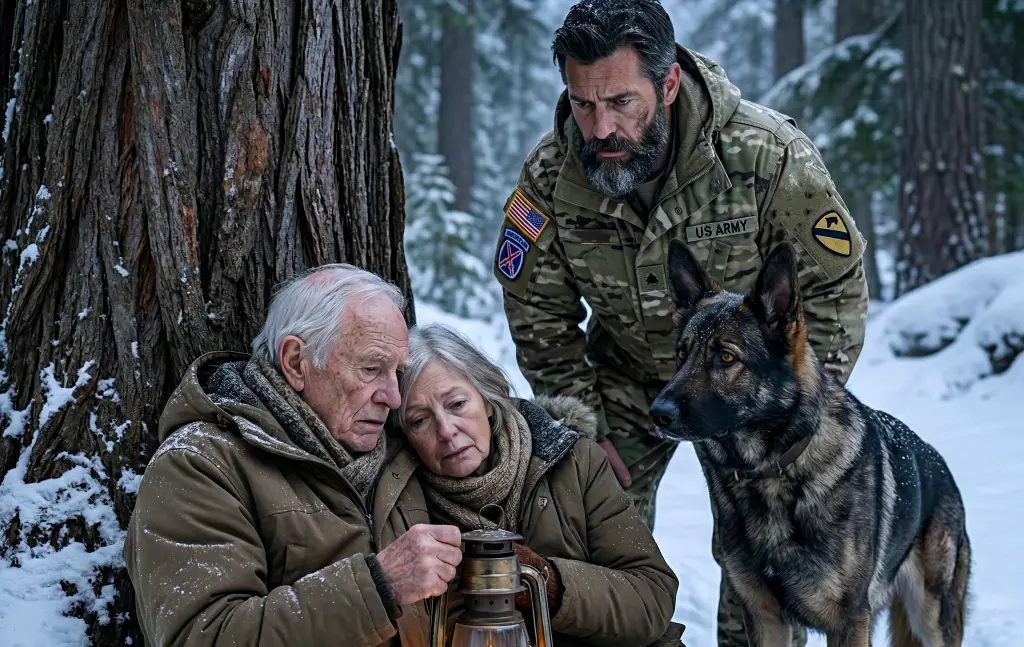
The Cascade Mountains were drowning in a suffocating white silence, their jagged slopes erased by a relentless blizzard that blurred the line between earth and sky. The wind did not howl; it moved through the evergreens with a slow, relentless force, as though the world itself had grown exhausted from the effort of speaking. Late winter had laid claim to the territory without ceremony. It was the kind of cold that bypassed the skin entirely, sinking its teeth straight into the marrow and settling deep within the memory.
Beneath the shifting drifts and lengthening shadows, the mountain road was little more than a treacherous scar twisting through the timberline. Logan Hayes kept his burdened truck centered by feel alone, his gloved left hand holding the steering wheel steady while his right rested against the frosted glass of the driver’s side window. The bitter chill seeping through the pane served as a grounding wire. It was a physical sting to remind him that he was still occupying his own body.
At thirty-nine, Logan looked like a man the years had meticulously built up, only to begin systematically unbuilding. He possessed a tall, broad-shouldered frame that filled the cab, his dark hair cropped severely close to the scalp and threaded prematurely with coarse silver. A thick, untrimmed beard softened the sharp, unyielding angles of his jaw, framing a face that appeared chiseled from weathered stone rather than grown from flesh. His eyes, sweeping the blinding road ahead, were the color of scuffed steel.
They were neither bright with hope nor entirely deadened to the world. Rather, they were forged into a guarded neutrality by too many dawns that had offered no redemption. There was a time when he believed implicitly in the concept of purpose. His past service had ingrained in him the absolute certainty that every physical movement required a reason, and every drawn breath carried a consequence.
But conflict possessed a ruthless talent for unteaching the very foundations that discipline had built. His overseas deployments had left him with a quiet inheritance of ghosts. The memory was a relentless loop: the blinding, concussive force of a sudden ambush tearing through their convoy. It was that suspended fraction of a second when his closest friend and brother-in-arms, Daniel Rourke, simply vanished into a wall of fire.
The survivor’s guilt that followed him home did not announce itself with screams. It was a slow, creeping rot, a persistent ache in his chest that did not need to raise its voice to completely ruin a man. Now, with the years piling up behind him, Logan had traded high-stakes missions for endless highway miles. He swapped human company for unbroken silence, and civilian relationships for the steadfast loyalty of a dog who never demanded an explanation for his moods.
Arrow sat rigidly upright in the passenger seat. He was a six-year-old German Shepherd, his dense coat a striking mix of dark roasted coffee and charcoal ash. Running along his right flank was a faint, hairless ridge of scar tissue, a permanent souvenir from the exact same devastating encounter that haunted Logan’s waking hours. The dog’s amber eyes flicked rhythmically toward the passenger window every few seconds.
He scanned the blinding white terrain with the ingrained precision of a seasoned point man. Arrow was fiercely loyal, but there was a profound, almost calculating intelligence behind that golden gaze. It often felt as though the shepherd was not merely guarding Logan’s physical safety, but vigilantly watching over whatever small fragment of the man’s soul was still worth salvaging.
“Almost there,” Logan murmured to the empty cab, even though he knew perfectly well there was no actual destination.
He had convinced himself that this punishing drive through the upper Cascades was strictly for logistical maintenance. He reasoned it was a necessary trip to inspect an abandoned forest service outpost that his old unit once utilized as a cold-weather training site. But the unvarnished truth was far simpler: he just could not stand still. Forward momentum, no matter how aimless, felt infinitely safer than stagnation, because stillness only turned up the volume on the memories.
The massive truck continued its climb, the chained tires biting aggressively into the slick, hidden ice. The snowfall thickened aggressively, transforming the world beyond the hood into impenetrable, swirling shades of gray. The dashboard radio offered a faint, whispering hiss of static before dying completely, surrendering the cab to the hypnotic, vibrating hum of the engine.
Then, something anomalous registered in his peripheral vision. It was a small, golden pulse fighting through the blinding storm.
Logan blinked hard, leaning his torso over the steering wheel to peer through the sweeping wiper blades. A light. It burned too steadily to be the flash of a storm, and it sat far too low against the tree line to be a star. He eased off the accelerator, his thick boots brushing the brake pedal as a deep frown creased his forehead.
Nobody in their right mind had any business camping out here. Not at this altitude, and certainly not in the teeth of a blizzard this vicious. He rationalized that it could be a forgotten kerosene lamp left burning on the porch of a ranger station, or perhaps the desperate beacon of a lost hiker who had made a fatal miscalculation. Yet, something about the nature of the light made the short hairs on the back of his neck stand at rigid attention.
It wasn’t the illumination itself that disturbed him; it was the eerie, unnatural way it remained entirely stationary against the violent wind. Beside him, Arrow’s ears snapped forward, his muscular body going completely stiff. A low, rumbling growl vibrated deep within the dog’s throat, a sound that was rich with restrained warning.
Logan released a long sigh and pinched the bridge of his nose. “It’s just a reflection. Calm down,” Logan said.
But he knew the reassurance was meant entirely for himself. He reached out, his thick glove grasping the steering wheel with the intention of steering the truck back into the center of the lane and driving on. But his hand froze. Deep in the marrow of his bones, in that primitive space where survival instincts continued to thrive long after logic had surrendered, a subtle shift occurred.
Miles across the treacherous ridge, entirely unseen by the road, an elderly couple was currently losing a desperate war against that very same freezing wind.
Eighty-three-year-old Walter Finch moved with the agonizing stiffness of a man fighting a battle not just against the elements, but against the relentless gravity of time itself. His frame was wiry and stripped of excess, his steps calculated and brief. Decades ago, he had possessed a formidable, quiet strength, the kind of heavy-handed resilience earned from a lifetime of swinging hammers and weathering hardship. But the sheer scale and brutality of the mountain reduced him to something terribly small.
His thick wool cap was caked with a hardening layer of frost, and his breathing was shallow, rattling painfully in his chest. Yet, his gloved hand maintained a vice-like grip on the hand of his wife, holding on as if that single point of contact was the only tether keeping him anchored to the earth.
Evelyn Finch, two years his junior, was a slight, fragile woman. Her hair framed her face like a fine silver halo against the dark, dense wool of her hooded parka. Time had softened her features, carving wrinkles into her cheeks that were deep and gentle, reading like the worn creases of a cherished letter. Her pale blue eyes were clouded with an uncertain fog, often drifting and pausing on empty spaces.
It was as though she were constantly struggling to translate the shapes before her into memories she could trust. Alzheimer’s disease had been slowly dismantling her piece by piece, stealing names and dates, but it had not taken everything. It had not touched the core of her that still knew how to whisper her husband’s name when the cold bit through her coat.