


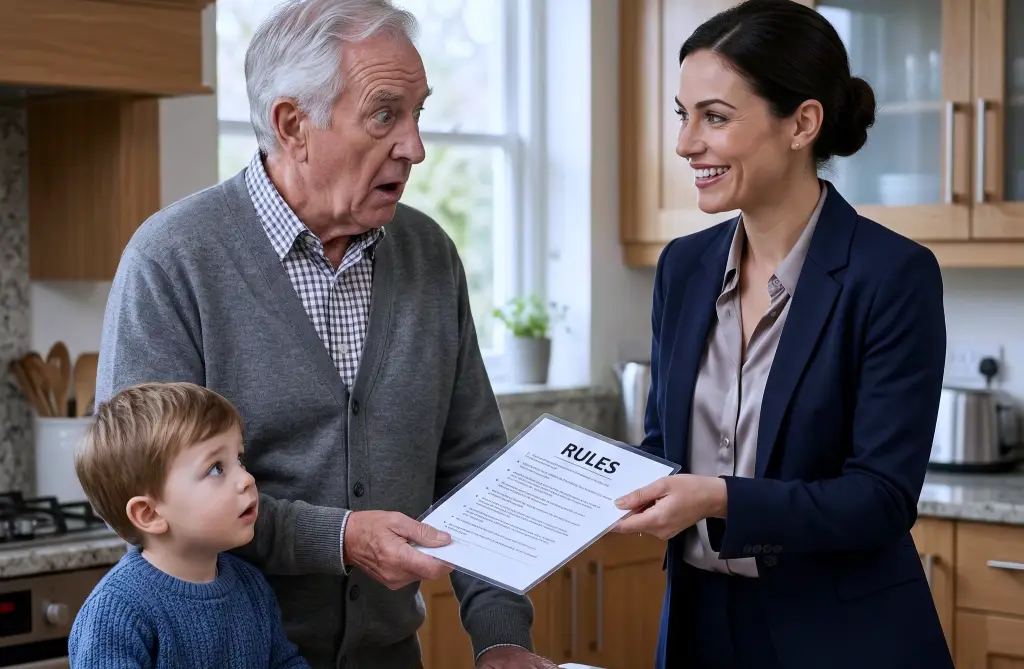
She handed me a list of rules the first time I tried to hold my own grandson. I still remember standing in the doorway of their house in Oakville, a stuffed bear tucked under my arm, and my daughter-in-law Vanessa sliding a laminated sheet of paper across the kitchen counter toward me like I was signing a lease. “No unannounced visits,” it read.
“No bringing food without prior approval. No discussing family finances with my son. No taking Noah anywhere without written consent 48 hours in advance.” I read it twice. Then I looked up at her and smiled.
Because what else do you do when the woman your son married hands you a document to govern how you love your grandchild? “Just so we’re all on the same page,” she said. My son Michael was standing near the back of the kitchen, looking at his shoes. That was three years ago.
Noah was three then, and the bear I brought him that day is probably in a donation box somewhere. I never did see him play with it. My name is Walter Brandt. I’m 67 years old.
I spent 31 years working as a civil engineer for the city of Hamilton, and I retired when my wife, Diane, got sick. Diane passed four years ago from pancreatic cancer, 11 weeks from diagnosis to the end. She was the kind of woman who remembered every birthday in the extended family. She kept a handwritten recipe box going back to her own mother, and once drove two hours in a January snowstorm to bring soup to a neighbor she barely knew.
She loved Michael fiercely and unconditionally. She adored Noah from the moment she first held him, two weeks before her diagnosis. She used to say that Noah was the universe’s way of giving her something incredibly beautiful to look at on the way out.
After she died, I thought the hardest part was going to be the silence in the house. I was wrong. The hardest part was realizing that the family I thought I had was slowly being managed away from me, one laminated rule at a time. It started before Diane even passed.
Vanessa and Michael had been married for five years at that point. Things had always been a little stiff between Vanessa and me, but I’d put it down to personality differences. She was organized, particular, and private. I respected that and gave them space.
I didn’t drop by unannounced, didn’t offer opinions on their choices, didn’t interfere. When they bought their house in Oakville, a four-bedroom semi on a quiet crescent, I gave them $60,000 as a gift. It was the bulk of what remained from a small inheritance my father had left me. I didn’t attach conditions to it.
I didn’t ask for anything back. It was family money, and they were family. What I didn’t know was that $60,000, in Vanessa’s mind, wasn’t a gift. It was a transaction.
Somewhere along the way, she had assigned me a value, calculated what I was worth to her household, and was quietly running the numbers. After Diane died, I tried to be present without being intrusive. I’d call ahead. I’d keep visits to once a week, Sunday afternoons, for two or three hours.