


My mother-in-law, Dolores, stood over our stainless-steel kitchen trash can, holding my daughter’s unicorn birthday cake as if it were a bag of hazardous waste. Just moments ago, it had been a masterpiece. Three pristine layers of vanilla sponge that I’d spent hours meticulously decorating were now hovering dangerously over soggy coffee grounds and yesterday’s greasy leftovers.
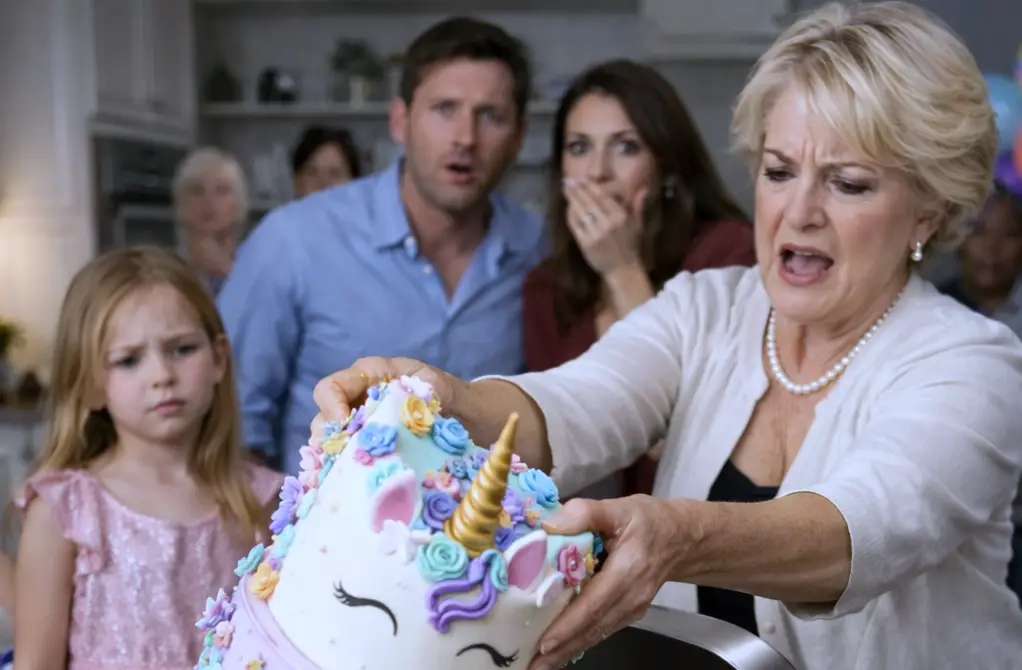
“She doesn’t deserve a celebration,” Dolores announced. Her voice didn’t waver. She projected those sharp words right into the living room, making sure every single person at my seven-year-old’s birthday party heard her loud and clear.
Those six words sliced right through the cheerful melody of the “Happy Birthday” song we had been singing just a breath before. The silence that followed was suffocating. My husband, Craig, just stood there. He was perfectly frozen, his hands suspended mid-clap, completely mute—as always. Our daughter, Rosalie, watched with wide, devastated eyes as her grandmother prepared to casually destroy what was supposed to be the absolute highlight of her special day. Around us, the other parents collectively gasped, pulling their own children a little closer.
The kids went dead quiet. All the joyful chaos evaporated. But what unfolded in the next few minutes would make Dolores deeply regret the day she ever set foot in our home. Looking back as a thirty-four-year-old elementary school teacher, I honestly thought I had children all figured out. I thought I knew how their minds worked, right up until my own flesh and blood showed me what raw, unfiltered courage actually looks like.
Rosalie had just turned seven that very day. She isn’t your average first grader. This is a kid who names her plush teddy bears after Supreme Court justices and actively insists on scanning the morning news headlines with me over cereal. The word “smart” doesn’t even begin to scratch the surface. She has this uncanny ability to absorb every microscopic detail in a room while pretending to be completely lost in her coloring books or mindlessly tapping away at her tablet games.
Craig, my husband of nine years, is thirty-six and works as a lead software developer for a booming tech startup downtown. He’s an absolute wizard with computers, but when it comes to human confrontation, he folds like a cheap lawn chair. He’s the kind of fiercely polite guy who will automatically apologize if someone else carelessly steps on his foot. When we first met, I fell head over heels for that deep-seated gentleness. Over the years, however, I realized that very same quality meant he would never, ever stand up to the one person who desperately needed to be put in her place.
That person was Dolores. At sixty-two years old, the retired bank manager was a professional joy-killer. She wielded her disapproval like a weapon, holding strict opinions on absolutely everything—from the exact way I ought to fold my fitted sheets to the precise ratio of green vegetables that belonged on Rosalie’s dinner plate. In Dolores’s gray, joyless world, children were meant to be seen and not heard. And they certainly weren’t meant to be celebrated unless they had somehow earned it through flawless academic perfection and unwavering, soldier-like obedience.
We had planned such a simple, sweet afternoon. The guest list included three kids from Rosalie’s new school, their respective parents, Craig, myself, and Dolores. Just twelve people in total, squeezed into our cozy Portland craftsman house, surrounded by delicate paper butterfly decorations and the sweet smell of baking.
But Dolores always brought her own agenda. What she utterly failed to realize, however, was that my seven-year-old had been brewing an agenda of her own.
For weeks leading up to the party, Rosalie had been glued to her tablet, obsessively tinkering with what she vaguely referred to as her “special project.” Whenever I peeked over her shoulder to ask about it, she’d flash me this tight, secretive little smile and brush it off as homework. Craig brushed it off entirely, assuming it was just another one of her wildly imaginative creative writing stories.
We were both completely clueless. The exact second Dolores released her grip and let that gorgeous cake plummet into the trash, I saw a profound shift in Rosalie’s expression. Oh, the tears were welling up, definitely. But simmering just beneath that glossy layer of heartbreak was a fierce, burning resolve. It was a familiar, hardened look I instantly recognized from my own childhood—the exact face I used to make when I finally decided I was done being pushed into the dirt.
My little girl furiously wiped her eyes, squared her small shoulders, and marched straight over to her tablet.
“Grandma, I made you a special video,” she said, her voice piercing the heavy silence. “Want to see it?”