


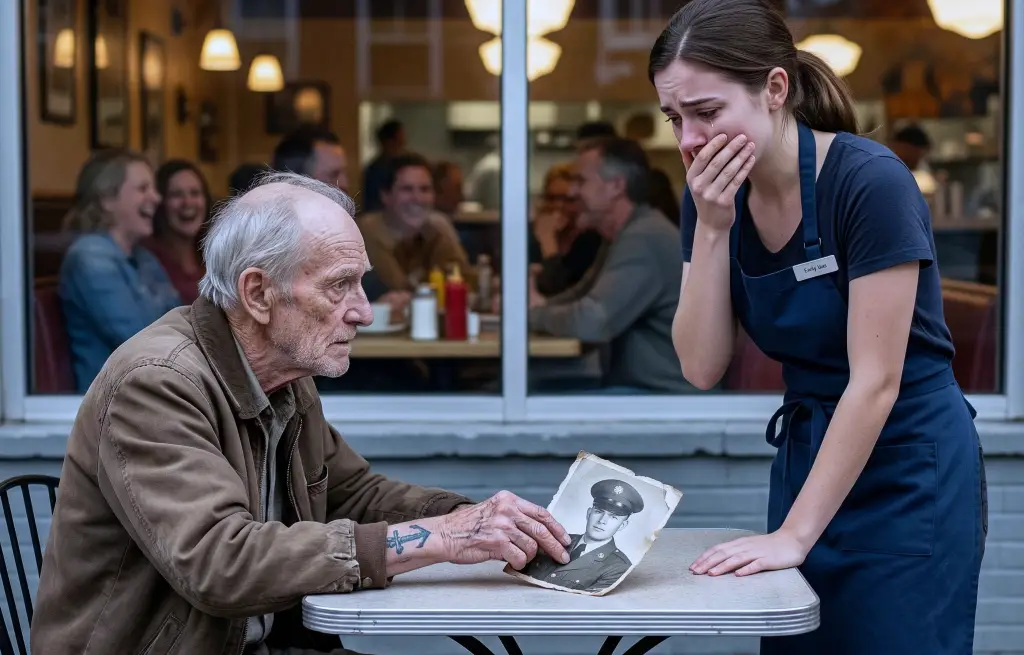
To the casual observer, the ink etched into the old man’s translucent skin was entirely unremarkable. It was a washed-out, blurred symbol from a forgotten era, its indigo lines bleeding into the surrounding tissue, barely visible on the frail forearm that rested quietly against the Formica tabletop. A brisk Sunday morning had descended upon Havenwood, Colorado, and the interior of The Patriot’s Grill was a warm, bustling sanctuary of clinking silverware and the rich aroma of black coffee. The dining room was packed with its usual weekend crowd, the volume amplified by the weekly discount offered to military veterans.
Tucked away in the furthest corner booth, largely swallowed by the cracked vinyl seating, the elderly man sat with a profound, immovable dignity. He looked to be well into his eighties. He was rail-thin, his posture slightly stooped under the weight of invisible years, crowned with a shock of snow-white hair that caught the diner’s fluorescent lighting.
Beneath the table, hidden by the shadows and the hem of his trousers, a heavy metal prosthetic leg rested exactly where his own flesh and bone had once been. Before him sat a modest tray holding a simple breakfast of eggs and toast, alongside a glass of ice water condensing on the table. His name was Arthur Coleman, a man who had forged his soul in the deep crucible of 1969, serving as a logistics technician for SEAL Team Bravo.
He wore no dress uniform. He displayed no polished medals or embroidered hats to announce his history to the room. His only armor was a threadbare brown jacket that had seen better decades, and that single, aged tattoo on his left wrist: a rudimentary dagger piercing the center of a heavy ship’s anchor.
Occupying a large, central table nearby were four boisterous, middle-aged men. They dominated the space with their loud voices and expansive gestures, casting patronizing, dismissive glances toward Arthur’s quiet corner between massive mouthfuls of hash browns and eggs.
“I bet he drew that on with a pen this morning,” one of the men said, a cruel smirk playing on his lips as he gestured toward Arthur with his fork.
“Look how ancient it is,” another chimed in, wiping his mouth with the back of his hand. “Probably got it in some back-alley shop for twenty bucks.”
“What kind of supposed soldier doesn’t even have a veteran’s ID for the discount?” the third man added, shaking his head in mock disappointment.
Arthur heard them. He said nothing, his weathered hand simply cradling the cold glass of water.
A moment later, a young server hesitantly approached his booth. She looked barely out of high school, her apron spotless, her shoulders hunched with obvious discomfort. She stopped at the edge of his table, her head bowed slightly, unable to meet his calm gaze.
“I am very sorry, sir,” she murmured, her voice trembling over the din of the restaurant, “but we’ve had a complaint. A guest said your presence is making others uncomfortable. Would you mind moving to one of the tables on the outdoor patio?”
Arthur remained perfectly still. For a long, suspended heartbeat, his pale blue eyes stared at the wall behind her, distant and unfocused, as if looking through the wood paneling and into another lifetime entirely. Then, with a slow, deliberate nod that carried no trace of anger, he acquiesced.
Without a single word of protest or a demand to speak to the management, he began the arduous process of leaving his sanctuary. He gathered his plastic tray. Pushing off the table, he forced himself upright, his joints popping, his movements stiff and heavily reliant on his upper body strength.