


My name is Emma Wilson. I am twenty-two years old, and as I stood on the sprawling, manicured green of Westfield University, the reality of my college graduation washed over me. It wasn’t merely an academic milestone. It tasted like the sweetest, most frigid form of vindication imaginable.
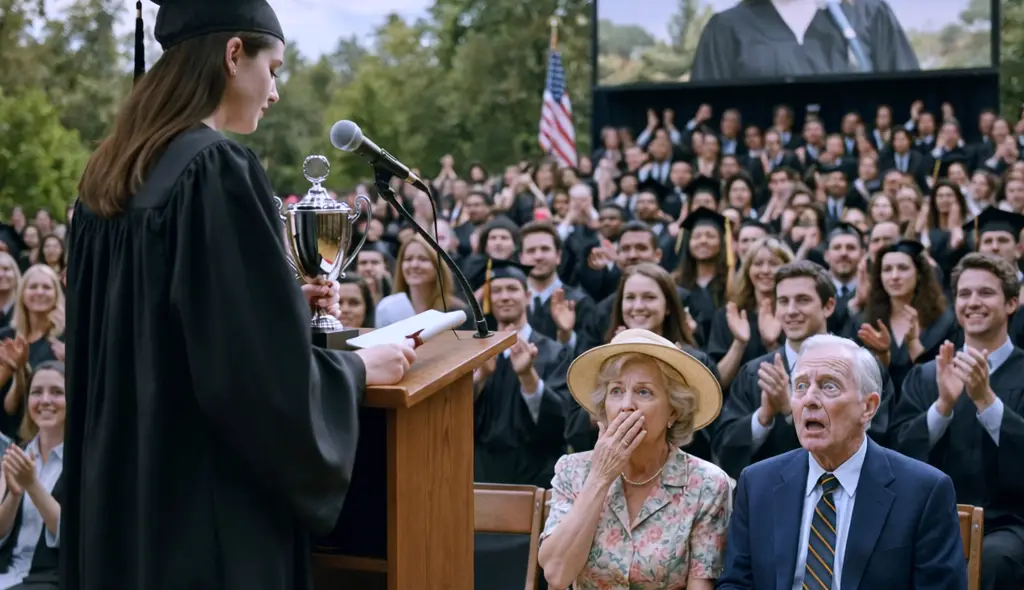
The May breeze caught the heavy fabric of my graduation gown, sending it fluttering against my legs. I stood shoulder-to-shoulder with my sister, Lily. We wore matching caps and gowns, a visual of perfect sibling harmony that masked a deeply fractured reality. By all conventional logic, this sun-drenched afternoon should have been a moment of pure, unadulterated joy. Yet, the road that had dragged me to this manicured lawn was paved entirely with years of accumulated emotional scar tissue.
Even over the distant hum of the marching band, I could still hear the ghost of my parents’ words. They echoed in the hollow spaces of my mind, as jagged and sharp as the very second they had been spoken.
“She deserved it, but you didn’t.”
I grew up in what appeared to be a postcard-perfect slice of suburban Michigan. Our two-story house sat securely behind a gleaming white picket fence that practically vibrated under the summer sun, projecting a flawless facade of wholesome family values. Inside, the walls were plastered with cherry-wood framed photographs. They featured endless forced smiles, perfectly curated to mask a much more complicated, suffocating reality.
My parents, Robert and Diana Wilson, were the undisputed pillars of our local community. Dad was a steady, number-crunching accountant who viewed the world through risk assessments. Mom taught high school English, parsing out classic literature while failing to read the dynamics of her own household. We weren’t incredibly wealthy, but we were comfortably upper-middle class. Financial ruin was a ghost story, something that wasn’t supposed to be written into my destiny.
And then there was Lily. Two years my junior, she perpetually existed miles ahead of me in the only race that mattered: our parents’ affection. Lily was a cascade of golden blonde curls and effortless, magnetic charm. She possessed a maddening knack for academic achievement that seemed to require absolutely zero friction. She was the breathing embodiment of every single value Robert and Diana held dear.
The dynamic calcified while we were still stumbling around as toddlers. Lily was anointed the golden child, the undisputed protagonist of our family’s sprawling narrative. I was the supporting character. The afterthought. The background extra.
I can still summon the exact sensory weight of those Christmas mornings. The air in our living room would hang thick with the scent of burning pine logs and sugary cinnamon. I would sit on the edge of the rug, my face locked into a painful, forced smile, watching my sister. Lily would tear into shimmering wrapping paper, squealing as she revealed the year’s most coveted, staggeringly expensive gadgets and imported toys. When my turn finally arrived, the anti-climax was palpable. I would unwrap aggressively practical bundles of plain white tube socks, or perhaps a generic, plastic-wrapped craft kit fished from a discount bin at the local pharmacy.
“Your sister needs more encouragement to nurture her talents,” Mom would explain smoothly, noticing my falling face. If I ever dared to question the glaring disparity, that was her default script.
Even at eight years old, the logic of her words tasted wrong. It sat on my tongue like spoiled milk. But survival in that house meant learning how to swallow the bitter disappointment without choking.
The school events were the true arenas where the spotlight burned the hottest. When Lily announced a science fair, our house went into a state of beautiful, frantic mobilization. Both Robert and Diana would burn their personal days at work. They would hover over Lily for hours at the kitchen table, wielding hot glue guns and massive sheets of pristine poster board, orchestrating elaborate, guaranteed-to-win displays.
My world was different. Whenever I had a school art exhibition, I considered it a massive stroke of luck if Mom managed to rush through the gymnasium doors for fifteen minutes during her lunch break. She would pace the linoleum floor, checking her silver wristwatch every thirty seconds, her eyes constantly darting back toward the exit.
“Art is just a hobby, Emma,” Dad would tell me later, his voice heavy with practical dismissal. “It won’t get you anywhere in the real world.”
My grandmother, Eleanor, was the only person who possessed the vision to truly see me. Our humid summer visits to her weathered lake house morphed into my sole sanctuary. It was the only place on earth where my lungs fully expanded. We would sit side-by-side for hours on her creaking wooden porch. She would sip iced tea and watch in comfortable silence as I dragged charcoal across thick paper, sketching the gentle ripples of the lake water and the dark, swaying pine trees.
“You have a special way of seeing the world, Emma,” she would tell me. Her voice was a raspy, comforting rumble. “Don’t let anyone dim your light.”
It was inside the walls of her small, dust-mote-filled library that my worldview cracked wide open. I began pulling down heavy biographies of relentless entrepreneurs and titans of industry. I inhaled stories of people who had dragged themselves over seemingly insurmountable obstacles. Sitting on Grandma Eleanor’s faded rug, I began to dream of something much larger than merely surviving the suffocating grip of my childhood.
I dreamed of constructing a fortress of achievement. I wanted it so towering, so undeniably massive, that my parents would be forced to crane their necks backward just to look at me. By the time I hit high school, I had forged a thick, resilient armor born of pure necessity. I violently threw myself into every single business-related club the school had to offer.
I devoured advanced math and complex economics. I uncovered a deep, natural aptitude for numbers and strategic thinking that stunned even my most supportive teachers. When I clinched the regional business plan competition as a sophomore, my economics teacher, Mr. Rivera, was so ecstatic he called our house personally. He gushed through the landline about the exceptional, collegiate quality of my work.
“That’s nice,” Mom said smoothly after hanging up the receiver. Her eyes were already drifting away, her attention evaporating. She physically turned her back to me, facing my sister. “Did you remember to help Lily with her history project? She has that big presentation tomorrow.”
The writing was on the wall, painted in neon. During my junior year, a sinking, heavy feeling anchored itself in my gut. I sensed with absolute clarity that I was going to need my own financial resources, and I was going to need them much sooner rather than later. I marched down to a local coffee shop and took a job. I ground through twenty hours a week, coming home every night smelling of acrid roasted beans and sour, stale milk.
Despite the grueling shifts, I managed to maintain a pristine, untouched 4.0 GPA. Meanwhile, Lily casually joined the debate team and instantly, predictably, became the star. My parents cleared their schedules to attend every single tournament. They celebrated her minor, localized victories with extravagant special dinners at upscale steakhouses, dinners I couldn’t afford to join on my barista wages.
By the time senior year rolled around, the age gap between us had vanished academically. Lily had accelerated through her coursework, landing the two of us squarely in the exact same graduating class. We both sent applications to Westfield University, a highly prestigious institution renowned across the state for its elite business and political science programs. Against the staggering odds of selective admissions, two thick, heavy envelopes arrived in our mailbox on the exact same Tuesday.
I can still remember the violent trembling in my fingers as I tore the thick paper of my envelope open.
“I got in,” I announced at the dinner table that evening. My voice cracked under the weight of suppressed, desperate joy. “Full acceptance to the business program.”
My father briefly glanced up from the glowing screen of his phone. His expression remained utterly flat, devoid of a single ripple of emotion. “That’s nice, Emma.”
Mere minutes later, the front door flew open with a dramatic crash. Lily burst into the foyer, waving her own thick envelope in the air like a captured flag of victory.
“I got into Westfield’s political science program!” she shrieked, her voice echoing off the walls.
The transformation in the dining room was immediate, visceral, and deeply sickening. Dad practically leapt out of his dining chair, his phone forgotten. Mom rushed across the room to tackle Lily in a fierce embrace. Suddenly, our lukewarm, quiet dinner was completely abandoned in favor of an impromptu, chaotic gala. A bottle of expensive champagne was triumphantly popped for the adults, and sparkling cider was poured for us.
“We always knew you could do it!” Mom gushed, hugging Lily so tight her knuckles turned white. She seemed totally, blissfully amnesiac to the glaring fact that I had announced the exact same monumental achievement barely five minutes prior.