


Sarah Mitchell’s knuckles were bone-white where they gripped the leather steering wheel of her Ford pickup. Beyond the frosted windshield, the Montana blizzard had transformed Highway 287 into a suffocating, churning tunnel of white chaos. It was February the fifth. Exactly three years to the day. Her hands betrayed a violent tremble as the green reflective sign for Mile Marker 47 loomed through the swirling snow.
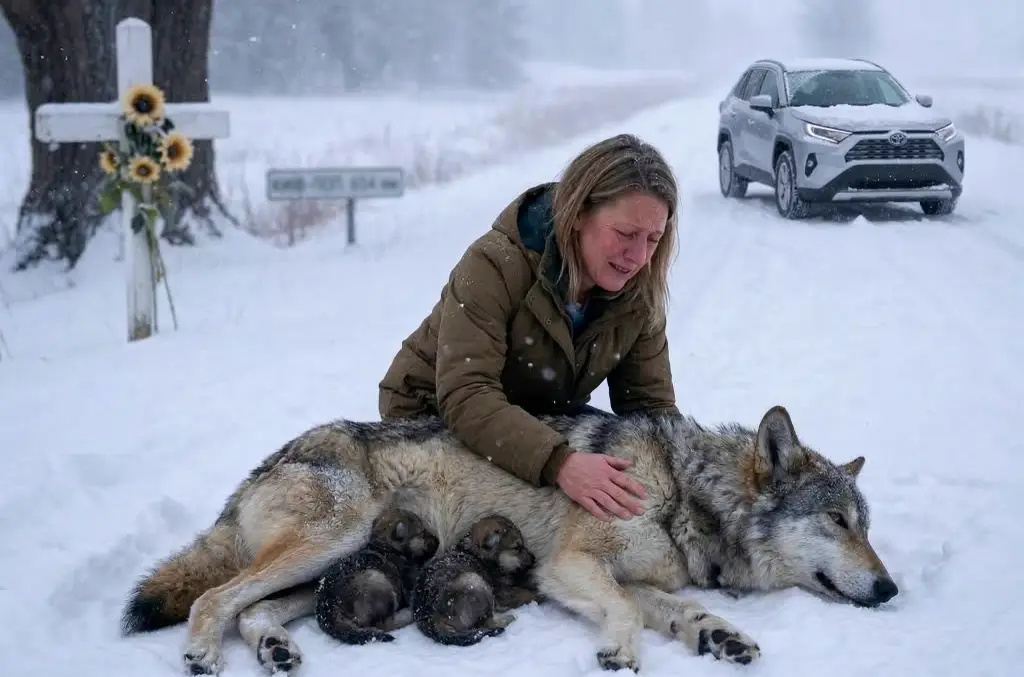
This was the curve. The exact contour of asphalt where her entire world had ended. It was here that her seven-year-old son, Ethan, had drawn his final, ragged breath after a patch of black ice sent their car spinning wildly out of control, slamming the passenger side—his side, the side she was supposed to protect but couldn’t—into the unforgiving trunk of a massive pine tree.
She had survived the mangled steel with nothing but a few superficial scratches. Ethan had held on for three agonizing hours in the bright, sterile chaos of the hospital trauma ward. Sarah had gripped his impossibly small hand the entire time, sobbing, begging a silent God for a trade. She had pleaded for a rewind, for her own life to be taken, for absolutely anything other than the crushing, suffocating reality settling over her chest.
What followed were three hollow years of weekly therapy sessions. In those quiet, carpeted rooms, Dr. Helen would lean forward and ask gentle, probing questions that Sarah simply could not answer. It was three years of her ex-husband standing in the hallway, exhausted and broken, repeating that the crash was not her fault. He eventually packed his bags and left because he could no longer bear to watch the woman he loved systematically destroy herself. And through it all, it was three years of knowing with absolute, terrifying certainty that it was her fault. She was the one behind the wheel. She was the one who had not seen the ice.
Every twelve months, Sarah made this solitary pilgrimage. She would drive the two desolate hours from her empty house in Helena just to nail a fresh white cross to that cursed, splintered bark and lay down a bouquet of sunflowers. She would stand in the cutting, sub-zero wind, let herself cry for twenty agonizing minutes, and then drive home, hating the reflection in her rearview mirror just a little bit more.
But this year, the script of her grief was about to shatter. At the precise coordinates where her son had slipped away, Sarah was about to find another mother dying in the frozen dirt. She was about to discover another family entirely destroyed by that very same merciless curve, and she would be forced into the most impossible choice of her life.
The snow began to fall in heavy, blinding sheets as Sarah eased the heavy pickup onto the narrow shoulder. The dashboard clock read exactly 4:14 in the afternoon. The exact minute the tires had lost traction three years ago. She reached over and grabbed the plastic-wrapped bouquet of sunflowers resting on the passenger seat. They were the specific variety Ethan had adored. She could still see the vivid memory of him plucking them from their backyard garden, running up to her with a gap-toothed grin that used to make her heart swell with a fierce, blinding joy—a joy she was entirely convinced she would never experience again.
She shoved her truck door open, leaning her weight against the howling wind. Her heavy winter boots crunched through the fresh, powdery snow as she walked the twenty meters toward the pine tree. Every exhale plumed into thick white clouds in the freezing air. This was the exact patch of gravel where the ambulance had parked, where the paramedics had worked with frantic, panicked energy over her fading child.
And then, she saw it. Something shifted in the deep drifts just ahead. A wolf.
She was a massive, magnificent creature, her thick coat a blend of slate grey and silver, now matted with ice. She lay collapsed on her side. Pressed desperately against her exposed belly were two tiny, squirming cubs. The mother wolf was trembling violently, her flanks rising and falling in shallow, irregular, terrifying spasms. It was the unmistakable, late-stage shudder of severe hypothermia. Sarah froze in her tracks. Her breath caught in her throat as her brain bypassed panic and dropped into the strange, clinical clarity that only accompanies profound shock.
Her eyes scanned the immediate area, cataloging the forensic story written in the snow. Large, heavy pawprints—deep, confident, and distinctly masculine—emerged from the dark tree line, leading straight toward the highway before stopping abruptly at the edge of the asphalt. A few feet away lay jagged, black skid marks from a passing vehicle. Scattered across the pristine white shoulder were dark, starkly contrasting patches of crimson blood.