


Part 1
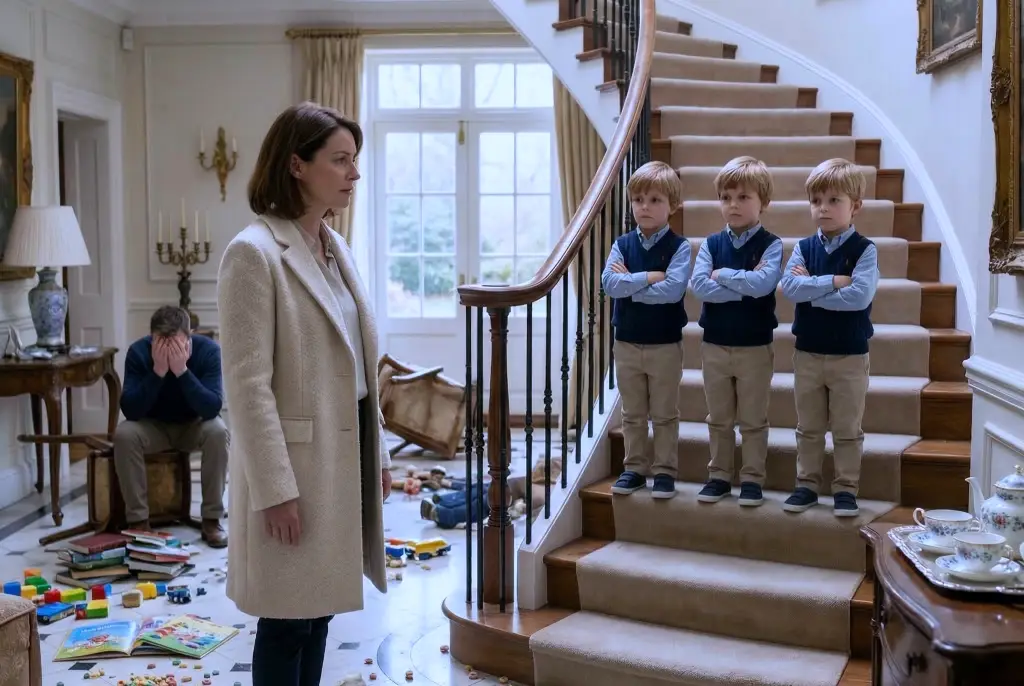
Belinda Johnson stood perfectly still beneath the grand, arched doorway of the Whittaker estate, allowing her eyes to slowly take in the absolute devastation before her. Calling the sprawling living room a domestic battlefield would have been a polite understatement. The space, which had clearly been designed as a breathtaking showcase of high-end interior architecture, now resembled the epicenter of a natural disaster. Vivid, primary colors of craft paint slashed across the once-pristine ivory walls in violent, arcing trajectories. Heavy, mahogany side tables and velvet-upholstered armchairs lay toppled on their sides like fallen soldiers, their delicate wooden legs jutting uselessly into the air.
Millions of down feathers, violently liberated from imported silk throw pillows, drifted downward in a bizarre, suffocating indoor blizzard, settling over the wreckage. Yet, it was not the sheer, breathless scale of the property damage that gave Belinda pause. It was the raw, unmasked agony burning in the eyes of the three six-year-old boys standing at the center of the ruins.
“You can’t make us like you!” Tommy screamed. As the oldest of the triplets, he had clearly appointed himself the general of this rebellion. His voice was a ragged, breathless tear through the heavy silence of the room. He snatched up a solid metal toy dump truck and heaved it directly at her feet with all the frantic strength his small, trembling arms could muster. The heavy metal clattered harshly against the hardwood. “We don’t want another nanny! We want our Mama!”
Just behind him stood his brothers, Danny and Bobby. They were positioned shoulder-to-shoulder like loyal foot soldiers preparing for a final, desperate stand against an invading force. Their small, identical faces were an absolute mess, heavily streaked with a mixture of drying tears, sweat, and the tacky residue of spilled paint. Their narrow chests he heave rhythmically with the sheer physical exertion of their massive tantrum. These three small, exhausted children had successfully waged a war of attrition against seventeen highly qualified nannies over the span of a mere six months. Judging by the fierce set of their tiny jaws and their firmly planted feet, it was abundantly clear they were fully prepared to make Belinda casualty number eighteen.
Belinda did not flinch. As she looked down at these deeply heartbroken children, she did not see the unruly monsters or feral demons the placement agency had so frantically warned her about. She saw three little boys who were drowning in a suffocating sea of grief and sheer terror, thrashing wildly to protect whatever fragile pieces of their hearts remained from the very real risk of being abandoned again.
“I know you miss your Mama,” Belinda said softly. Her voice slipped through the wreckage, calm and remarkably steady, a stark contrast to the chaos. She stepped forward, her flat shoes carefully navigating over the jagged plastic ruins of shattered action figures scattered across the expensive hardwood. She ignored the surrounding disaster entirely, her focus locked solely on the boys. “And I am not here to replace her. I am here because I think you need someone who understands exactly what it feels like when your entire world falls apart.”
The barrage of thrown objects ceased instantly. The boys froze in place, utterly stunned by the quiet gentleness of her tone. No childcare professional had ever spoken to them with such quiet conviction before; the usual script involved frantic yelling, harsh scolding, or, most frequently, a terrified, tearful retreat toward the front door. Tommy stared up at her, his bright blue eyes narrowing with deep, protective suspicion.
“You don’t know anything about us,” he challenged, though the fierce venom had noticeably bled out of his young voice, leaving only a wavering uncertainty.
Belinda slowly sank to her knees, lowering herself until she was exactly at their eye level. She paid absolutely no mind to the wet puddle of blue paint on the floor that immediately began seeping into the fabric of her skirt. “You’re right, I don’t know everything about you yet,” she admitted, keeping her tone conversational and light. “But I know that you are scared. I know that you are angry. And I know that you think if you are mean enough to me, I will turn around and leave just like all the others did.”
The three brothers exchanged quick, bewildered glances. They shifted their weight, completely unmoored. They had clearly prepared for a fight, not for a stranger to peer directly into their minds and gently lay out their secret battle plan.
“But here’s the thing,” Belinda continued, offering them a small, deeply empathetic smile that crinkled the corners of her eyes. “I’m not going anywhere. And by the end of today, I’m going to show you something that will change everything.”
Tommy’s brow furrowed, his eyes narrowing even further as he desperately searched her calm face for the inevitable adult lie. “What?”
Belinda stood back up, casually brushing a stray, floating white feather from the sleeve of her dress. “I’m going to show you that it’s okay to let someone new care about you, even when your heart is broken.”
Before the boys could process the weight of her words, the heavy, rhythmic thud of dress shoes echoed from the long hallway behind them. The defiant posture vanished from the boys instantly, the blood draining from their small faces, leaving them deathly pale with sudden, paralyzing fear.
“He’s coming,” Danny whispered, shrinking backward and instinctively grabbing the hem of his brother’s shirt. “Daddy’s going to be so mad about the mess.”
What unfolded next in that ruined living room would completely shock everyone residing in the Whittaker household, most notably the man walking down the hall—a man who had spent the last agonizing half-year entirely convinced that his sons were lost to him forever. To truly comprehend the gravity of the shifting tides in that house, one had to understand the crushing weight pressing down on the man who owned it.
Exactly six months earlier, John Whittaker had been sitting in his sprawling corner office on the forty-fifth floor of Whittaker Industries. The floor-to-ceiling windows offered a sweeping, panoramic view of the bustling American city below, but John was staring blindly at his cell phone as it vibrated violently across his glass desk, ringing for the third time that morning. He knew, with a dark, sinking sensation in his gut, that the caller was either his personal assistant reporting yet another explosive crisis involving the household staff, or the boys’ private academy calling with a fresh incident report. As he reluctantly swiped the screen to answer, he quickly realized it was both.
“Mr. Whittaker,” his assistant, Rebecca, said the very second the line connected. Her usually crisp, professional voice was pulled tight, vibrating with barely suppressed stress. “I have bad news and worse news.”
John squeezed his eyes shut and pinched the bridge of his nose, feeling the familiar, rhythmic throb of a tension headache beginning its daily pulse right behind his eyes. “Give me the bad news first.”
“The school called,” Rebecca recited, likely reading from a rapidly scribbled notepad. “The boys started a massive food fight in the cafeteria, managed to lock their homeroom teacher inside the janitorial supply closet, and flatly refused to come out of the plastic playground tunnel when the bell rang for class.”
John exhaled a long, shuddering sigh, feeling the immense, crushing weight of the world pressing down heavily on his broad shoulders. He sank deeper into his leather chair. “And the worst news?”
“Nanny number seventeen just quit,” Rebecca said, her voice dropping a full octave in defeat. “Mrs. Patterson left her keys on the kitchen counter. She said, and I quote, ‘Those children are possessed by demons, and no amount of money is worth risking my sanity.'”
Sitting in the silent chill of his office, John felt as though the carefully constructed foundation of his reality was crumbling into dust. Just a half-year ago, he had been a profoundly successful businessman with a brilliant, beautiful wife and three joyful, affectionate children. Now, Sarah was gone. She had been killed instantly in a horrific, mangled car accident on a rain-slicked highway, an event that had utterly shattered their family into unrecognizable fragments. John was drowning in the aftermath. He was desperately trying to be both a father and a mother to three deeply traumatized boys who seemed absolutely determined to burn their entire world to the ground.
“Rebecca, call the nanny agency,” John ordered, turning his chair to stare out at the gray city skyline, though he wasn’t really seeing it. “Tell them we need someone immediately. Today.”
“Sir, I already did,” Rebecca replied, her tone softening with genuine pity. “They said they are completely out of candidates. Word has gotten around the local agencies about the boys. No one wants to work for the Whittaker family anymore.”
John remained silent, watching the tiny, ant-like cars navigate the streets hundreds of feet below. He possessed a net worth of over two billion dollars, yet all the wealth he had amassed could not solve the single most agonizing problem in his existence. His sons were falling apart, scattering like leaves in a storm, and he had absolutely no idea how to gather them back together.
At only thirty-five years old, John had built a massive corporate empire from nothing but sheer grit and intelligence. He was brilliant, relentlessly determined, and had genuinely never met a problem he could not outmaneuver or solve. But grief was a different kind of beast entirely; it had mutated his bright, loving boys into volatile strangers, and John felt utterly helpless as he watched them spiral deeper into this dark abyss of anger and rampant destruction.
The unspoken, suffocating truth was that John was battling his own suffocating grief just as fiercely. Sarah had not just been his wife; she had been his truest best friend, his equal partner, and the absolute, beating heart of their entire household. In her sudden absence, John felt entirely lost, navigating a dense fog. He found himself purposely working longer, grueling hours at the office simply because wrestling with corporate mergers was vastly easier than walking into that deafeningly quiet mansion and facing his sons’ hollow, accusing eyes.
The boys blamed him for their mother’s tragic death, and though the accusation had never once crossed their lips, it hung heavy in the air between them. Sarah had been out driving that fateful afternoon specifically to pick up a surprise birthday gift for John when the accident occurred. The survivor’s guilt was a living thing, eating John alive from the inside out, and he knew, with breaking certainty, that his sons felt the exact same venom in their veins.
“Sir?” Rebecca’s hesitant voice cut through the heavy silence on the line, pulling him violently back to the present reality. “What should I do about finding a new nanny?”
John sat quietly for a long moment, allowing the sheer desperation of his situation to cloud his usually sharp judgment. “Post an ad online,” he finally instructed, his voice flat and resigned. “Offer double the usual going salary. Someone out there must be desperate enough to work with my sons.”
As he disconnected the call, John had absolutely no way of knowing that the woman who would eventually answer that frantic, desperate advertisement would irrevocably alter the trajectory of all their lives forever.
Part 2
Across town, thirty-year-old Belinda Johnson sat cross-legged on the faded rug of her cramped apartment, the harsh blue light of her laptop screen illuminating her face in the dark room. Outside, a heavy, relentless rain drummed against the single thin windowpane, mirroring the dreary uncertainty that had settled over her life. She had been out of work for two long months ever since her previous employers, a kind family she had been with for years, had abruptly relocated to Europe for a corporate merger.
Belinda had been a professional nanny for eight years, dedicating her life to nurturing other people’s children. But lately, the American job market in the affluent suburbs had grown fiercely competitive. Wealthy parents were suddenly demanding younger candidates armed with expensive degrees in early childhood development, prestigious certifications, and flawless, blue-blood references.
What those elite families completely missed when scanning Belinda’s modest resume was her singular, irreplaceable gift: she intimately understood the intricate architecture of human pain. Belinda had grown up lost within the sprawling maze of the state foster care system. Her parents had perished in a devastating house fire when she was only seven years old, leaving her with nothing but the clothes on her back and a heart shattered into jagged pieces.
She had been passed from group home to foster family, an unwanted guest constantly moving out of trash bags, never remaining in one place long enough to unpack, let alone feel safe or truly loved. By the time she officially aged out of the system on her eighteenth birthday, Belinda had developed a sixth sense for recognizing the subtle, silent signs of a child drowning in emotional agony. She had learned the hard way that the children who acted out the most violently were almost always the ones starving the most desperately for a steady, unconditional love.
When Belinda’s tired eyes scanned across John Whittaker’s newly posted job listing, her finger paused on the trackpad. The phrasing was remarkably stiff, almost sterile in its professionalism: “Seeking experienced nanny for three energetic boys. Previous nannies have found the position challenging. Competitive salary for the right candidate.”
Something buried within those carefully curated words made Belinda sit up straighter. “Previous nannies have found the position challenging” was high-society code for a household in absolute freefall. It meant the children were entirely out of control, the parents were at the end of their rope, and the checkbook was wide open for anyone willing to step into the crossfire.
Intrigued, Belinda opened a new tab and ran a quick internet search on the Whittaker family name. The search results hit her like a physical blow to the chest. Six months ago, local news outlets had covered the tragic, sudden death of Sarah Whittaker, leaving behind a young billionaire husband and a set of six-year-old triplet boys. Belinda’s chest tightened painfully as she scrolled through the archived photographs of the smiling mother.
She knew exactly the kind of suffocating darkness those three little boys were navigating because she had walked that exact same lightless path herself. She knew the paralyzing fear of the dark, the blind, raging anger at the unfairness of the universe, and the desperate, primal instinct to aggressively push everyone away before they inevitably abandoned you, too.
“Those boys don’t need a nanny,” Belinda whispered to herself in the quiet isolation of her apartment, the sound of the rain continuing its steady rhythm against the glass. “They need someone who understands the language of grief.”
She closed the standard job board templates and spent the rest of the sleepless night meticulously crafting an application that read less like a corporate resume and more like a deeply personal promise.
The following morning, John sat rigidly behind his massive mahogany desk, dreading the impending lineup of interviews. The sprawling mansion was unnervingly quiet, an artificial peace brought on only because the boys had been dropped off at their private academy. John knew from bitter experience that the silence was strictly temporary. Rebecca, his ever-efficient assistant, had aggressively sourced and scheduled meetings with five potential candidates, yet John felt no flicker of optimism. The moment most childcare professionals caught wind of his sons’ localized reign of terror, they respectfully declined the interview.
The first candidate arrived precisely at nine o’clock. She was a stern, unsmiling woman in her late fifties, dressed in a severely cut gray suit. She sat ramrod straight in the plush visitor’s chair, her hands folded tightly in her lap.
“Mr. Whittaker,” she stated crisply, her tone clipped and authoritative. “I understand your children are currently exhibiting severe behavioral issues. I believe in establishing strict, non-negotiable discipline and absolute firm boundaries. I assure you, I have never met a child I could not swiftly bring under control.”
John shifted uncomfortably, a sour taste coating his tongue. His sons did not need to be broken like wild horses or managed like insubordinate employees; they needed to be healed. He politely cut the interview short.
The second candidate was a stark contrast—a young woman fresh out of a liberal arts college, practically vibrating with eager, unearned enthusiasm. She wore a bright, floral dress and smiled entirely too much, but John could see instantly that she lacked the heavy armor required for his household.
“I just absolutely love children!” she gushed, leaning forward with wide, naive eyes. “I’m sure once the boys see how fun and creative I am, they’ll completely forget all about being sad.”
John thanked her politely for her time, suppressing a heavy sigh, and moved on. The third and fourth candidates were frustratingly similar variations of the first two—either drill sergeants looking to enforce militant order, or dangerously naive optimists who vastly underestimated the sheer destructive power of three grieving boys.
Then, Belinda arrived.
When John opened the heavy oak door to his office, he found a woman in her early thirties standing in the hallway. She possessed warm, intelligent brown eyes and offered a gentle, unforced smile. She wore a simple, professional navy dress, standing with a quiet, grounded confidence that instantly set her apart from the nervous energy of the previous applicants.
“Mr. Whittaker, I’m Belinda Johnson. Thank you for taking the time to meet with me today.”
As he gestured for her to enter, John acutely noticed that Belinda was not craning her neck to gawk at the imported crystal chandelier or the priceless, original oil paintings lining the corridor, a habit almost every previous visitor possessed. Instead, she had stopped to look at a silver-framed family photograph resting on a side table—a candid shot of Sarah laughing with the boys on a sandy beach. Her gaze was deeply respectful, reverent even.
“Tell me about yourself, Miss Johnson,” John invited as they took their seats, genuinely curious.
Belinda took a slow, steadying breath, meeting his gaze directly. “Mr. Whittaker, I want to be entirely upfront. I do not hold a prestigious college degree in child psychology. I do not have framed certificates in early childhood education. What I do have is eight solid years of in-the-trenches experience working with children, and a personal childhood that taught me exactly what it feels like when the floor falls out from under your entire world.”
John sat back in his heavy leather chair, entirely caught off guard by her raw, unvarnished honesty. “What do you mean by that?”
“My parents died in a fire when I was seven,” she explained, her voice steady but laced with old, heavy sorrow. “I spent the remainder of my childhood entirely in the foster care system, moving from stranger’s house to stranger’s house. I know precisely what it is like to be terrified that every single person you dare to care about will vanish. I know what it’s like to deliberately push people away, simply because being angry hurts a lot less than being abandoned.”
Belinda leaned forward slightly, resting her hands on the edge of his desk, her expression intensely earnest. “Mr. Whittaker, I have read about your family’s recent, tragic loss, and my heart breaks for what you and your sons are enduring right now. Your boys are not bad children; they are grieving children. And grief, especially in young children who lack the vocabulary for it, almost always disguises itself as anger, defiance, and rage.”
For the very first time in six agonizing months, John felt a faint, fragile spark of genuine hope ignite in his chest. “The previous nannies all told me my sons were fundamentally impossible to manage.”
“That is because they were trying to manage them like a project, instead of trying to understand them like human beings,” Belinda said gently, her voice a soothing balm to his frayed nerves. “Your sons aren’t actively trying to be difficult, Mr. Whittaker. They are just desperately trying to survive the day.”
John stared at her, deeply moved. He finally felt like someone was looking at his broken family and seeing the people, not just the wreckage. “Miss Johnson, I have to warn you to be fair. My sons have successfully driven away seventeen trained nannies in just six months. They can be incredibly destructive.”
Belinda smiled, a genuine, deeply warm expression that reached her eyes. “Mr. Whittaker, I have worked with traumatized children who set their foster parents’ garages on fire because they were terrified of getting too comfortable. I’ve worked with kids who systematically shattered every dish in the house because they felt entirely broken inside themselves. Destruction is just severe emotional pain with nowhere else to go.”
John looked at this remarkable, steady woman who seemed entirely unfazed by the darkness that had consumed his home. “When can you start?” he asked, his voice thick with emotion.
The very next morning, the heavy fog of dawn was still clinging to the manicured lawns when Belinda arrived at the Whittaker mansion at precisely seven o’clock. She carried a large stainless steel thermos of dark roast coffee and a worn Tupperware container filled with freshly baked homemade cookies. She understood deeply that first impressions were critical, particularly with children whose trust had been shattered. John met her in the grand foyer, his tie loose, looking exhausted, gray, and deeply stressed.
“The boys are still asleep, but they will be up soon,” he said, aggressively rubbing his bloodshot eyes. “Are you absolutely sure you are ready for this?”
Belinda stepped forward and handed him the warm thermos. “I thought you might need some coffee to start the day. And Mr. Whittaker, I want you to know right now that no matter what happens in this house today, I am not giving up on your sons.”
John wrapped his cold hands around the heated metal of the thermos, profoundly touched by the simple, maternal gesture. When was the last time anyone had simply asked what he needed? “Thank you, Miss Johnson. That is very kind of you.”
“Please, call me Belinda.”
At exactly half past seven, the heavy, muffled silence of the mansion was abruptly shattered by the rapid, chaotic sound of running feet echoing down the grand staircase, immediately followed by loud, overlapping shouting and the sharp, distinct crash of something ceramic shattering against tile.
“They’re up,” John muttered, a pained grimace twisting his features.
Belinda did not hesitate. She followed the echoing noise down the long hallway, pushing through the swinging doors into the massive, gourmet kitchen. There, she found three identical little boys with tousled dark hair and wide, bright blue eyes deeply engaged in what could only be described as a full-scale, tactical syrup war. The pristine, white marble kitchen island was completely coated in a thick, sticky, amber mess. Tommy was currently standing triumphantly on top of a highly expensive barstool, hoisting a massive, full gallon jug of orange juice over his head, fully preparing to empty it directly onto his scrambling brothers.
“Food fight!” Danny yelled at the top of his lungs the second he spotted Belinda standing in the doorway.
Instead of shouting, instead of lunging forward to grab the juice, or threatening them with timeouts, Belinda did the absolute last thing they expected.
She threw her head back and laughed.
“Wow,” she said brightly, walking calmly right into the sticky epicenter of the chaos, her sensible shoes sticking slightly to the expensive floor tiles. “You guys are genuinely really good at making messes. I’m actually incredibly impressed.”
The three boys froze mid-strike, utterly disoriented by her bizarre reaction. The massive jug of orange juice slowly lowered an inch. “You’re not going to yell at us?” Danny asked, eyeing her with deep suspicion.
“Why on earth would I yell? This looks like it was actually pretty fun, though I bet you are all incredibly sticky and gross right now.”
The boys exchanged rapid, uncertain glances, entirely thrown off balance by Belinda’s breezy, unbothered attitude.
“I’m Belinda,” she continued smoothly, pulling out a chair at the sticky oak kitchen table and sitting down as if a syrup-coated kitchen was the most normal thing in the world. “And I brought cookies, but I guess you’re all probably way too full from eating all that pancake syrup to want any.”
“We weren’t eating it,” Tommy fired back defensively, carefully stepping down from the stool. “We were throwing it.”
“Ah, I see. Much more fun than eating it, I bet. What are your names?”
Tommy crossed his sticky arms tightly over his chest, immediately stepping in front of his brothers to shield them. “I’m Tommy. That’s Danny, and that’s Bobby. And we really don’t like nannies.”
“That’s perfectly okay,” Belinda said cheerfully, popping the lid off her Tupperware container. “I’m not really a nanny anyway.”
“What are you then?” Danny asked, inching closer despite his brother’s protective stance, clearly unable to contain his curiosity.
“I’m a friend who happens to know how to bake really, really good cookies and tell absolutely awesome bedtime stories.”
Bobby, the smallest of the three, perked up slightly from behind Tommy’s shoulder. “What kind of stories?”
“All kinds,” Belinda said, her voice dropping into a theatrical whisper. “Stories about incredibly brave knights, magical animals hidden in forests, and kids who go on amazing, dangerous adventures.”
The boys were clearly hooked, their eyes wide, but Tommy wasn’t ready to let his guard down so easily. He lifted his chin defiantly. “We don’t want friends,” he stated firmly, his little voice trembling slightly with the weight of his own words. “Friends leave.”
Belinda felt a sharp, physical ache in her chest at the profound pain radiating from the small boy. She softened her posture, leaning her elbows on the table. “You’re right, Tommy. Sometimes, friends do leave. Sometimes, the people we love the most in the whole wide world leave, even when they fight really, really hard to stay.”
The boys fell completely silent. The kitchen was still, save for the slow drip of syrup falling from the counter to the floor. Belinda could see the shiny gloss of fresh tears welling up in their bright blue eyes.
“But you know what I learned?” Belinda asked gently, holding their gaze. “Just because someone leaves, it doesn’t mean they didn’t love you with all their heart. And it definitely doesn’t mean that every single person you ever meet will leave you, too.”
“Our mama left,” Bobby whispered, a single tear escaping and cutting a clean line through the sticky residue on his cheek.
“I know she did, sweetheart,” Belinda said softly. “And I bet that hurts so much inside that sometimes you feel like your chest is just going to break wide open.”
All three boys nodded in unison, the defiance fully breaking as the tears finally began to flow freely.
“Can I tell you a big secret?” Belinda asked, lowering her voice so they had to lean in to hear her. They nodded again, wiping their noses. “I lost my Mama and my Daddy when I was just a little bit older than you guys. And for a really long time, I was so mad and so incredibly scared that I tried to push everyone in the world away. I thought if I was mean enough, and bad enough, people would leave before I could start loving them.”
The boys stared at her with wide, unblinking eyes, completely captivated by the mirror image of their own souls. “Did it work?” Tommy asked in a quiet, fragile voice.
“For a little while, it did,” Belinda admitted with a sad smile. “But mostly, I was just so lonely. I missed out on knowing some really wonderful, kind people because I was just too terrified to let them care about me.” Belinda reached into the plastic container and pulled out the cookies. “These are chocolate chip. They were my Mama’s absolute favorite in the world. I make them whenever I miss her the most.”
She gently pushed the container to the center of the table. “You don’t have to eat them if you don’t want to. And you don’t have to like me today, or tomorrow, or ever if you don’t want to. But I am going to be right here in this house every single day, whether you are perfectly good or terribly bad, whether you are happy or sad. Because that is exactly what people who care about you do. They stick around.”
The grand kitchen remained entirely silent except for the soft sounds of the boys sniffling. Then, slowly, Bobby took a tiny, hesitant step toward the oak table.
“Can I… can I try a cookie?” he asked shyly, his eyes darting between his brothers and Belinda.
“Of course you can, sweetheart.”
Bobby took a small bite, and his tear-filled eyes instantly lit up. “It’s really good.”
Danny and Tommy exchanged one final, long glance, and slowly, their shoulders dropped. They approached the table, pulling out chairs and reaching into the container. As the three boys sat quietly eating their cookies, slowly beginning to physically relax in Belinda’s calm presence, John stood frozen in the hallway doorway, watching in absolute, breathless amazement. In less than twenty minutes, this quiet, determined woman had miraculously accomplished what seventeen highly trained professionals could not do in six months. She had reached the hearts of his sons.
But John had absolutely no way of knowing that this fragile, beautiful morning peace was about to be violently shattered by news that would threaten to tear their new beginning apart at the seams.