


“She doesn’t even know what day it is, Your Honor. She can barely dress herself.”
My stepmother delivered the lie without a single flutter of her eyelashes. She was sitting a mere three feet away from me at the heavy mahogany table in courtroom 4B of the Harris County Probate Court in Houston, Texas. The fluorescent lights overhead caught the gleam of my dead father’s credit card wrapped around her wrist—a diamond-encrusted Cartier watch he had bought her exactly two Christmases ago.
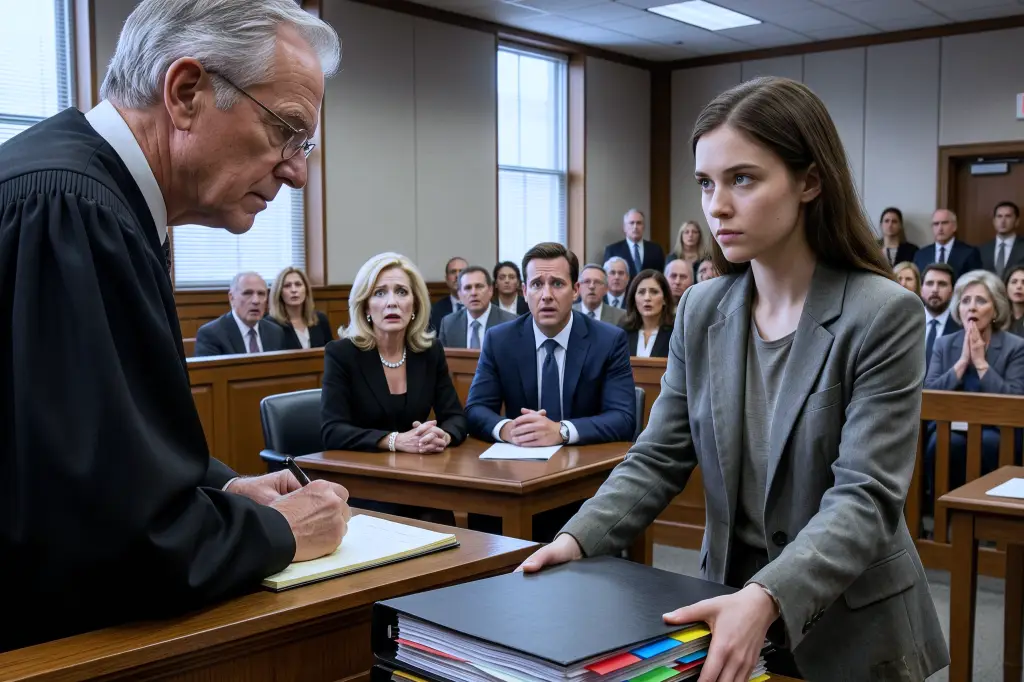
She was looking a judge dead in the eye, calmly swearing that I was mentally incompetent.
I didn’t flinch. I didn’t let a single tear slip. Instead, I folded my hands neatly in my lap, felt the rough fabric of my cheap blazer, and silently counted.
Fourteen.
That was the precise number of days Diane had left before the ground opened up and swallowed everything she had ever stolen from my family.
It is a profoundly surreal experience to sit in a room packed with people who share your last name, people who are supposed to love you, and watch them swallow poison disguised as concern. I was entirely alone that morning. Not a single soul sitting in the gallery behind the wooden barrier was on my side.
Diane had been a fixture in my life since I was eleven years old. She had swept in and married my father a mere eight months after my mother succumbed to pancreatic cancer. I still remember the day she first showed up at our front door: sporting fresh blonde highlights, flaunting a newly minted real estate license she would never actually use, and flashing a blinding smile that could charm the skin right off a rattlesnake.
My father, God rest his soul, was a good, honest man who was simply drowning in the murky depths of his own grief. Diane tossed him a lifeline, but that rope quickly proved to be a very tight leash.
For seventeen long years, she managed him. She methodically pruned his life, isolating him from his brother, from his old college buddies, and from anyone who might have cared enough to tell him the ugly truth: Diane didn’t love him. Diane loved his portfolio.
She loved the sprawling four-bedroom estate in River Oaks. She loved the sun-drenched lake house in Conroe. Most of all, she loved the fat, quarterly dividends pouring in from the commercial real estate trust my grandfather had scraped together from nothing back in 1974.
Then, fourteen months ago, my father’s heart gave out. A massive stroke. He passed away in the sterile chill of the ICU at Houston Methodist Hospital at exactly 6:47 on a rainy Tuesday morning. I was sitting beside his bed, listening to the rhythmic beep of the monitors flatlining as I held his cooling hand.
Diane wasn’t in the room. She was out in the waiting room, pacing the scuffed linoleum floor with her phone pressed to her ear, frantically calling his financial advisor.
In the hazy, grief-stricken week following his funeral, I unearthed three distinct facts.
First, my father had quietly updated his will eighteen months before he died. He left the River Oaks house to Diane, which was generous enough. But the trust—a massive umbrella covering roughly $4.2 million in commercial properties and investment accounts—he left entirely and exclusively to me.
Second, Diane had known about this devastating change to her retirement plan for exactly four months. She had gone snooping through his mahogany study desk while he was out at a routine cardiology appointment and stumbled upon the draft of the new will.
Third, and this was the revelation that shifted the tectonic plates of our entire family dynamic, Diane had spent those four intervening months slowly, methodically siphoning money out of the trust’s operating account.
She didn’t take it all at once. She was too cunning for that. It was a phantom bleed: 5,000 dollars here, 8,000 dollars there. It was just enough to cushion the lavish lifestyle she knew was on borrowed time, but strategically kept under the threshold that would trigger an automatic bank audit. By the time my father drew his last breath, she had quietly funneled just over $310,000 into dark accounts I wasn’t supposed to be able to see.
Most people, upon discovering a betrayal of this magnitude, would completely lose their minds. They would scream until their throats bled. They would hire a shark of a lawyer, file a loud, messy lawsuit, and dial every relative in their contacts list to wage a scorched-earth war.
Most people would react.