


Ten-year-old Henry Elias Crawford dropped to his knees in a desolate clearing of the northern Wisconsin Pinelands, finally broken by the unbearable weight of his two-year-old sister. It was late October of 1894, and the sun was bleeding its last pale light across the horizon. Against his back, Violet trembled with a violence that terrified him.
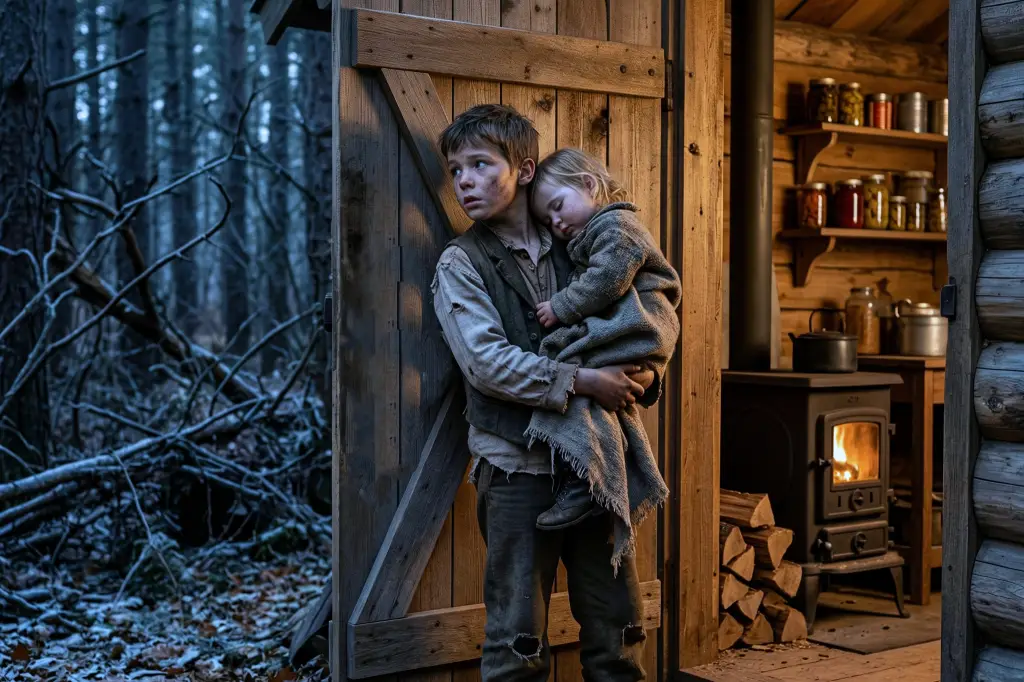
Henry could feel the fragile rattling of her tiny bones through his damp shirt, sensing her life slipping away into the encroaching frost. With numb, fumbling fingers, he carefully untangled her from his back and laid her gently upon a bed of frozen, decaying leaves. He stripped off his own threadbare coat, draped it over her small body, and pulled her tight against his chest to share whatever residual warmth he had left.
He was just a boy, not a savior, and he knew with crushing certainty that he had failed her. Closing his eyes against the biting wind, he whispered the only prayer his mother had ever taught him for impossible moments, sending a desperate plea into the vast, uncaring wilderness. When he finally opened his tear-blurred eyes, an illusion seemed to materialize from the shadows. There, cutting through the chaotic tangle of pine branches, was the distinct, sharp angle of a wooden roofline catching the absolute last ray of daylight—a geometric impossibility hidden within the wild chaos of the forest.
To comprehend why the sight of that simple, impossible structure felt like a direct transmission from God, one had to look back to the hours just before dawn on that very same day.
The ordeal of the Crawford children had not begun in the chilling silence of the untamed woods, but within the walls of a small, drafty house ruled by profound resentment. It was born from a calculated decision made by a woman who was supposed to be a mother, a final betrayal that had been festering for long, suffocating months. Their descent into nightmare didn’t start with a prayer spoken in the frozen pines. It began with the quiet turning of a key in a brass lock, and a heartless command whispered into the dark.
For months, Henry had learned to measure his very existence by the quality of silence in his own home. In the hours before the sun rose, the quiet was thin and brittle, a fragile skin of peace stretched tightly over the darkness. It was the only time of day he felt something approximating safety. Within those hushed hours, he was not an obstacle. He was not a burden. He was simply a boy, lying awake on a thin, prickly straw mattress, listening to the soft, rhythmic breathing of Violet sleeping beside him.
Their world had not always been this small or this terrifying. Once, the cabin had echoed with the booming, chest-deep laugh of their father and the gentle, melodic hum of their mother’s songs. Back then, the air had smelled of sweet wildflowers and freshly baked bread. But that life was gone. The four walls of the cabin near the bustling Wisconsin logging camps had transformed into a monument to everything they had lost.
The atmosphere inside was heavy, thick with the unspoken disdain of their stepmother, Bernadette. Her mere presence was a constant, chilling reminder that Henry and Violet were living on borrowed time. Under her reign, every creak of the floorboards and every gust of wind rattling the frosted windowpanes felt like a looming threat.
Henry clung fiercely to the fragmented memories of his mother. He remembered her warm, calloused hands and a smile so bright it seemed to illuminate the darkest corners of the room. Yet, those memories were fading. They were growing as indistinct and blurry as a watercolor painting left out in a heavy rain.
She had passed away giving birth to Violet, trading her own life for her daughter’s. Her absence left a cavernous void that their father could never quite fill. He was a colossal man, a logger with hands the size of dinner plates and shoulders built for swinging heavy axes. For two years, he had tried to be both mother and father, his grief a palpable, heavy entity residing in their small home. He would return from the logging camps late in the evenings, smelling sharply of pine sap and stale sweat. Gathering them both into his massive arms, his large, rough frame served as a temporary shield against the encroaching loneliness of the world.
He used to tell Henry grand stories of the deep woods, spinning tales of mythical creatures that supposedly darted between the ancient trees. In those fleeting moments, sitting by the hearth, the world felt vast and brimming with magic, rather than small and suffocating. But that fragile stability shattered completely the day their father brought Bernadette Holt home.
Bernadette had been a cook at the local logging camp. She possessed a hard, weathered face and calculating eyes that seemed to constantly assess the monetary value of everything they landed upon. She married their father a mere eight months after their mother’s passing, and her arrival ushered in a new, insidious kind of winter—one that seeped directly into the structural timbers of the cabin.
She didn’t yell or raise her voice. Not at first. Bernadette’s cruelty was a quieter, far more deliberate thing. It manifested in the way she meticulously doled out the smallest possible portions of food onto their tin plates. It was in her refusal to speak their names, referring to them only when absolutely necessary. It was in the way her cold gaze would slide right past Henry and Violet, as if they were made of clear glass.
Henry quickly learned to interpret the subtle shifts in her posture and the severe tightening of her lips. This silent language of disapproval became his primary textbook for survival. He understood, with the profound and tragic clarity of a child in constant peril, that they were not family to this woman. They were merely bad investments in an unforgiving ledger.