


If my night driver hadn’t missed my exit, I would have unlocked my peeling front door, stepped into my quiet house, and walked straight into a nightmare I was never meant to survive. My name is Lydia Moore. I am sixty-one years old, and the life I have now was bought and paid for by twelve minutes of paying attention in the dark.
It started with an ending. Six months before that night, I stood shivering in a sterile hospital room in Glendale. I held my husband Daniel’s hand as the relentless beeping of the machines finally gave way to a suffocating silence. We had been married for thirty-nine years. He had spent his life teaching high school history, pouring his heart into teenagers who rarely looked up from their phones. I had spent mine as a legal assistant, buried under mountains of paperwork.
When Daniel’s heart stopped, mine kept beating, though I couldn’t understand why. The life insurance we had banked on barely made a dent in the towering medical bills and the staggering cost of a modest funeral. Whatever pennies were left evaporated into property taxes, utilities, and the sheer, exhausting expense of simply breathing in Los Angeles, a city that absolutely refuses to slow down for someone else’s grief.
I retreated to the small, aging bungalow in East Los Angeles that Daniel and I had scraped together to buy decades ago. Back then, the neighborhood felt like a promise wrapped in sunshine. Now, the paint curled off the siding like dead skin, the streetlights outside flickered with an unreliable hum, and the silence inside those walls felt heavier than a physical weight. Our only son lived in Arizona. He called when he could carve out the time, but we had drifted. Grief doesn’t always bring people together. More often than not, it just stretches the distances that already exist between you until the thread snaps.
At sixty-one, the dream of a quiet retirement was dead. I needed money. I managed to land a night position downtown at a private legal records archive. It wasn’t a glamorous law firm. It was a subterranean, windowless operation that stored dusty civil case files, sealed depositions, and evidentiary documents for ongoing, high-stakes litigation.
My job was tedious but required absolute precision. I had to log physical files, verify the chain of custody, and flag any discrepancies. The work demanded intense focus and complete discretion. It paid just barely enough to keep my head above water.
My shift always ended at exactly 11:45 p.m. For years, I had relied on the city bus to get around. But the city had recently slashed the transit budget, and my route was cut. The final bus of the night now rumbled away long before I even punched out.
Walking through the concrete canyons of downtown Los Angeles alone at midnight simply wasn’t an option. My body couldn’t handle a sprint, and my nerves were already frayed to the breaking point. My son, practically begging over the phone from Arizona, insisted I download a rideshare app. I pushed back, stubborn as always, until the reality of the dark streets left me no choice.
That was how Aaron came into my life. The very first time his dark sedan rolled up to the curb outside the archive building, I hesitated on the pavement. It was late. The street was a ghost town. Through the windshield, I saw a man who looked to be in his early fifties. He had heavy, tired eyes and moved with a careful, deliberate stiffness. But his profile on the app glowed with a perfect five-star rating across hundreds of rides.
I took a breath, opened the back door, slid onto the leather seat, and gave him my address.
“Long night?” he asked quietly, catching my eye in the rearview mirror.
“Every night,” I said.
He just nodded. It was a slow, knowing gesture, like those two words had told him my entire life story.
Over the next few weeks, Aaron’s dark sedan became the only constant in my fractured world. He was always the one who accepted my ride request. Same lonely nights. Same exact time. Same calm, unbothered presence. He never pried. He never forced me into exhausting small talk. But he paid attention. He noticed when my hands shook as I buckled my seatbelt. He noticed when I stared blankly out the window. He noticed when the midnight air left me shivering, silently dialing up the heat before I could ask.
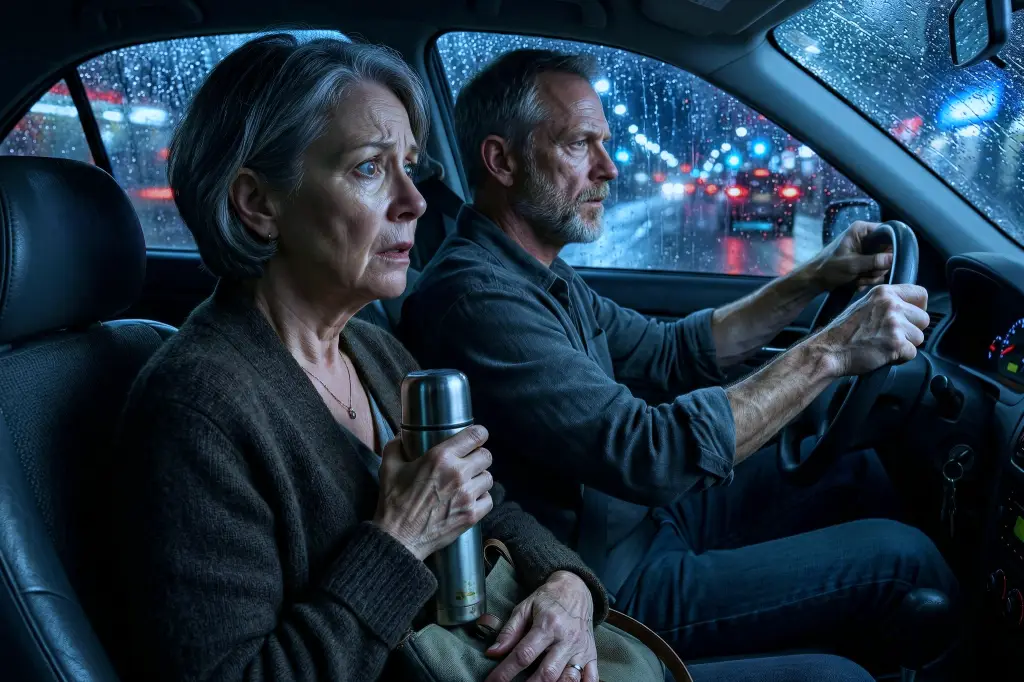
By October, the chill in the air had teeth. That was when I started bringing him tea. It was just chamomile, steeped in my own kitchen and poured into a battered travel cup. The night shifts often left my nerves wired and my hands trembling, and clutching the warm thermos on my way out the door steadied me. One particularly cold night, I brought a second thermos and handed it over the center console.
“You don’t have to do that,” he said, looking at the steaming cup.
“I know,” I replied, settling back into my seat. “But the nights are long.”
He accepted it with a short nod, but the weight of his appreciation hung in the quiet car. It felt like something much heavier than simple gratitude.
By the time November rolled around, those twelve-minute rides across the sleeping city were the only time I spoke to another human being face-to-face. Aaron memorized my routine. He learned exactly where the potholes were on my street. He knew the way my front porch light flickered before buzzing to life. He even knew which nights I lingered on the porch to lock my deadbolt twice.
What I didn’t know yet was that someone else had been watching me, too.
Aaron rarely initiated conversation, but when he did, he didn’t waste breath on the weather. He asked questions that actually mattered, and then he let the silence stretch out, waiting for my answer without ever rushing me. I quickly learned that quiet didn’t make him anxious. He lived in it.
One rainy night, a few weeks into our routine, he finally told me a piece of his own story. He used to be an electrical systems technician. For nearly twenty years, he had worked maintenance for massive commercial buildings all across the sprawling city. Then, a rusted scaffolding gave way. The fall crushed two vertebrae in his lower back. The company threw a settlement at him to make him go away. His career vanished overnight, but the agonizing pain decided to stick around permanently.
Driving the graveyard shift paid his rent and kept his stiffened back moving. More importantly, it allowed him to check on his aging mother every single morning before he finally tried to sleep. She lived completely alone, and her memory was washing away in unpredictable, heartbreaking waves. Aaron had quietly rearranged his entire existence around her fading mind.