


I didn’t even get the chance to pull out my chair before he severed the cord. The cafe was suffocatingly crowded, swimming in the ambient sounds of a muted jazz trumpet filtering through the overhead speakers and the heavy, sweet scent of roasted espresso blending with overpriced pastries. I had barely taken two steps toward our usual corner table when Jason looked up from his perfectly frothed, completely untouched cappuccino.
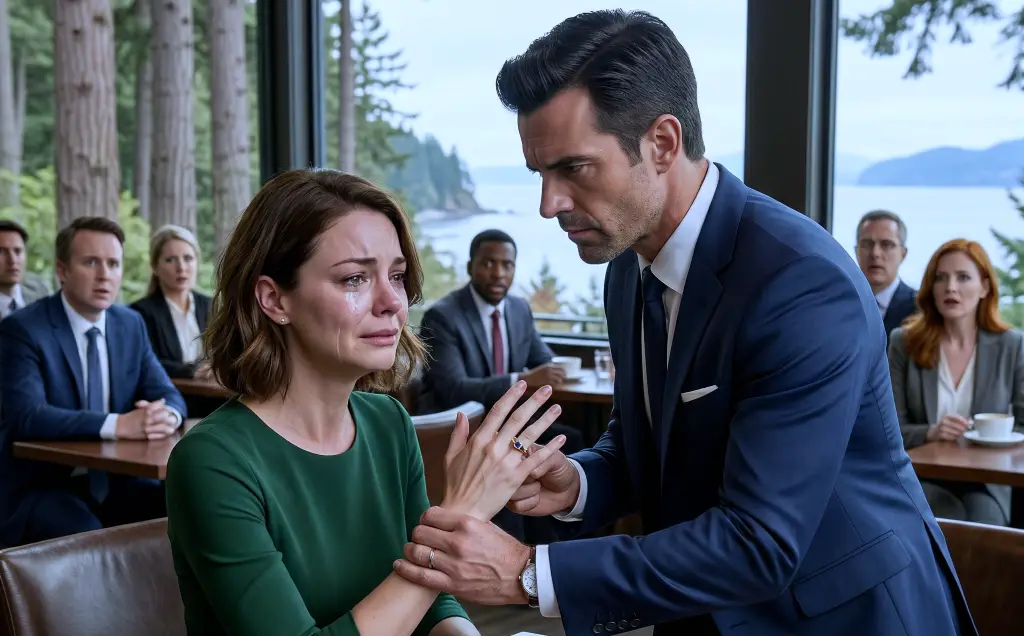
“We need to talk,” he said.
My stomach plummeted, hitting the floor long before I did. I will never forget the exact cadence of his voice in that moment. It was entirely flat, stripped of any warmth, carrying the practiced rhythm of a rehearsed monologue. I took my seat anyway, my palms suddenly damp against the fabric of my coat.
“What’s going on?” I asked, forcing a brittle smile to my lips in a desperate bid to keep the world spinning on its normal axis. “Is this about the caterer?”
He did not answer that question. Instead, he reached a perfectly manicured hand into the inside pocket of his tailored cashmere coat. He withdrew a small, dark velvet box and placed it squarely in the center of the wooden table. He was not bringing it out to give it to me. He was bringing it out to take something back.
“I can’t marry you, Emily,” he said.
Just like that. Seven words delivered with casual precision, carving through my chest sharper and cleaner than any surgical scalpel I had ever held in the trauma ward.
“What?” I whispered, the syllable barely making it past the sudden lump in my throat.
He leaned back in his chair, his shoulders dropping slightly, as if the sheer weight of his honesty had finally set him free from a terrible burden. “It’s not you,” he continued, his tone infuriatingly even. “It’s just that we are heading in entirely different directions. I’ve made connections recently. Important ones. Megan Langley and I were aligned in ways I simply didn’t see before.”
Megan Langley. The daughter of Gregory Langley, the ruthless venture capitalist who practically owned half of the tech startups on the West Coast. My heart began to batter against my ribs, a frantic bird trapped in a cage.
“You’re leaving me for her?” I asked, the reality of the betrayal settling over me like ice.
“It’s not like that,” he deflected quickly, though the lack of eye contact confirmed that it absolutely was. “This is better for both of us, Emily. You deserve someone simpler.”
He did not even flinch when I stared at him, my silence hanging heavy and stunned between us. I was desperately trying to calculate how the man I was scheduled to walk down the aisle toward in exactly sixteen days could erase my entire existence with such clinical efficiency. Then, as if he had not already gutted me thoroughly enough for one afternoon, he gestured vaguely toward my left hand.
“Also, the ring,” he added, his voice dropping to a conversational murmur. “It’s a family heirloom. My grandmother would be absolutely devastated if it left the family.”
I slipped it off. My fingers were trembling so violently I could barely clear the knuckle, but I managed it. I placed the warm gold band gently onto the table, right next to the velvet box.
“Thank you for your honesty,” I said.
I stood up, turned on my heel, and walked away. I marched straight past the heavy glass doors, past a young couple sharing a slice of cheesecake, past the dozen curious eyes of strangers trying to piece together the silent tragedy that had just unfolded in their periphery. It was only when I turned the corner onto Elm Street, shielded by the brick facade of a bookstore, that the tears finally broke loose.
I did not go back to the apartment we shared. I could not stomach the thought of looking at the half-packed moving boxes or the white silk dress suspended like a ghost in the bedroom closet. I could not face the echoing silence of a future that had just been cancelled.
But when I finally did return hours later, the erasure was already complete. My entire life had been condensed into a row of suitcases sitting rigidly by the front door. They were meticulously labeled with crisp white tape. Clothing. Books. Toiletries. Everything was carefully sorted, as if I were a defective parcel being returned to sender.
Jason had not done this. He wouldn’t have possessed the logistical consideration. It had to have been his mother, stepping in to sanitize her son’s apartment of the inconvenient bride.
I sank onto the hardwood floor beside those bags and stayed there for hours. My old studio lease had expired, the keys handed over to a bright-eyed nursing student a few weeks prior. Every spare cent I had managed to save over the last two years had been swallowed by wedding deposits. I had less than one hundred dollars to my name, and a full, grueling week standing between me and my next hospital paycheck.
That was when I surrendered and did the one thing I had not done in over a year. I called my foster mother.
Margaret Temple answered on the third ring, her voice humming with the same warm, steady cadence that had grounded me throughout my chaotic youth.
“Emily, honey, where have you been?” she asked brightly. “I was just about to call you about those silver shoes we looked at last week.”
I opened my mouth to speak, but the only sound that escaped was a jagged, humiliating sob. That was all the communication she required.
An hour later, I was curled into a tight ball on her faded plaid couch, my hands wrapped around a steaming mug of peppermint tea. Margaret stood behind me, gently smoothing my hair exactly as she used to when I was thirteen years old and broken from yet another foster placement gone horribly wrong. She did not pry. She did not demand explanations. She simply unfolded a thick, heavy knit blanket, draped it over my shivering legs, and offered the only sanctuary she had.
“Stay as long as you need,” she said quietly. “You hear me? I’ve got the space, and you’ve got absolutely nothing to prove to anyone.”