


My name is Savannah Brooks. I am twenty-eight years old, and the night my father threw the entirety of my life onto the front lawn, I had just finished a grueling twelve-hour shift trying to keep a severely burned Labrador retriever breathing.
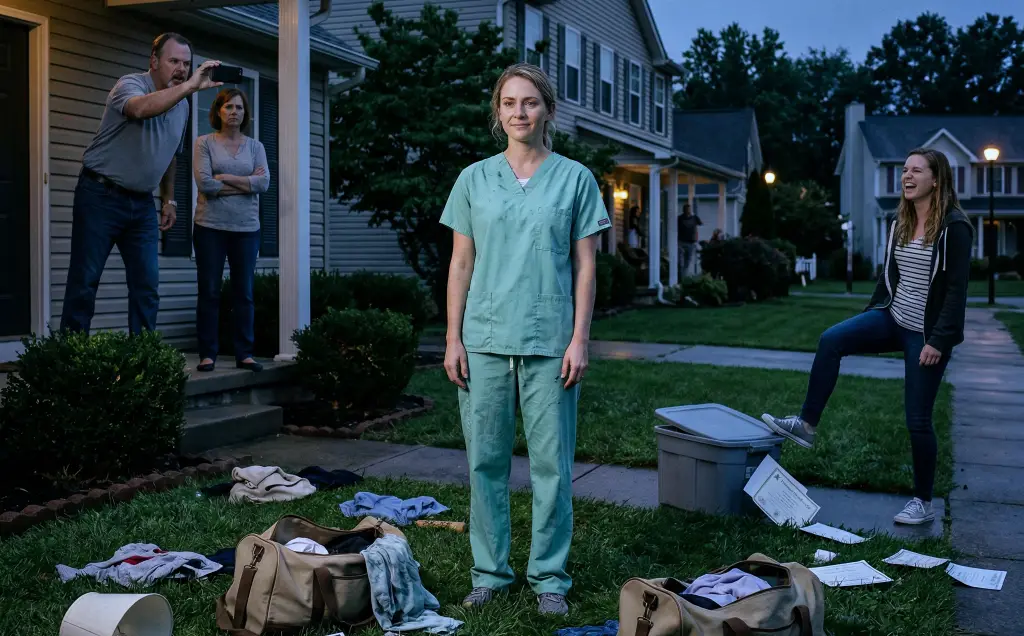
I still carried the sharp, sterile stench of antiseptic and the heavy, tragic odor of damp, singed fur woven into my clothes when I finally pulled my car into the driveway of my childhood home. I was desperate for a hot shower and a few hours of quiet, but what I found waiting for me under the harsh glare of the streetlights was a meticulously staged execution of my dignity. My heavy canvas duffel bag lay in the center of the grass, its zipper split open, spilling my folded clothes into the dew.
My mint-green work scrubs were inexplicably tangled around the base of a shattered floor lamp. My heavy winter coat had been tossed carelessly, half-buried in the damp mulch of my mother’s flower bed, and a cardboard storage box of my childhood photographs had been violently dumped upside down, the glossy memories scattered across the yard like worthless trash.
My father was standing at the edge of the porch, bathed in the sickly yellow glow of the overhead light. He had his smartphone raised, the camera lens pointed squarely at my face, recording the entire spectacle as if humiliating his eldest daughter was nothing more than prime evening entertainment. Behind his shoulder, my mother stood as rigid as a statue, her lips pressed into a thin white line, her arms folded tightly across her chest to form a barricade of silent complicity.
Off to the side, my sister Tessa let out a sharp, cruel laugh. She stepped forward and casually nudged one of my plastic tote bins with the toe of her sneaker, tipping it over. A thick stack of my framed veterinary training certificates spilled out, the glass scraping and sliding across the rough asphalt of the street.
“You’re twenty-eight years old,” my father barked, his voice carrying a harsh, jagged edge designed specifically to carry across the manicured lawns and echo off the vinyl siding of the neighboring houses. “You suck us dry like an absolute leech. I want you gone. Tonight.”
Out of the corner of my eye, I could see the silhouettes of the people across the street. They were sitting quietly on their front porch, their heads tilted, pretending to be engrossed in the evening air while practically holding their breath so they wouldn’t miss a single second of our family’s collapse.
I turned my attention back to the phone pointed at my face. I didn’t look away, and I didn’t shrink. Instead, I smiled straight into the dark little lens of his camera. I stood there and felt the profound, dizzying surrealism of being labeled a parasite by the very people who had spent my entire adult life relying on me. In that exact fraction of a second, the desperate, pleading child inside of me simply stopped breathing. Something fundamentally shifted in my chest, and my blood ran ice cold.
I walked past them and began gathering my belongings. I loaded every last sweater, every broken frame, and every scattered photograph into the back of my car. I moved with a mechanical, eerie precision. I did not shed a single tear. I did not beg for my bedroom back. I entirely deprived them of the messy, dramatic, hysterical scene they were so desperately trying to provoke.
When the trunk finally slammed shut, I walked slowly up the concrete steps until I was standing level with all three of them. I looked at their expectant, defensive faces and spoke in a voice so quiet it forced them to lean in to hear it.
“I hope you all sleep well tonight,” I said softly. “Because one day, none of you are going to be able to sleep at all.”
I didn’t drive to a friend’s house to crash on a couch, and I didn’t park behind a grocery store to sob against the steering wheel. I merged onto the interstate and drove three exits south in total silence. I eventually pulled into the desolate, brightly lit parking lot of a twenty-four-hour gas station, turned off the engine, and pulled out my phone. While I had been silently gathering my ruined belongings from the grass, I had accidentally bumped the screen and triggered a voice memo.
Sitting in the dim cabin of my car, I pressed play. The audio was muffled but unmistakable. The unmistakable boom of my father yelling about how much I owed them. The sharp, venomous sound of my sister laughing at my expense. And underneath it all, the chilling apathy of my mother’s voice murmuring, “Just let her go, Richard. She brought this on herself.”
I sat in the glow of the dashboard and replayed that torturous audio file three times in a row. I didn’t listen to it because I enjoyed the pain; I listened to it because I needed the absolute brutality of their voices burned into my brain. I needed to hear it clearly enough so that I could never, ever let myself rewrite the memory into something softer later on.
Families operating on toxic dynamics only survive by slowly convincing you to doubt your own sanity. I knew their playbook by heart. By the time the sun came up, my father would have casually rebranded the eviction as a minor misunderstanding. By next week, my mother would be telling her friends that I was simply being dramatic. By Christmas, the collective family narrative would be that I had selfishly stormed out over absolutely nothing, breaking their hearts in the process.
But the digital recording didn’t lie. It was an anchor to reality.
I spent my first night of exile in a cheap, extended-stay motel off the highway. The bathroom had a flickering fluorescent tube that buzzed like an angry hornet, and my dinner consisted of two stale granola bars I bought from a vending machine in the lobby. Sitting on the edge of the lumpy mattress, I established one hard, unbreakable rule for the rest of my life: I was never going back.
Around half past one in the morning, the silent room was illuminated by the sudden glow of my phone screen. First came six missed calls in rapid succession. Then eleven text messages. Then twenty. My father’s texts were furious, demanding to know my exact geographic location. My mother’s texts were dripping with manufactured panic, claiming my departure proved I was acting entirely unstable. My sister, true to form, simply sent: “lol have fun paying for your own everything.”
I didn’t reply to a single syllable. Instead, I meticulously took screenshots of every incoming message, created a new digital folder on my phone, and titled it: When They Start Lying. It might sound petty to anyone who has never been pushed to the absolute brink, but when the people who raised you attempt to publicly humiliate and destroy you, capturing documentation is no longer pettiness. It is armor.