


Sweat gathered heavily at the nape of my neck, tracing a cold, damp path down my spine as the Amtrak express train violently lurched forward. My braced legs immediately screamed in a sudden, sharp chorus of agony. I had only just managed to drop my exhausted frame into the single remaining empty seat on the crowded carriage, finding myself situated right beside a heavily scarred man and his massive German Shepherd. Most service animals I encountered out in the world either ignored me entirely or shrank away, spooked by the harsh, unnatural metallic clank of my forearm crutches.
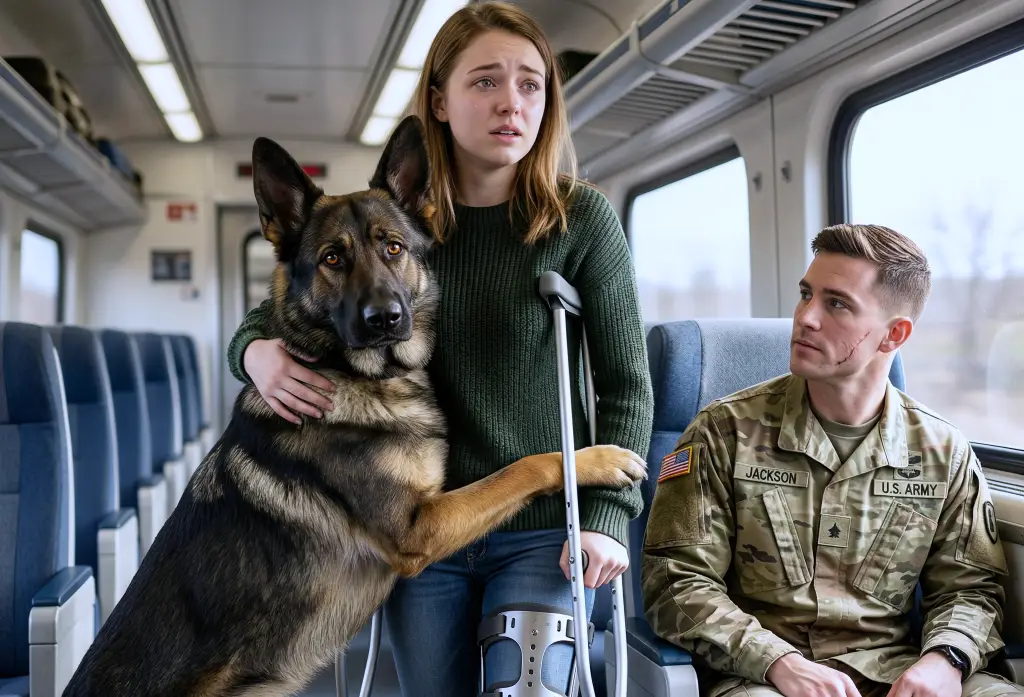
But this dog was entirely different. Instantly, the beast’s amber eyes locked onto my face, and its powerful posture stiffened into a rigid, terrifyingly focused stance. It was not preparing to attack me. I could sense that immediately. Instead, every muscle in its vast body telegraphed that it was preparing to kill anything that dared to come within striking distance of where I sat.
To say that Penn Station during the Friday evening rush hour was a hostile environment would be a profound understatement. For anyone else, it was a nuisance. For me, Chloe Rollins, it was an absolute, waking nightmare. I was born with a severe, tethered spinal cord. Over my twenty-four years of life, my condition had demanded multiple invasive surgeries, leaving me entirely reliant on a pair of custom titanium forearm crutches and a set of heavy, rigid leg braces just to maintain a vertical posture. Every single step I took was a calculated, exhausting negotiation with gravity, friction, and pain.
And today, the pain was undeniably winning.
The air down in the station had been suffocatingly thick. It was a suffocating miasma that smelled heavily of stale salted pretzels, noxious exhaust fumes from the idling locomotives, and the anxious, sour sweat of ten thousand frantic commuters all desperately trying to escape New York City for the weekend. I had booked a ticket on the 5:15 PM northbound train to Boston, desperate to get back to the familiar safety of my own apartment.
By the time the boarding call echoed over the distorted, crackling public address system, I was already thoroughly exhausted. My muscles burned with a fiery, relentless lactic acid ache that radiated fiercely from my lower back all the way down to my numb, tingling toes. As the garbled voice announced the track number, the massive crowd surged forward, moving with the unthinking, crushing momentum of a tidal wave.
I was instantly shoved aside. I always tried to remind myself that people did not mean to be inherently cruel. They simply did not see me. In a dense, vertical city of millions, a struggling girl with a pronounced limp was nothing more than an inconvenient obstacle on the way to the platform. A businessman rushing past in a slick, tailored gray suit bumped my left shoulder hard, sending my fragile center of gravity completely off balance. I stumbled sideways, managing to catch myself heavily on my left crutch. I gasped aloud as a blinding spike of white-hot pain shot straight up my compromised spine.
By the time I finally navigated the terrifying, narrow gap between the dirty concrete platform and the metal lip of the train carriage, the car was already packed to capacity. Every single window seat had been claimed. Selfish commuters had strategically placed their designer leather bags, heavy briefcases, and wool coats on the empty aisle seats. They stared fiercely down at their glowing smartphone screens, projecting a universal aura of hostility to avoid making eye contact with anyone who might dare ask them to move their belongings.
I dragged myself down the narrow, carpeted aisle. The rhythmic clack-thump, clack-thump of my crutches drew brief, intensely annoyed glances before people quickly looked away, pretending I did not exist. My arms were shaking uncontrollably beneath the cuffs of my sweater. I knew with absolute, terrifying certainty that if I did not sit down within the next sixty seconds, my failing legs would simply give out, and I would collapse right there on the filthy, stained floor of the train.
At the very back of the carriage, I spotted a small, singular sliver of hope—an empty aisle seat. But as I drew closer, dragging my heavy braces across the floor, I immediately realized exactly why it had been left empty. The window seat was occupied by a man who looked as though he had been rough-hewn directly out of a slab of granite.
He wore a faded, olive drab tactical jacket over a dark shirt, rugged dark denim jeans, and a black baseball cap pulled low over his brow. A jagged, heavily faded pink scar traced a brutal path from his left earlobe all the way down, disappearing beneath the collar of his shirt. He sat perfectly still, his eyes closed, but his posture was far from relaxed. He looked exactly like a tightly coiled spring, ready to snap with devastating force.
That imposing presence wasn’t the only thing keeping the aggressive New York commuters at bay, however. Curled on the floor, squeezed tightly between the man’s heavy combat boots and the empty seat I desperately needed, was a dog.
It was not a standard, friendly Golden Retriever or an eager-to-please Labrador. It was a ninety-pound sable German Shepherd. The animal was strapped into a heavy-duty tactical harness equipped with rigid grab handles, reinforced nylon stitching, and a stark Velcro patch that read, DO NOT PET. WORKING K-9. The dog’s thick double coat was a striking, primal mix of dark charcoal and vibrant burnt orange. It looked significantly less like a domesticated pet and more like a wild wolf that had been formally drafted into military service.
I hesitated in the aisle, my heart hammering against my ribs. Suddenly, the locomotive blew its horn—a deafening, vibrating blast that signaled our imminent departure. A sharp, violent tremor ran right through my bad leg, a warning sign of an impending collapse.
I had absolutely no choice. I stepped forward, gripping the molded plastic handles of my crutches so tightly my knuckles turned white.
“Excuse me?” My voice trembled pathetically, sounding incredibly small and fragile even to my own ears.
The man did not flinch, but his eyes snapped open in an instant. They were a piercing, unforgiving shade of cold steel gray. He looked up at me, his intense gaze swiftly sweeping over my pale, sweat-slicked face, the white-knuckled death grip I had on my crutches, and finally resting on the heavy, custom carbon-fiber and titanium braces caging my legs.
He did not offer a polite, disarming smile or a warm, conversational greeting.
“Is this seat taken?” I asked, my breath catching nervously in my dry throat.
For a terrible, agonizing second, the man said absolutely nothing. He simply evaluated me with an intense, analytical stare that made me feel as though I were being scanned by an X-ray machine. Then, he gave a single, curt nod. He didn’t speak a word. He merely reached his hand down and delivered a sharp, completely silent hand signal to the massive predator resting at his feet.
The German Shepherd moved with terrifying, liquid fluidity. Without making a single sound, no claws scraping, no whining, it slid backward, pressing its large, muscular body tightly against the man’s shins, completely clearing the foot space for me.
“Thank you,” I breathed out. I practically collapsed into the upholstered seat. I leaned my metal crutches against the window divider and closed my eyes, letting out a long, incredibly shaky sigh as the train finally jolted into heavy motion. The pure, unadulterated relief of getting my body weight off my screaming legs was intoxicating.
For the first ten minutes of the northbound journey, absolute silence reigned in our row. I kept my eyes firmly closed, focusing entirely on taking slow, measured breaths, silently willing the agonizing spasms deep in my lower back to finally subside. Beside me, the scarred man remained as profoundly still as a statue.
I would not learn the man’s name was Jackson Reynolds until much later, long after the nightmare had ended. Nor would I know that he was not just an ordinary military veteran. He was a recently retired elite operator from the Naval Special Warfare Development Group, a tier-one counterterrorism unit more commonly known to the public as SEAL Team Six.
Jackson had spent the last fourteen years of his life operating in the darkest, most unfathomably dangerous corners of the globe. He had survived brutal ambushes in the freezing mountains of the Hindu Kush, executed high-stakes hostage rescues off the sun-scorched Horn of Africa, and engaged in close-quarters combat in desperate places that did not officially exist on any government map. And the massive animal currently resting quietly at his feet, Havoc, was absolutely not a therapy dog.