


The rain came down in relentless, freezing sheets the morning they buried Marissa Chase. Max stood at the edge of the yawning grave, the damp chill seeping deep into the wool of his charcoal suit, and did not cry. It wasn’t a lack of love that kept his eyes dry. He loved his mother, but it was a complicated, oxygen-deprived sort of love—the kind you harbor for someone who has spent a lifetime rationing the truth. He stood there because something in the cemetery air smelled profoundly wrong. It wasn’t just the damp earth or the bruised petals of the funeral arrangements; it was the distinct, suffocating scent of old secrets finally rotting through the floorboards.
Richard McKnight stood rigidly beside him. Impeccably dressed in a tailored black overcoat, Richard presented every inch the picture of a devastated, stoic widower. Twice during the graveside committal, he reached out and placed a heavy, paternal hand on Max’s shoulder.
Twice, Max subtly shifted his weight, letting the hand fall into the empty space between them.
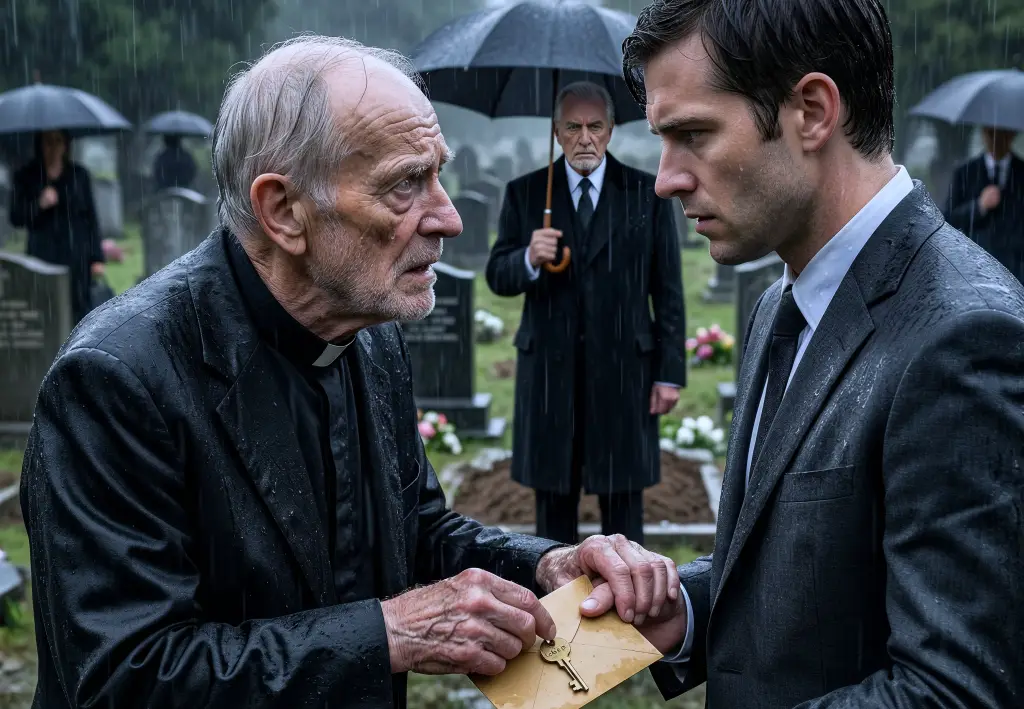
Father Joseph Schneider presided over the service. He was a frail man, somewhere near seventy, his vestments looking two sizes too large for his shrinking frame. As he read the final rites, his liver-spotted hands trembled against the leather-bound book. More unsettling, however, were his eyes. They kept darting through the curtain of rain, finding Max with a frantic, piercing intensity throughout the entire ceremony. It wasn’t the comforting, pastoral glance a priest typically offers his congregation. It was something entirely different. It was the desperate look of a man choking on guilt with nowhere left to put it.
As the service concluded and the mourners began to disperse across the sodden lawn, Father Schneider intercepted Max near the wrought-iron gates. He reached out, his fingers gripping Max’s wrist with surprising strength.
“She only ever called you Maxwell when something truly mattered,” the priest whispered, his voice barely rising above the downpour.
Before Max could process the strange opening, the old man pressed a small, slightly damp envelope and a stiff card into his palm.
“Your real birth certificate is inside,” Father Schneider said, his eyes darting nervously toward the line of idling cars. “Don’t open it here. And whatever you do, do not go home.”
Max looked down at the card. Cedar Hills Storage, Locker 9.
“Go tonight. Go alone,” the priest urged, his breathing shallow. “There’s more inside. Everything she couldn’t say while she was living.”
Right on cue, Max’s phone buzzed violently in his jacket pocket. He pulled it out, shielding the screen from the rain. It was a text message from Richard.
Don’t listen to anyone at the church. Come straight home. We need to talk.
Max stared at the glowing letters. He looked up at the priest’s pale, terrified face, and then down at the heavy envelope in his hand. He slipped the items deep into his inner pocket, offered Father Schneider a quiet nod of thanks, and walked out through the mud to his sedan.
He put the car in drive, pulled away from the cemetery, and completely ignored the route that led back to his stepfather’s house.
Cedar Hills Storage sat on the desolate east edge of town. It was a sprawling compound of gray, corrugated metal buildings and flickering sodium security lights that the management clearly had no motivation to fix. Max pulled up to the gate at exactly 11:15 PM. The night attendant, slouched inside the illuminated glass booth with headphones jammed in his ears, was entirely absorbed in whatever was playing on his phone screen. He hit the gate release button and waved the sedan through without ever looking up.
Max drove slowly down the narrow asphalt lanes, his headlights washing over the rusted roll-up doors, until he found Locker 9 at the dead end of the second row. A small brass key had been meticulously taped to the back of the card Father Schneider had given him. He peeled it off, slid it into the padlock, and turned it.
The lock clicked open. Max grabbed the handle and shoved the metal door upward. It rolled up its tracks with a deafening, metallic screech that echoed across the empty compound.
The air inside the unit was stale, smelling of dust and undisturbed time. In the center of the concrete floor sat a heavy black duffel bag, a cardboard box of documents tightly bound with red string, and a framed photograph carefully wrapped in thick brown paper.
He knelt on the cold floor and unwrapped the photograph first.