


Morning sunlight cascaded through the soaring glass walls of the airport terminal, washing the polished concourse in a brilliant, golden hue. The rhythmic, hollow clatter of rolling suitcases, the distant chime of boarding announcements, and the soft, overlapping hum of a thousand different conversations created an atmosphere of predictable routine. It was just another busy Tuesday morning.
Flight attendants in crisp uniforms navigated the crowds with practiced smiles, families huddled impatiently near check-in counters, and weary travelers formed meandering lines for overpriced coffee. Nobody sipping their espresso or checking their boarding pass could have possibly known that within the hour, this sanctuary of transit would become the stage for something the world would talk about for years.
I adjusted the heavy brass badge pinned to my uniform shirt and tightened my grip on the leather leash in my hand. As the head handler for the airport’s elite K-9 division, I was leading our unit through a routine security sweep of Gate Twelve. Beside me walked fourteen purebred German Shepherds, moving in absolute, unbroken formation. We were a wall of disciplined muscle and sharp instinct. These were not ordinary working dogs; they were the most rigorously trained detection canines in the country. Each dog in the unit possessed a highly refined specialty. Some were calibrated to sniff out chemical explosives, others to detect concealed narcotics, hidden electronics, or subtle crowd threats. But when we moved together, we operated as a single, breathing entity.
Rex, my lead dog, walked just a half-step ahead of my left knee. His amber eyes constantly scanned the sea of moving faces and clustered luggage, his senses processing the environment a thousand times faster than my own. Passing travelers frequently paused to admire the unit, lifting their phones to snap photos or pointing us out to wide-eyed children. I always allowed it, maintaining a professional but approachable demeanor. In an era dictated by heightened security and underlying public anxiety, I knew people found comfort in the sheer presence of the dogs. They were living, breathing symbols of protection.
The heavy silence of our patrol was broken by the sharp burst of static from my shoulder radio. “Unit Seven, maintain your sweep at Gate Twelve,” the dispatcher’s voice crackled, flat and strictly business. “Keep your formation tight. We have VIP movement scheduled in exactly thirty minutes.”
“Copy that, Control,” I replied smoothly, keeping my tone leveled. “Unit Seven holding the line.”
I had executed this exact patrol pattern hundreds of times over my career, but as we rounded the corner toward the boarding area, something subtle in Rex’s posture caught my attention. The shepherd’s pointed ears twitched backward, and his heavy stride faltered for a fraction of a second. His gaze broke away from the main concourse and anchored onto a quiet waiting area near the expansive windows. I followed his line of sight, scanning the immediate vicinity. I saw a weary janitor pushing a yellow mop bucket, a businessman typing aggressively on a laptop, and a small family sharing a pastry. There was nothing overtly out of place. I gave a gentle tug on the leather lead, assuming Rex had just caught the scent of an abandoned breakfast sandwich, and continued our patrol.
I was entirely unaware that my dog had already tasted something wrong in the air. Rex’s instincts were legendary within the department, a razor-sharp radar that never misfired. Today, however, that radar felt restless. The energy radiating through the leash into my palm felt like the quiet, electric static that builds right before a torrential storm.
I delivered a short, sharp whistle. Rex instantly snapped his attention forward, his spine straightening into a posture of perfect obedience. The surrounding passengers watched in hushed admiration as our unit swept past the terminal kiosks. Not a single person in that sunlit building—not even myself—could have predicted that before the morning was over, my flawless unit would outright defy every command I gave them, breaking rank to surround a tiny, terrified child in a desperate bid to save her life.
The morning rush continued its relentless pace around us. Echoing announcements called final boardings, children tugged relentlessly at their exhausted parents’ hands, and the world kept turning. But as we circled back toward the eastern edge of Gate Twelve, a solitary figure stood out against the chaotic blur of movement.
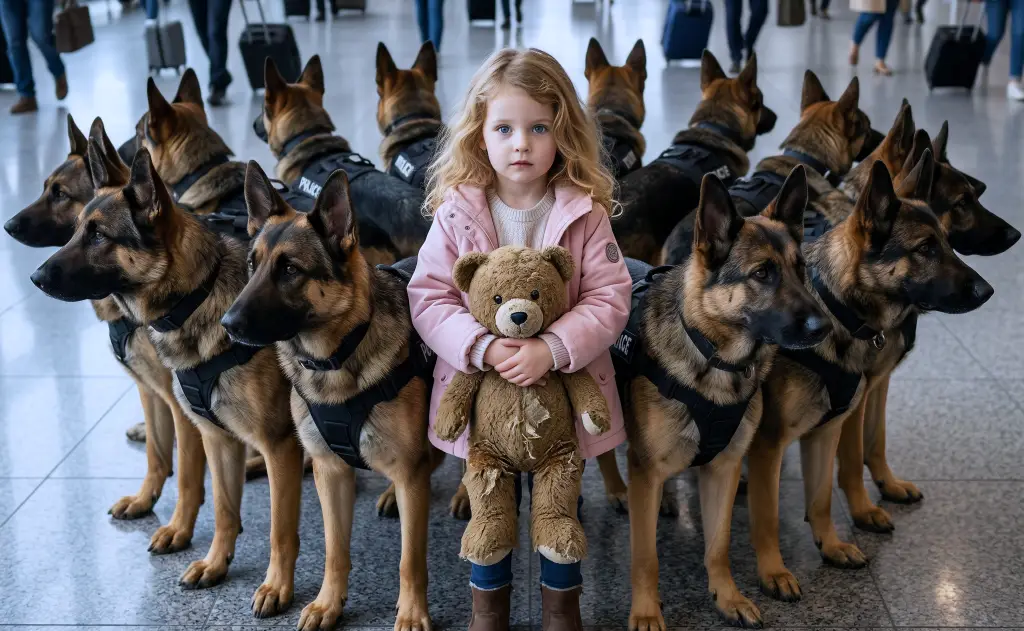
It was a little girl, certainly no older than four. She was standing entirely alone beside a towering luggage cart, dwarfed by the silver metal frame. She wore a soft pink jacket that seemed to catch the morning light, her blonde hair falling in messy waves around her pale face. She wasn’t crying. She wasn’t looking around for a parent. She was simply standing perfectly still, her small arms wrapped fiercely around a worn-out, threadbare stuffed bear. She gripped the toy with such intensity that her tiny knuckles were stark white.
I noticed her purely by accident, my eyes sweeping the perimeter as we concluded the boarding area check. There was something deeply unsettling about her stillness. It was a haunting, unnatural calm that did not belong to a child who had wandered away from her family in an international airport.
I slowed my pace and exchanged a hard glance with Officer Diaz, who was handling a massive shepherd named Thor just to my right.
“Did anyone see her come in?” I asked, keeping my voice low so as not to spook the child.
Diaz scanned the crowd and slowly shook his head. There were no frantic parents running down the concourse. No guardian calling out a name. She was an absolute ghost in the middle of a crowded terminal.
Before I could key my radio to alert terminal security, Rex abruptly stopped walking. The leash pulled taut in my hand. His ears snapped forward, rigidly at attention, and he turned his massive head entirely toward the blonde girl. His posture transformed in a heartbeat, shifting from a relaxed, alert patrol stance into an attitude of hyper-focused, cautious curiosity.
Behind me, I heard the faint clicking of claws on linoleum as the unit broke their perfect rhythm. One by one, the other thirteen German Shepherds mirrored Rex. Their noses lifted toward the high ceiling, taking short, rapid sniffs of the recirculated air, as if some invisible, volatile substance had just bled into the atmosphere.
My brow furrowed. “Easy, Rex,” I murmured, wrapping the leather leash twice around my wrist to secure my grip. But Rex wasn’t pulling, and he wasn’t acting aggressive. He was locked on. His dark eyes never wavered from the little girl in the pink jacket.
The surrounding travelers were beginning to notice the disruption. A few people pointed, murmuring to their companions. A teenager pulled out a smartphone, clearly assuming they were about to document a heartwarming community policing moment—a lost toddler being gently rescued by the handsome K-9 unit.
But the air in the concourse suddenly felt unbearably heavy. I approached the girl with slow, measured steps, deliberately lowering myself into a crouch to appear less intimidating.
“Hey there, sweetheart,” I said, keeping my voice soft and melodic. “Are you lost?”
The child did not blink. She didn’t offer a single word in response. She only hugged the battered stuffed bear tighter against her chest, looking down at me with wide, glassy blue eyes. They were the eyes of a child who was miles away, trapped in a daze.
“Do you know where your mommy or daddy is?” I tried again, offering a reassuring smile.
Nothing. The only sound was the incredibly faint, rhythmic clicking of the bear’s hard plastic button-eye hitting the zipper of her jacket as her tiny hands trembled against it.
Behind my back, the dogs began to shift anxiously. The scrape of their paws against the floor grew erratic. Then, Rex let out a low, vibrating growl from deep within his chest. It wasn’t an aggressive snarl; it was a pure, primal warning.
I turned my head slightly, my instincts flaring into high alert. A cold prickle of adrenaline washed over my shoulders. Something was terribly wrong here. If my fourteen highly trained, disciplined canines were losing their composure, I was walking blind into a nightmare.
The tension shattered a fraction of a second later.
Rex’s low warning growl violently escalated into a sharp, deafening bark that bounced off the glass walls like a gunshot. Instantly, all fourteen police dogs moved as one. They broke formation completely, dragging their handlers forward, their eyes dead-locked on the tiny girl.
Panic swept through the concourse like wildfire. Bystanders gasped and scattered, conversations dying instantly in their throats. People froze with their coffee cups suspended in mid-air, watching in absolute horror as a pack of massive police dogs formed a tight, deliberate circle around the solitary four-year-old.
“Hold positions!” I roared, my voice tearing through the sudden chaos as I fought against Rex’s weight.
But my command dissolved into the ether. For the first time in their lives, the dogs ignored us. They didn’t bare their teeth, and they didn’t lunge to attack. They simply stood their ground, their muscular bodies coiled tight, their heads lowered and tails straight. They were building an impenetrable, living wall around the child, as if some unseen, catastrophic danger was looming over her, and only they knew it was there.