


The sharp, concussive crack of aluminum striking cheap linoleum echoed like a gunshot. Half a heartbeat later, a man’s body hit the floor. His prosthetic leg twisted at a sickening angle beneath him. Standing over him, two teenagers wrapped in designer jackets erupted into laughter, the sound so violently loud and unrestrained that one of them had to grip the edge of a vinyl booth just to keep his balance.
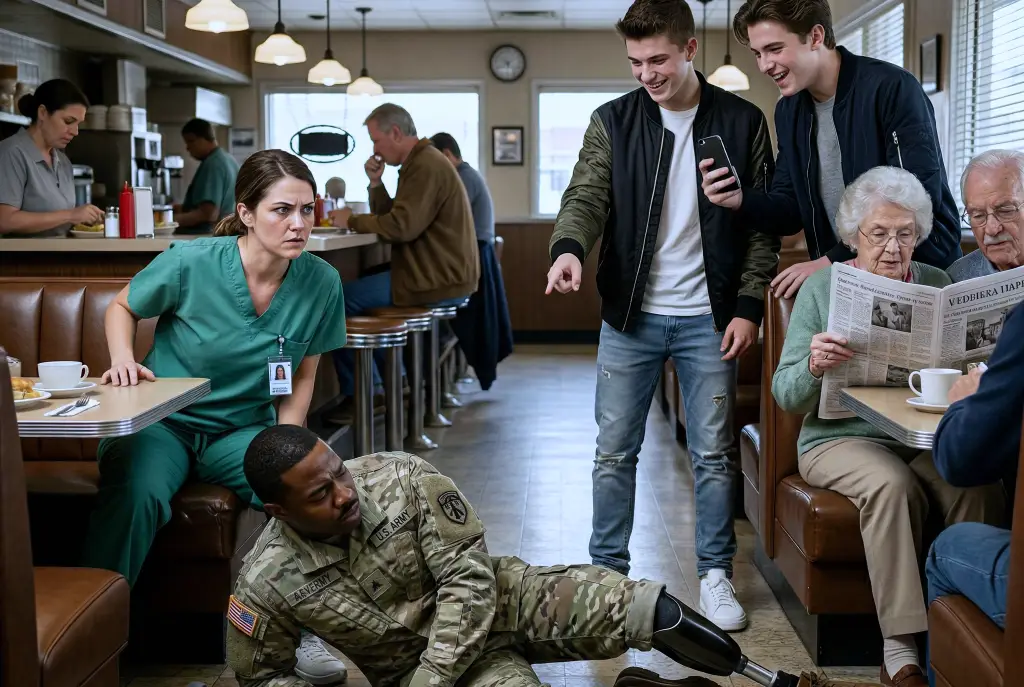
The morning rush at Riley’s Diner instantly flatlined.
Coffee cups froze halfway to open mouths. Cell phones slipped quietly back into coat pockets. Eyes darted downward, suddenly intensely interested in half-eaten eggs and hash browns. A disabled United States Marine lay sprawled across the center aisle of a crowded American diner, the target of two trust-fund heirs playing a cruel game of public humiliation, and the room did nothing. Not a single patron moved a muscle.
Except for the woman sitting in the dimmest corner booth, staring at a mug of black coffee that had gone ice-cold an hour ago.
Her green hospital scrubs were stiff, wearing the invisible grime of a two-day marathon. Her identification badge hung crookedly from her collar, reading Sarah Mitchell, RN. In a matter of seconds, she was going to make a choice that would systematically dismantle her career, drag her into the crosshairs of unimaginable wealth, and fundamentally alter the trajectory of her life.
She pushed herself up from the table. The entire diner seemed to hold its collective breath.
To understand the weight of that moment, you have to rewind to the beginning of that October Tuesday. Sarah Mitchell had been awake for exactly thirty-one consecutive hours when she first pushed through the glass doors of Riley’s Diner. The overhead fluorescent lights stabbed at the backs of her retinas. Despite walking three miles through a bitter autumn wind, the sterile, chemical stench of Greymont Memorial Hospital’s intensive care unit still clung to her skin, fighting a losing battle against the diner’s heavy aroma of burnt coffee and frying bacon.
Her shift had been a nightmare that left permanent scars on her psyche. Two of her patients had coded before midnight. She had spent an hour absorbing the verbal abuse of a terrified, grieving family furious over denied insurance claims, all while their father slipped away just six feet down the hall. Then, to cap it off, a brand-new medical resident had nearly contaminated a central venous line, an error Sarah had to physically intervene to prevent. She had navigated the chaos with the same absolute, unyielding discipline that had kept her breathing in Helmand Province. It was the same iron will that had carried her through the dust and blood of a convoy ambush that claimed the lives of three soldiers in her unit, and the same quiet endurance that got her through the medical discharge process, ending her Army career at the age of twenty-six.
Seeking sanctuary, Sarah slid into the very last booth by the front window, running her fingers over the strips of silver duct tape holding the cracked vinyl upholstery together. She ordered dry toast she had no intention of eating and coffee she knew she wouldn’t taste. Around her, the diner hummed with the comforting, oblivious rhythm of Tuesday morning. Heavyset construction workers inhaled massive plates of eggs before their job sites opened. A smattering of office employees hunched over their glowing screens. Two booths over, an elderly couple shared sections of a physical newspaper, a quiet ritual they looked to have maintained for forty years. It was a perfectly normal, safely forgettable morning.
Nine minutes later, Daniel Brooks walked through the door.
Sarah zeroed in on him immediately. It was an involuntary reflex, the way combat veterans recognize the calculated, hyper-vigilant rhythm of another soldier navigating a civilian space. He was a Black man, perhaps thirty years old, possessing broad shoulders that still naturally settled into the rigid posture of military attention, even as he carefully threaded his way through the cramped labyrinth of tables.
His crutches were standard military-issue aluminum, the gray rubber grips worn entirely smooth from relentless use. The right leg of his denim jeans was neatly pinned back just below the knee cap. It was a clean amputation, and judging by the careful, deliberate way he shifted his center of gravity, it was an above-the-knee loss. He wore a faded olive-drab Marine Corps t-shirt. It had been run through so many wash cycles that the iconic eagle, globe, and anchor emblem had surrendered its color, fading into a ghostly silver silhouette.
There was a profound, quiet exhaustion carved into the lines of his face. Sarah recognized it instantly, having seen the exact same hollowed-out expression staring back at her from her own bathroom mirror. It was the face of a man who had realized, through painful repetition, that asking the world for help exacted a far heavier toll than simply suffering in silence.
He navigated his way to the front counter without brushing against a single patron. He ordered a bowl of oatmeal and a black coffee, counting out the exact payment in crumpled bills and heavy coins from a battered leather wallet. Mike, the heavyset man working the counter, gave him a slow, silent nod. From her vantage point, Sarah couldn’t quite decipher if the gesture was rooted in genuine respect or quiet pity.
Daniel turned away from the register, his eyes sweeping the crowded diner. He was actively reading the room, employing that deeply ingrained situational awareness that never fully washes out of a combat veteran’s blood. He was looking for the path of least resistance, calculating the exact trajectory to an empty table where he wouldn’t be forced to squeeze past an occupied chair or apologize for his physical footprint.
That was the precise moment the two teenagers sauntered in.
They breached the diner doors as if they held the deed to the building and owned the oxygen inside it. They were eighteen or nineteen years old, draped in the kind of effortless, casual luxury that easily eclipsed Sarah’s entire monthly rent. The taller boy had artfully tousled blonde hair, held in place by some imported product, and wore an unzipped Burberry trench coat layered casually over a dark Princeton University hoodie. His shadow, a slightly shorter kid with dark hair, animated his speech with sweeping hand gestures, ensuring the heavy gold Rolex on his left wrist caught the diner’s fluorescent light with every movement.
They were loud. Not joyful, but aggressively, performatively loud—the distinct acoustic signature of the deeply insulated, projecting their voices to demand an audience.
Sarah narrowed her eyes, watching as the duo scanned the room with the predatory boredom of wealthy children desperately seeking entertainment. Their gazes swept past the broad-shouldered construction workers—too physically intimidating. They skipped over the elderly couple—too frail to be amusing. They dismissed the office workers as entirely too boring.
Then, their eyes locked onto Daniel.
He was temporarily paused in the center of the narrow aisle, shifting his weight on his crutches to give a harried waitress enough room to balance three heavy breakfast platters past him.
The blonde teenager aggressively elbowed his dark-haired friend in the ribs. A sharp, cruel smirk carved itself across his face.
A heavy, freezing knot materialized in the pit of Sarah’s stomach.
“Excuse me,” Daniel said, his voice a low, polite rumble as he tried to angle his shoulders to slip past the lingering waitress.
Operating with absolute coordination, the two boys drifted forward, planting themselves directly in the center of the narrow walkway. They mirrored the casual, relaxed posture of people who had simply stopped to chat, perfectly mimicking an accidental blockade.
“Oh, sorry, man,” the blonde boy drawled, though he didn’t shift his expensive boots a single fraction of an inch. “Didn’t see you there.”
His dark-haired companion let out a high, nasal snicker.
A muscle feathered in Daniel’s tight jaw, but he kept his tone completely even, stripped of any provocation. “If you could just step to the side—”
“What happened to your leg?” the dark-haired boy interrupted. He pitched his voice loud enough to slice through the ambient noise of the diner. Conversation at the surrounding tables immediately died. “Skateboarding accident?”
“Yeah, must have been a pretty gnarly wipeout,” the blonde chimed in, his eyes shining with a malicious, glittering joy. “Did you forget to buckle your helmet?”
The silence in the diner shifted. It morphed from casual quiet into the suffocating, toxic stillness of bystanders desperately hoping to remain invisible. The waitress practically flattened herself against a booth to squeeze past them, keeping her eyes rigidly fixed on her heavy plates.
Daniel stood perfectly still, balancing his weight on the aluminum struts. His face drained of all emotion, settling into a stony, neutral mask. It was a defense mechanism Sarah knew intimately. It was the absolute stillness of a man who had endured this exact humiliation a hundred times before. He was running a rapid internal calculus, measuring the cost of engaging versus the mathematical probability of squeezing past them without initiating a physical altercation.
“Move aside,” Daniel commanded. The polite request was gone, replaced by a flat, unyielding directive.
“Hey, we’re just asking a simple question,” the blonde boy fired back, throwing his hands up in a theatrical display of mock innocence. “It’s a free country, right? You fought for that, didn’t you? Freedom of speech?”
“Leave him alone,” a raspy voice muttered from a table near the back.
But the man who spoke didn’t stand up. He didn’t take a single step forward.
“Or what?” the dark-haired teenager snapped, spinning on his heel to glare at the corner. “You gonna waddle over here and do something about it, old man?”
The elderly patron immediately dropped his gaze back to his newspaper.
Daniel gritted his teeth and attempted to execute a tight pivot to step around their left flank. Instantly, the blonde boy shifted his footing, stepping precisely into the gap. It was a sick, choreographed waltz. Deliberate, targeted cruelty masquerading as clumsy coincidence. Every time the Marine shifted his weight to the left, the teenagers drifted left. When he attempted to pivot right, they casually mirrored him.
All the while, they kept their faces frozen in expressions of wide-eyed, innocent confusion, acting utterly baffled as to why this crippled man was having such a hard time walking.
“Maybe you should just call an Uber, man,” the dark-haired kid suggested, grinning broadly. “It’s probably a lot safer for you than trying to walk on your own.”
His blonde friend doubled over, barking out a harsh, performative laugh specifically engineered to degrade and humiliate.
Sitting in her booth, Sarah’s knuckles turned bone-white around her ceramic mug.
She had witnessed this exact psychological dynamic before, playing out in vastly different environments across the globe. It was the raw, unadulterated exercise of power for nothing more than the sheer thrill of it. It was the intoxicating high some human beings experienced when they realized they could inflict pain with absolute impunity. In the dusty heat of Helmand, it had looked like insurgent fighters taunting bound prisoners. In the sterile chill of the ICU, it looked like corporate insurance representatives coldly denying life-saving coverage while hiding behind a wall of bureaucratic plausible deniability.
The uniforms changed, but the monster was exactly the same.
Daniel’s face remained a masterclass in calculated indifference, but Sarah’s trained eyes caught the micro-expressions. She saw the rigid cords of tension pulling taut across his broad shoulders. She watched his knuckles drain of color, turning absolute white as his grip threatened to crush the rubber handles of his crutches.
He was balancing on a razor’s edge, a single heartbeat away from either exploding into violence or shattering entirely.
The teenagers knew it, too. They were actively banking on it. It was a predatory calculation: if the Marine finally snapped and caused a scene, they could instantly pivot, playing the role of innocent, terrified victims assaulted by a crazed veteran. If he simply absorbed the abuse in silence, they got to revel in the intoxicating power trip of the show. Either way, they won.
“I need to get past,” Daniel stated. The polite request had vanished, replaced by a cold, vibrating thread of steel. It was the distinct cadence of an officer issuing a direct command that he knew would be ignored, but was morally obligated to give anyway.
“So get past, man,” the blonde boy replied, offering a wide, vacant smile without shifting a single inch of his expensive footwear.
That was the moment Daniel made the decision to force the issue, attempting to push his way through the narrow, eight-inch gap between their shoulders.
It happened with devastating speed.
As Daniel moved, the blonde teenager executed a flawless piece of physical theater. He feigned a sudden, startled flinch, stepping backward and dropping his shoulder squarely into Daniel’s chest. It was a bump of meticulously calculated force. If Daniel had been standing on two biological legs, it would have been a minor stumble, an annoyance.
But on one leg and two aluminum struts, it was catastrophic.
The physics of his balance instantly collapsed. Daniel’s prosthetic leg twisted unnaturally on the slick linoleum. His center of gravity violently shifted the wrong way. He went down hard.
The heavy aluminum crutches flew outward, clattering across the floor in a chaotic spray of noise. Before his body hit the linoleum, his right shoulder slammed brutally against the sharp, reinforced edge of an adjacent dining table. The heavy, wet thud of his body hitting the ground acted like a vacuum, instantly sucking every ounce of oxygen and conversation out of the diner.
For three excruciating seconds, absolute paralysis gripped the room. Not a single person took a breath.
Then, the two teenagers erupted. It wasn’t a polite snicker or a nervous chuckle to break the tension; it was full-throated, theatrical, belly-deep laughter. They doubled over, practically weeping with manufactured joy, aggressively slapping each other on the back like they had just witnessed the punchline of the century.
The dark-haired boy immediately dug into his jacket pocket, whipping out his smartphone and aggressively tapping the screen to start recording. “Oh my god, bro, did you see that? The dude just tipped over like a cow!”
“Should we call a tow truck?” the blonde boy gasped, wiping a tear of mirth from his eye. “Help, I’ve fallen and I can’t get up! Someone hit the Life Alert!”
They were performing in high definition now, actively playing to a captive audience of bystanders who were desperately trying to look anywhere else. Out of the corner of her eye, Sarah saw a few other patrons sliding their phones out, but it was impossible to tell if they were documenting the harassment to help, or just pretending to be immersed in their screens to avoid making eye contact. The elderly woman in the booth nearby had fresh tears spilling over her wrinkled cheeks, but her husband kept a firm, trembling hand on her arm, keeping her pinned to the vinyl seat.
Behind the counter, Mike moved his heavy hand toward the landline phone, ostensibly to call the police. Yet, he moved with the agonizing, molasses-slow reluctance of a man who already knew that a patrol car wouldn’t arrive in time to make a damn bit of difference.
Daniel lay sprawled on his side. He had one large hand pressed firmly against his ribs where he had struck the table, his chest heaving. His other hand blindly stretched across the linoleum, desperately straining to reach the smooth handle of his fallen crutch. His face had flushed a deep, dark crimson. Sarah recognized the flush. It wasn’t the red of physical agony; it was the intense, burning fire of profound humiliation. It was the soul-crushing shame of a grown man, a trained warrior, being rendered entirely helpless in a public arena, reduced to nothing more than a cheap physical comedy act for the amusement of cruel children.
Sarah Mitchell had been subjected to extensive, brutal training in a multitude of disciplines. She knew how to push combat-strength adrenaline into a dying soldier’s heart under heavy artillery fire. She knew how to execute rapid medical triage in the dirt when she had ten bleeding bodies and only enough supplies to save three. She knew how to compartmentalize her own terror and maintain absolute, icy clarity when the entire world was screaming in chaos around her.
But the United States Army had never issued a field manual for this highly specific, suffocating moment. No instructor had ever taught her the exact mathematical formula to determine the precise second when remaining a silent witness morphed into active complicity.
She stood up.
The physical movement was smooth, quiet, and perfectly controlled, but in the absolute, frozen stillness of Riley’s Diner, it felt like an explosion. Every pair of eyes in the room, previously locked onto the floor or the ceiling, snapped directly to her.
The wrinkled green scrubs painted a clear, immediate picture for the two boys. Medical staff. Probably just off a marathon shift. Exhausted. Female. Not a physical threat. The teenagers glanced at her, processed her appearance, and dismissed her entirely in the span of a single second. To them, she was just a hundred-and-twenty-pound woman running on fumes, a minor distraction from their two-hundred-pound, trust-fund-fueled amusement.
Sarah ignored them. She walked toward Daniel with the exact same measured, unhurried cadence she utilized when approaching a critical patient in the trauma bay. No sudden movements. No frantic rushing. No hesitation.
She dropped to her knees beside him on the hard floor, ignoring the sharp protest of her overworked joints. She leaned in close, forcing him to meet her gaze. Up close, the raw, bleeding shame in his dark eyes was devastating. It was a psychological laceration far deeper and more dangerous than any physical trauma.
“Are you hurt?” Sarah asked. She pitched her voice low, creating a private, insulated bubble meant strictly for the two of them.
Daniel squeezed his eyes shut and gave a sharp, negative shake of his head. He clearly didn’t trust his vocal cords to hold steady.
“Anything broken?” she pressed, her eyes doing a rapid, clinical sweep of his body. “Ribs? Left wrist? Collarbone?”
“No,” Daniel finally managed to choke out, his voice thick with gravel. “Just… just embarrassed.”
“There is absolutely nothing for you to be embarrassed about,” Sarah said. She locked eyes with him, injecting absolute, unyielding sincerity into the words.
She smoothly collected his scattered crutches, running a quick, practiced eye over the aluminum shafts to ensure the structural integrity hadn’t been compromised by the fall, and placed them securely into his waiting hands.
“Oh, wow, how incredibly sweet,” the blonde teenager drawled from a few feet above them, his voice dripping with venomous sarcasm. “Are you his personal nurse? Make sure you check his diaper while you’re down there, sweetheart. He might need a changing.”
Sarah Mitchell stood up.
She rose slowly, uncoiling her spine. When she finally turned to face the two teenagers, something fundamental in her physical geometry had shifted. It wasn’t a posture of overt, screaming aggression, but the energy radiating from her was suddenly dense and terrifyingly still.
The two boys were far too arrogant, and far too insulated by a lifetime of wealth, to recognize the shift. But Sarah knew exactly what she looked like. She had seen that exact, hollow-eyed reflection staring back at her from the shattered side mirror of a Humvee after a three-hour firefight. She had seen it in the bloody reflection of the hospital glass after a brutal, losing shift in the ICU.
She looked like a woman who had completely, permanently run out of patience for the world’s bullshit.
“You need to leave,” Sarah stated. There was zero heat in her tone. No trembling rage, no elevated volume. It was delivered as a flat, immutable law of physics.
The dark-haired boy threw his head back and barked a laugh. “Or what, sweetheart? You gonna fight us? Two on one? How’s that fair to you?”
“Last chance,” Sarah said, her voice dropping an octave, settling into a cold, dead calm. “Walk away. Right now.”
“Yeah?” The blonde boy stepped forward, purposefully invading her personal space. He drew himself up to his full six-foot-two height, aggressively attempting to leverage his size to physically intimidate her. “What exactly are you gonna do about it, lady? Look at you. You look like you can barely keep your eyes open.”
He was entirely correct on that specific point. Sarah’s legs felt like lead pillars. Her lower back was a tight knot of screaming nerves. Every muscle fiber in her body felt as though it had been violently wrung out and hung up to dry. She had been awake and functioning for thirty-one hours straight, burning through every last reserve of adrenaline just to keep her patients breathing.
But thirty-one hours of sleep deprivation was an absolute joke compared to the crushing exhaustion of three combat deployments in the Middle East. And, more importantly, being tired did not equate to being helpless.
That was the exact moment the blonde teenager made the fatal error of his young life.
He reached out and wrapped his large hand firmly around Sarah’s left wrist. He didn’t squeeze hard enough to bruise the bone or snap the joint; he squeezed just hard enough to exert physical control. It was a classic, arrogant establishment of dominance. A physical reminder that he was larger, he was stronger, and she needed to learn her proper place in the hierarchy.
The grip lasted for exactly one and a half seconds.