


When I finally pushed open the front door of my childhood home, the silence that greeted me felt far heavier than the canvas duffel bag slung over my shoulder. I let the bag drop to the hardwood floor with a dull thud and placed my military cover on the kitchen counter. I had been due to rotate back stateside for months, yet nobody moved to close the distance.
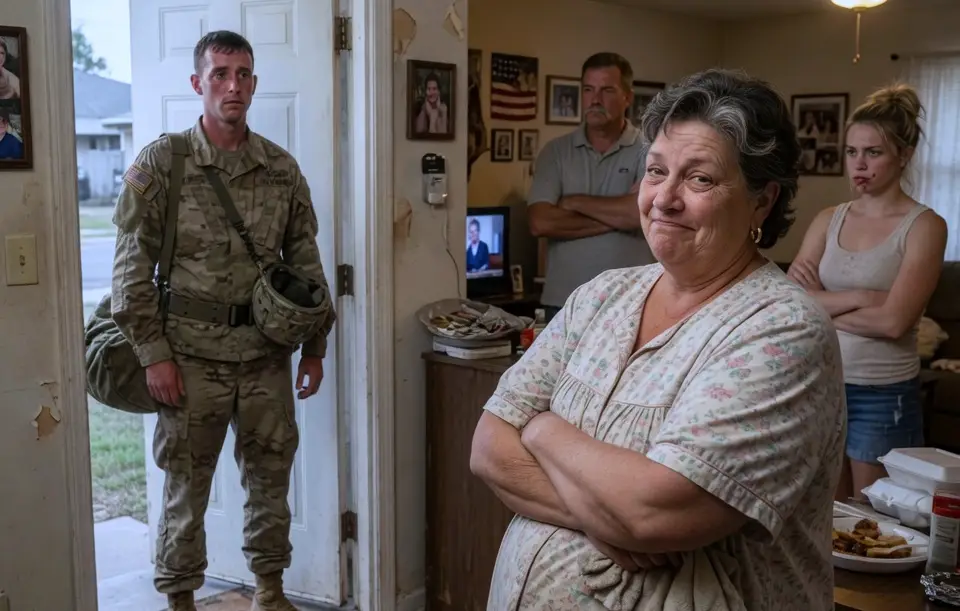
“You survived?”
The words slipped from my mother’s mouth, sharp and unvarnished. She took a sudden, staggering step backward, her hand blindly searching for the wooden door frame to steady herself. Beside her, my father gripped my younger sister’s hand with white-knuckled force. Cecilia’s face drained of all color, transforming into a pale, ghostly mask. I stood frozen in the entryway, locking eyes with each of my family members in turn, searching desperately for the warmth of a homecoming.
Instead, I found disappointment.
It was etched into the lines of their faces, clear as a cloudless sky. They had always looked at me as if I were the family regret, the stray dog they were forced to claim. I had foolishly hoped that my deployment, the medals, and the sacrifices would finally rewrite that narrative. In my jacket pocket sat the paperwork for a massive career promotion, accompanied by a staggering $300,000 bonus. I had rehearsed the reveal a hundred times on the flight home, imagining the exact moment their pity would morph into pride.
Before I could even reach into my pocket, my father cleared his throat and broke the silence.
“Son, maybe you should extend your deployment,” he suggested.
Suddenly, three heads tilted upward, their eyes locking onto me with a suffocating, breathless anticipation. They were waiting for me to agree, to turn around and walk right back into the line of fire. The betrayal was a physical ache in my chest. In a fraction of a second, the naive boy seeking his family’s approval died, and the hardened soldier took the wheel.
“I can’t,” I replied, keeping my voice deadpan.
I watched them closely, letting the silence stretch before delivering the killing blow.
“I was exposed to the burn pits during my tour. The doctors said it gave me a rare form of cancer. I only have eight months left to live.”
As soon as the lie left my lips, I studied their reactions with the predatory focus of a hawk. For a fleeting, microscopic second, I caught the undeniable sight of a smirk dancing across every single one of their faces.
“That’s so sad,” Cecilia blurted out. She dramatically buried her face in her hands, her shoulders shaking in a remarkably hollow performance of grief.
“They better provide good death benefits, at least,” my mother said. She stepped forward and gave my arm a rigid, obligatory rub. “I think they give $400,000 to grieving families.”
That night, the house settled into darkness, but sleep was the furthest thing from my mind. I lay perfectly still on the sagging living room couch, my breathing slow and rhythmic. From the glow of the kitchen, the muffled voices of my mother, my father, Cecilia, and her boyfriend, Pender, drifted down the hallway.
“His insurance pays out $400,000 when he goes,” my mother whispered, the greed practically vibrating in her throat.
“Pender, you can finally start your business,” Cecilia added, her tone light and airy.
“And Cecilia’s wedding will be fully funded,” Pender responded, the clinking of a glass punctuating his sentence.
Lying in the dark, I smiled silently at the ceiling. Over the years, I had heard dozens of horror stories in the military—tales of spouses draining bank accounts and relatives selling off assets the moment a soldier shipped out. I knew from hard experience that the absolute best revenge was not a screaming match. It was feeding directly into their delusions and giving them the rope to hang themselves.
Over the next few days, I played the role of a dying man with Oscar-worthy dedication. I would intentionally drag my feet, letting my shoulder check the hallway walls as if my balance was failing. I spent time in the bathroom coughing violently, ensuring I left a few tissues spotted with bitten-lip blood right at the top of the trash can.
The trap was fully set by the time Pender started casually complaining about his commute. He leaned against the kitchen counter, scrolling through his phone, and loudly mentioned how much he wanted a new truck.
I forced a deep, rattling wheeze from my lungs. “I wish I could help,” I rasped, gripping the edge of the table for fake support.
That was when my father’s eyes lit up with a sickening spark of inspiration.
“Actually, son, could you sign something for us?” he asked smoothly, pulling a manila folder from his briefcase. “It’s just standard family paperwork. Financial planning stuff.”
I let my hands tremble wildly as I took the pen, squinting at the pages and pretending my vision was far too weak to read the fine print. I knew exactly what it was. It was a $100,000 loan leveraged directly against my life insurance policy.
“Whatever helps the family, Dad,” I whispered, signing my name with a shaky scrawl.
What they didn’t realize as they eagerly snatched the folder back was that they had just committed a federal crime.
The real game began in earnest the afternoon Pender unexpectedly quit his job. The front door banged open, and he strutted into the house carrying a folded cardboard box overflowing with office supplies.
“Why work when we’re going to be rich in five months?” he announced to the empty hallway, completely unaware that I was sitting silently in the adjacent room.
I listened, perfectly still, as he recounted his dramatic exit to Cecilia, replaying his final phone call with his boss.
“I told that lazy jerk, you didn’t even bother checking my resume!” Pender bragged, tossing a stapler into the box. “I faked half my degree and my certifications, and they never even knew!”
“Pender, you’re terrible!” Cecilia fake-scolded, erupting into a fit of manic, high-pitched giggling.
A few nights later, we were all gathered around the dining room table. The air was thick with their quiet, buzzing anticipation of my demise. I pushed a piece of cold chicken around my plate, deciding it was the perfect moment to twist the knife.
“You know,” I said casually, my voice breaking the silence. “The doctor said something strange at my appointment today.”
Four forks paused in mid-air.
“My white blood cell count is actually improving,” I continued, offering a faint, hopeful smile. “He said the cancer might not be as aggressive as they originally thought.”
Cecilia’s fork slipped from her fingers, clattering violently against her porcelain plate.
“What?” she gasped. She quickly cleared her throat, forcing the corners of her mouth upward into a grotesque imitation of a smile. “I mean, doctors can be wrong. Let’s not get our hopes up too high.”
“Yeah,” Pender chimed in, leaning forward quickly. “False hope is a cruel thing, man. We should really just prepare for the worst.”
I nodded slowly, letting my eyes drift downward in feigned resignation. But in the back of my mind, I was miles away. I was thinking about the fact that I had already spent a portion of my $300,000 bonus. I thought about the sleek, midnight-black Mercedes AMG currently sitting in a climate-controlled storage facility, and the sprawling downtown penthouse I had already fully furnished with modern leather and steel. Every single day, while my family assumed I was wasting away at a chemotherapy clinic, I was out living my actual life.
For a brief, fleeting moment, the deception almost made me feel a pang of guilt. That is, until the funeral planning began.
My mother sat down at the kitchen table and pulled out a literal three-ring binder.
“We’ve picked your casket,” she announced, sliding a glossy brochure across the table. She pointed a manicured fingernail at the absolute cheapest, particle-board option on the page. “And Cecilia has agreed to give your eulogy.”
“We already told the funeral home that payment in full will come directly from the life insurance,” my father explained, pouring himself a cup of black coffee without meeting my eyes.
To fund their lavish pre-grieving lifestyle, my father had boldly cashed out his entire 401k. He had taken a brutal forty-percent penalty, completely losing the $80,000 he had painstakingly saved over thirty years of grinding work.
“Smart thinking, Dad,” I wheezed, covering my mouth.
Cecilia had taken the liberty of dropping out of college in the middle of her final semester. By walking away, she had forfeited her degree entirely, burning the $60,000 in tuition she had already paid.
My mother, not wanting to be left out, had prematurely broken the lease on their rental property. She now owed $15,000 in early termination penalties. She had proudly told her furious landlord to go ahead and sue her, screaming from the front porch that she was going to be filthy rich very soon.