


The winter sun hanging over Bozeman, Montana, has a deceptive quality to it. It spills across the snowdrifts in blinding, golden sheets, making the landscape look like a postcard, but if you step outside, that light does absolutely nothing to stop the cold from biting straight through your insulated jacket.
My name is Caleb. I am forty-five years old, and on that particular afternoon, I was just a man trying to get home. I had finished my regular volunteer shift at the local animal shelter hours ago. The heater in my truck was losing its battle against the sub-zero chill radiating from the windshield, and my mind was wonderfully, blissfully blank.
Then, I heard it. It cut through the rhythmic hum of the tires against the salted asphalt. It wasn’t a bark. It certainly wasn’t a whine. It was a fractured, pathetic little rasp, the sound of a creature trying to scream when its vocal cords had already frozen over.
I eased onto the shoulder, my boots crunching into the heavy snowbank as I stepped out. The wind immediately whipped tears into my eyes, forcing me to squint against the aggressive glare of the ice. Down in the drainage ditch, half-buried in a drift of dirty, roadside slush, lay a dark shape. My initial thought was that a garbage bag had blown off the back of a passing pickup. But as I trudged closer, the frozen plastic shifted.
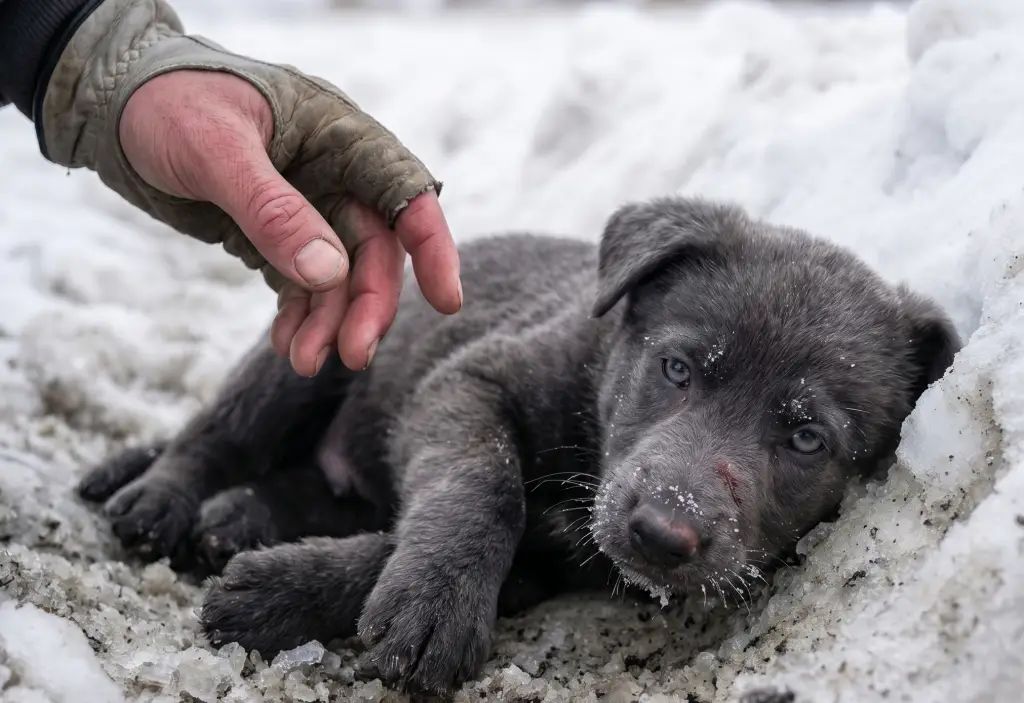
It was a puppy. He looked to be about eight weeks old, resembling a tiny German Shepherd with a coarse, dark gray coat that acted as perfect camouflage against the shadowed snow. Half of his little body was entirely submerged in the icy crust. His paws were splayed at unnatural, stiff angles, and his eyes held that dull, glassy emptiness that usually means the spark has already packed up and left.
His legs seemed comically large for his emaciated frame, and delicate crystals of frost clung tightly to his stiff whiskers. When I dropped to my knees beside him, soaking my jeans in the snow, he made a valiant, agonizing attempt to lift his front paw. He couldn’t even manage an inch before his strength evaporated entirely.
His chest was perfectly still. You do not need a veterinary degree or a thermometer to recognize when a two-month-old animal has only minutes left. I slipped my bare hands beneath his belly, trying to be as gentle as the frantic moment allowed. Lifting him was horrifying. He felt exactly like hauling a soaked, freezing towel out of a basin—heavy, waterlogged, and alarmingly limp.
Without a second thought, I unzipped my heavy coat and shoved him directly against my sweater, pressing his icy skin flush against my chest in a desperate bid to transfer my own core heat. That was when it happened.
Pressed against my ribs, that rigid, freezing bundle pulled in a jagged breath. He released a muted, cracked little howl, a devastating sound that felt like a plea to a mother who was never coming back.
By the time my truck slid into my driveway on the rural outskirts of Bozeman, I had lost all sensation in my fingertips. I didn’t care. My entire universe had narrowed down to the fragile, icy weight tucked inside my jacket. I shoved the truck door open with my shoulder, kicked off my snow-caked boots in the entryway, and bypassed the living room entirely, heading straight for the kitchen linoleum.
Years of muscle memory from fostering countless shelter dogs took over before my brain could even formulate a plan. I dragged an old, faded quilt from the hall closet and dropped it on the floor. I yanked the space heater from the pantry, plugging it in and cranking the dial to its maximum setting. Meanwhile, a pot of water was already rattling on the stove for a makeshift heating pad.
I carefully unwrapped him and laid him on the quilt. Under the harsh fluorescent light of the kitchen, I finally got a good look at him. He was just a baby. His dark gray fur was horribly matted with tiny globes of ice, and the very tips of his ears felt brittle, like dried leaves. When I ran my hands over his ribs, his skin felt paper-thin, offering absolutely no resistance.
I touched his paws, waiting for the instinctual flinch of a frightened stray. He didn’t pull away. He didn’t have the energy. I wrapped a hot water bottle in a thick bath towel and slowly wedged it against his belly, tucking another edge beneath his chest, terrified of burning his delicate skin.
For the longest time, nothing happened.
Then, his spine jerked. It was a sudden, violent twitch, as if his nervous system was finally waking up and realizing how much pain it was in. I rushed to the counter, watered down a can of low-sodium chicken broth, and heated it until it was just barely above lukewarm. I knelt on the floor, holding the ceramic bowl directly under his chin.
His nose twitched. He blinked, the glassy film fading just a fraction, and his pink tongue darted out. He took three, maybe four clumsy, desperate laps of the broth. That was it. He was utterly spent.