


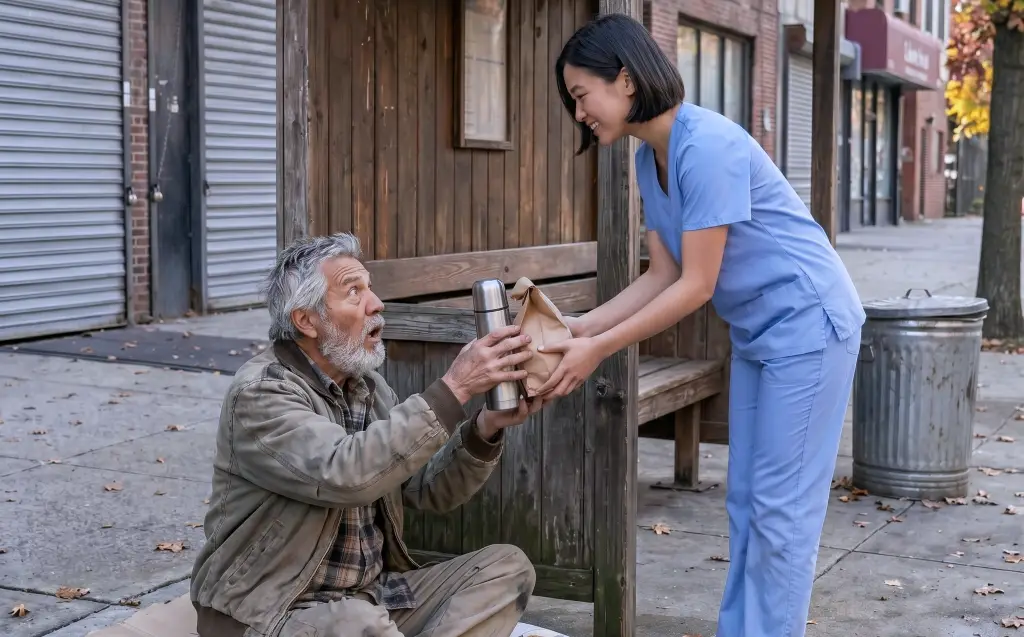
For a solid six months, my mornings operated on a rhythm dictated by a peanut butter sandwich and a piece of fruit. Usually a banana. Sometimes an apple. It was a simple offering, paired with a dented thermos full of black coffee, delivered at exactly a quarter past six to a man who slept at a bus stop. I was twenty-two years old, a young Black woman running on fumes, juggling two soul-crushing jobs just to keep a deteriorating roof over my head. He was sixty-eight, a white man weathered by the streets, a phantom who told impossible stories that nobody in their right mind believed.
Then came the dawn that shattered the routine. The knock on my apartment door was sharp, heavy, and completely out of place for the fourth floor of my rundown building. It was early, the sun barely scraping the horizon. I was still wearing my stained hospital cafeteria uniform, my bones practically vibrating from the exhaustion of a brutal double shift.
When I turned the deadbolt and pulled the door open, my stomach dropped into my worn-out sneakers. Three military officers stood in the dim, flickering fluorescent light of the hallway. They wore crisp, immaculate dress uniforms, a jarring contrast to my peeling doorframe. A colonel, his posture rigid and commanding, stood at attention.
“Miss Cooper,” the colonel said, his voice carrying an undeniable weight. “We are here about George Fletcher.”
George. The old man from the bus stop. The name caught in my dry throat. “Did something happen to him?” I asked, my fingers gripping the edge of the door so hard my knuckles ached.
The colonel’s face remained carved from stone, entirely grave. “Ma’am, we need to talk about what you did for him.”
To understand how I ended up staring down a military colonel at dawn, you had to go back six months to late March, the first time I actually let myself see George. Before then, he was just part of the urban landscape. I caught the number forty-seven bus every morning at half past six. The stop was a miserable three blocks from my apartment, situated right on the cracked concrete outside a shuttered laundromat that always smelled faintly of stale detergent and damp rot.
That specific patch of concrete was George’s bedroom. He slept on a flattened, corrugated cardboard box, a frayed wool blanket pulled tightly up to his bearded chin. His entire life was crammed into a heavy-duty black trash bag sitting faithfully at his side. Most commuters treated him like an invisible obstacle, their eyes fixed firmly on their phones as they hurried past. A few would deliberately cross the street, their hurried footsteps echoing their discomfort. For two solid weeks, I had been one of the cowards. I kept my head down, telling myself the lie that poverty demands: I didn’t have enough to help someone else because I barely had enough to survive.
But the freezing morning of late March forced my hand. I had aggressively packed an extra peanut butter sandwich for my lunch, only to realize my schedule was a suffocating trap. My shift at the hospital cafeteria dragged on until three in the afternoon, and by four, I had to be clocked in at the local grocery store, stocking heavy shelves until midnight. That sandwich was destined to sit in a lukewarm metal locker and spoil.
As I approached the bus stop, shivering in the dawn chill, George was already awake. His eyes caught the streetlights, sharp and astonishingly clear, lacking the hazy glaze I expected. He watched my approach with a guarded stillness, the posture of a man accustomed to being either entirely ignored or viciously yelled at to move along.
“Excuse me,” I said, my voice sounding incredibly small over the distant hum of traffic. I held out the plastic-wrapped sandwich. “I made too much this morning. Do you want this?”
He didn’t reach for it immediately. He looked at the crushed bread, then slowly lifted his gaze to study my face. The silence stretched, heavy and profound.
“You need that more than I do,” he said quietly, his voice a dry rasp that carried a strange, quiet dignity.
“That is highly debatable,” I countered, shifting my weight against the cold. “But I am offering.”
He finally reached out, taking the sandwich with both of his weathered, scarred hands as if I were handing him a brick of solid gold. “Thank you, miss.”
“Aaliyah,” I corrected him.
“George,” he replied, giving a single, solemn nod. “George Fletcher.”
I almost walked away right then. I almost retreated into the safety of my chaotic, overwhelming life, telling myself I had done my good deed for the year. But something tethered me to that spot. It was the way he had thanked me—devoid of the desperate, cloying tone I had braced myself for. It was pure, unadulterated dignity.
“Do you take your coffee black or with sugar?” I heard myself ask, surprised by my own words.
Thick, gray eyebrows lifted in mild surprise. “Black is just fine.”
The very next morning, I showed up with a steaming thermos of black coffee and a bright yellow banana. The morning after that, it was another sandwich and a crisp apple. Before the first week had bled into the second, it wasn’t just a charitable impulse; it was a deeply ingrained routine I could not imagine breaking. Every single day at six-fifteen, George was awake, sitting on his cardboard throne, waiting. We would talk for five, maybe ten minutes in the biting cold before the hydraulic hiss of the forty-seven bus announced my departure.
He was genuinely curious about my life. I told him about the nursing courses I squeezed in at the community college two nights a week, whenever my bank account allowed the tuition. In return, I asked about his days, and that was when the strange stories would pour out.