


The biting winter wind off the Ohio interstate had a way of seeping straight into your bones, but it was nothing compared to the chill of pulling up to the house I grew up in. Every evening, the driveway was a concrete monument to my place in the family hierarchy. My older brother Tyler’s massive, mud-splattered truck always sat dead center, claiming the prime real estate under the motion-sensor floodlight. If my younger sister Casey was home from her shift at the tanning salon, her leased sedan occupied the remaining pavement.
I was left to parallel park on the street, wedging my aging compact car against the icy curb. Guests got the driveway. I got the street. I was twenty-seven years old, a mother to a four-year-old girl named Birdie, and I was paying fourteen hundred dollars a month for the privilege of being treated like a vagrant in my parents’ home.
That staggering sum didn’t cover a designated parking spot. It didn’t cover a share of the groceries, nor a fraction of the utilities. For fourteen hundred dollars, my daughter and I were permitted to share a single, sagging full-size mattress in my childhood bedroom. Every night, Birdie would thrash in her sleep, her tiny heels digging into my ribs as if she were pedaling a bicycle up a steep hill, while I lay awake staring at the glow-in-the-dark stars I had pasted to the ceiling when I was nine.
At the time, I was employed as a housekeeper at a Hampton Inn just off the highway in Dayton. It was backbreaking, invisible work. I spent eight hours a day stripping heavy linens, scrubbing strangers’ grout, and breathing in the harsh, stinging fumes of industrial bleach. I earned exactly twelve dollars and sixty cents an hour. By the time the state and federal taxes took their bite, my monthly take-home pay hovered right around sixteen hundred dollars.
Once I handed over my exorbitant rent to my mother, Denise, I was left with two hundred dollars. Two hundred dollars to keep gas in my tank, to clothe a growing toddler, and to somehow feed the two of us. It was a suffocating, terrifying math that kept my heart racing at a permanent, low-grade panic.
The most bitter pill to swallow wasn’t even the money itself. It was the glaring, unapologetic hypocrisy living under the same roof. Tyler, thirty-one years old, resided in the finished basement. He had a sprawling space with his own private bathroom, a massive television, and a leather sectional. He bartended three nights a week and spent his remaining waking hours shouting into a headset while playing video games. He paid nothing.
Casey, at twenty-three, occupied her old room at the end of the hall, the one with the beautiful bay window and the walk-in closet overflowing with fast fashion. She worked twenty hours a week and spent her earnings on iced coffees and acrylic nails. She paid nothing.
I made the mistake of bringing this up to my mother exactly once. I had asked her, my voice trembling with exhaustion, why I was the only child bankrolling the household. Denise stopped wiping the granite island, looked at me as if I had just asked why the sky was blue, and let out a long, theatrical sigh.
“Because you have a child, Jolene,” she said, her tone dripping with a practiced condescension. “You are using significantly more resources.”
More resources. My four-year-old daughter, whose diet consisted largely of generic brand chicken nuggets, sliced apples, and tap water, was apparently a catastrophic drain on the family estate. My father, Hank, was present for this conversation. He sat rooted to his oversized recliner, his eyes glued to an ESPN broadcast, completely mute. He allowed my mother to run the household like a ruthless feudal lord, perfectly content to avoid the crossfire.
And Denise ran her kingdom with an iron fist wrapped in a velvet glove of maternal martyrdom. Everything she offered was framed as an astonishing act of charity. Allowing me to occupy my own childhood bedroom was presented as a favor so magnificent I ought to have been kissing the hem of her cardigan. But the fourteen hundred dollars was apparently just the baseline.
As winter deepened, she began dropping heavy, calculated hints that my financial burden might be eased if I simply pitched in a little more around the house. The word ‘might’ was her favorite weapon. She wielded it like a corporate lawyer holding a loophole.
Desperate for even a fifty-dollar reprieve, I took the bait. After spending all day cleaning seventy-five-dollar-a-night hotel rooms, I would come home and start my second shift. I wiped down the kitchen counters until they gleamed. I dragged the heavy upright vacuum across the living room carpet. I laundered Tyler’s sweat-soaked gym clothes, Casey’s polyester work polos, and my father’s endless rotation of khaki pants. On weekends, I knelt on the bathroom tiles, scrubbing away my siblings’ grime.
My knuckles were perpetually split and raw from the harsh chemicals and constant hot water. Birdie, sweet and oblivious to the quiet tragedy of our circumstances, would gently place little Disney princess bandages over my cracked skin, her small brow furrowed in deep concentration as if she were performing critical triage. Her soft little hands were the only anchor keeping me from floating away into total despair.
Things began to fracture on a bleak Thursday evening in late February. The Ohio sky had been spitting a miserable, freezing sleet all day. I had worked a grueling double shift because a coworker called out sick, racing across town afterward to pick Birdie up from the home daycare I could barely afford. When I finally pushed through the front door, my shoulders aching and my feet entirely numb, the rich, savory smell of pot roast hit me.
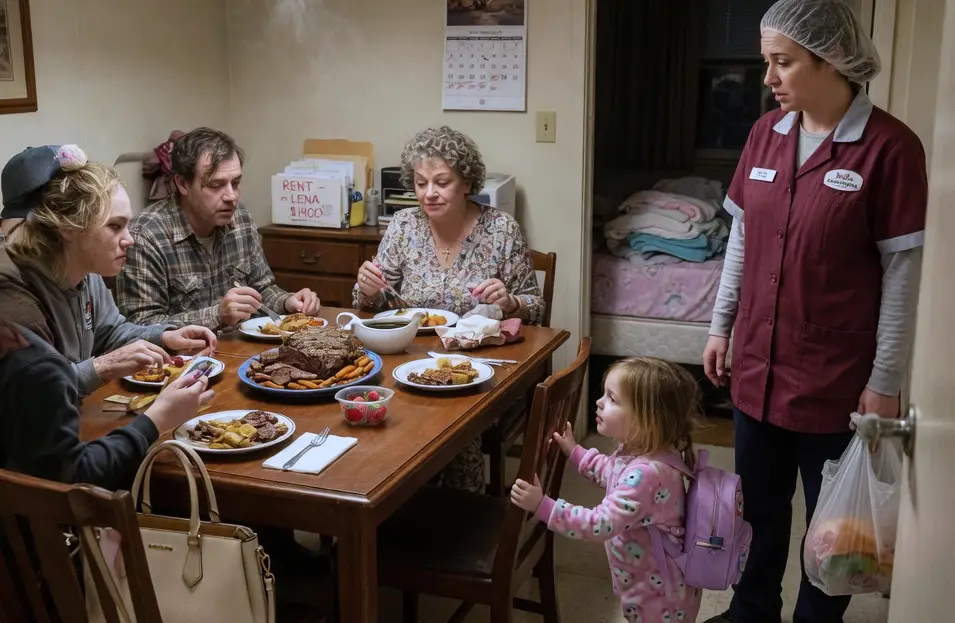
I walked into the dining room, shedding my wet coat, and found the entire family seated around the mahogany table. My mother, father, Tyler, and Casey were happily passing a platter of roasted carrots and potatoes.
I glanced around the table. There was no plate set for me. There was no tiny plastic cup set for Birdie.
Denise barely looked up from her meal. “Oh, there’s leftovers on the stove if you want to fix yourself something,” she murmured casually, taking a slow sip of her wine.
I set Birdie down, and my little girl immediately toddled toward the table. She was four years old, she was hungry, and she saw her family eating. She reached her small hands up, trying to scale the rungs of the only empty dining chair.
Casey reached out and gently but firmly blocked my daughter’s path. “Oh, careful,” my sister said, her voice entirely devoid of malice but full of profound ignorance. “That’s actually where my bag is.”
I looked at the chair. Casey’s designer leather purse was sitting comfortably on the upholstered cushion. The bag had a designated seat at the family dinner table. My daughter did not.