


The crystal chandeliers of the Fairmont San Francisco seemed to vibrate with the sudden, suffocating silence that had fallen over the grand ballroom. Eleanor sat immobilized in her customized wheelchair, the intricate beading of her midnight-blue gown catching the light. Across the expanse of polished parquet flooring, her husband of twelve years stood bathed in the warm glow of the spotlight. Victor casually draped his arm around the waist of a younger woman, her champagne-colored silk dress clinging to the undeniable, heavy curve of a late-term pregnancy. Around them, two hundred of the city’s most influential elite held their collective breath.
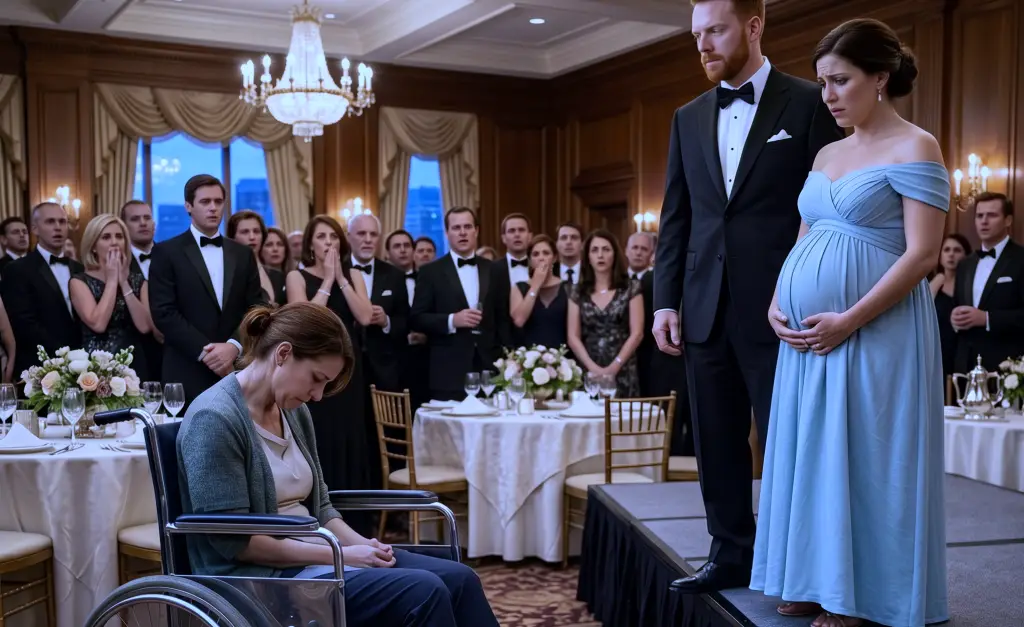
“I want to introduce you all to Olivia,” Victor announced. His baritone voice, the same voice that had charmed zoning boards and billionaire investors for over a decade, beamed with an intoxicating pride. “Not just as the brilliant new creative director for our company, but as the mother of my child. She is the future I have always dreamed of.”
The blinding pop of a camera flash shattered the quiet. Victor looked directly across the room at Eleanor. The expression resting on his handsome face was a meticulously curated, chilling cocktail of profound pity and absolute contempt.
“Sometimes,” he continued, smoothly raising a crystal flute of champagne toward the vaulted ceiling, “life gives us a miraculous second chance at happiness.”
Tears pricked the corners of Eleanor’s eyes, a hot, involuntary reaction to the public slaughter of her dignity. But then, something entirely unscripted happened. The tears did not fall. Instead, the corners of Eleanor’s mouth lifted. She smiled. It was a slow, deliberate expression of pure, terrifying clarity, and from fifty feet away, she saw the exact moment that smile sent a visible shiver down Victor’s spine.
To understand the architecture of that smile, one had to trace the cracks in the foundation back three years.
Before the betrayals, Eleanor and Victor Miller were the undisputed titans of the San Francisco architectural scene. Their residence, a stunning modernist glass house perched high in the Berkeley Hills, offered sweeping, unobstructed views of the Bay. It was a flawless physical manifestation of their synergistic success. Victor was the charismatic dealmaker, the handsome face that graced the covers of business magazines. Eleanor was the quiet, relentless genius. She was the visionary whose award-winning, sustainable designs were actively redrawing the city’s skyline.
They had been an impenetrable unit. As Diane, one of Eleanor’s oldest colleagues, used to marvel, Victor possessed the rare alchemy to sell Eleanor’s grandest visions, while Eleanor possessed the sheer intellect to build the exact reality Victor promised.
Then came a dismal, rain-swept Tuesday in November.
The catastrophe at the Embarcadero Piers construction site defied all logic. Eleanor was notoriously, almost ruthlessly obsessive regarding site safety. Yet, as she conducted a routine inspection of the fourteenth floor of their flagship residential project, a temporary metal platform gave way beneath her boots. The sickening free-fall lasted only seconds, but the impact upon the concrete below permanently shattered her lower spine.
“In those first chaotic weeks in the trauma ward, we frankly weren’t sure if she would ever walk again,” Dr. Rosario, the lead neurologist, had gently explained to the press.
Eleanor endured three agonizing spinal surgeries and months of grueling, tear-soaked physical rehabilitation. Eventually, she learned to navigate short distances with the aid of a walker, but the reality of her daily existence tethered her to a wheelchair. Her previously frantic schedule of hard-hat site visits and marathon design charrettes evaporated, replaced by the sterile routine of physical therapy sessions and clinical evaluations.
And Victor, the man who had stood at an altar and promised to weather any storm by her side, began to drift. It was imperceptible at first—a lingering glance at his watch, a sudden need to take a call in the other room—but the emotional erosion had begun.
To the outside world, Victor Miller played the role of the tragic, devoted saint to perfection. He spared no expense, hiring elite specialists and extensively retrofitting their multi-level home with ramps and a sleek residential elevator. At high-profile charity galas, he commanded the podium with moisture in his eyes.
“My wife has shown incredible courage,” he would murmur into the microphone, his hand resting with a heavy, possessive weight on Eleanor’s shoulder. “Her resilience inspires me every single day.”
Behind the heavy oak doors of their home, however, a vastly different reality had taken root. Conversations grew clipped and strictly logistical. Dinners were eaten in the echoing silence of their dining room, or increasingly, missed entirely due to Victor’s sudden, demanding late-night meetings. A thick, unspoken resentment had settled over their marriage like dust.
This yawning emotional chasm was palpable at the annual Golden Gate Foundation charity dinner. Warm, golden light spilled from the chandeliers over San Francisco’s high society. Eleanor sat quietly near the perimeter of the grand ballroom, her wheelchair strategically parked behind a massive arrangement of white orchids. From her shadowy vantage point, she observed Victor working the room. At forty-two, he possessed a striking, silver-fox magnetism, his custom-tailored tuxedo fitting his broad shoulders flawlessly. He glided between clusters of wealth and influence, dispensing effortless laughter and securing million-dollar handshakes.
“He certainly knows how to work a room, doesn’t he?” murmured an older, heavily jeweled woman who had taken the seat beside Eleanor. “Your husband has the mayor eating right out of his hand.”