


The winter morning in the far north of the United States possessed a clarity so absolute, it was almost painful to witness. Snow blanketed the mountain slopes in an unbroken, blinding sheet, catching the anemic sunlight and fracturing it like shattered glass across the pines. The air was not merely cold; it was surgical. It slipped into my lungs and settled deep in my chest, a quiet, stinging reminder that survival out here was a privilege, never a guarantee.
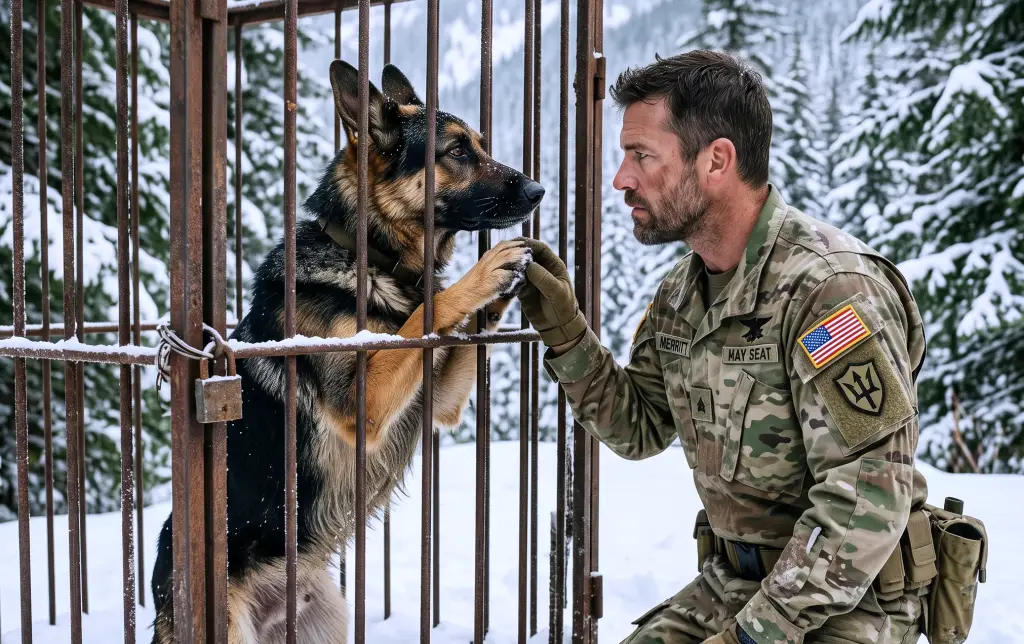
I kept my hands steady on the wheel as my truck crawled up the forest service road. At forty, I’ve found that discipline isn’t something you switch on and off. It settles deep into your marrow and simply stays. I had trained for years to carry my strength quietly, to be ready rather than to look formidable. But my history was written in the way I held myself: my dark hair kept in a strict, neat undercut despite my isolated life, my broad shoulders filling out a close-fitting camouflage top, and the familiar weight of a tactical belt sitting naturally at my waist. My blue-gray eyes swept the tree lines and snowbanks out of pure instinct, a habit of vigilance forged long before I ever drove this lonely stretch of mountain.
I hadn’t come up to the ridge for the scenery. The night before, Sheriff Nolan Briggs had called my cabin. His voice had sounded gravelly, heavy with the specific kind of exhaustion that comes from policing people you know. Nolan was a stocky, grounded man in his mid-fifties, his hair graying at the temples, possessing a practical, deep-rooted integrity that carried far more weight than the badge pinned to his chest. He had asked if I would drive up and take a look at a remote stretch of the woods. Locals had been calling in reports of off-rhythm chainsaws echoing down the valley—the erratic, hurried sounds of illegal logging crews, not the steady hum of sanctioned timber work.
Nolan trusted me with the quiet things because I didn’t exaggerate, and I didn’t fill silences with unnecessary talk. I had agreed to his request without a second thought. My life near the small town of Pineville was intentionally quiet. I kept to my own acreage and avoided messy entanglements, but my past had never taught me how to walk away from a wrong sound in the woods.
As the road climbed higher in elevation, the dense, crowding pines began to thin out, surrendering the landscape to exposed, jagged rock and wind-scoured drifts of snow. I instinctively eased off the accelerator. The hairs on the back of my neck prickled, alerting me to something distinctly out of place long before my conscious mind could name it.
Then, I saw it.
Just beyond the ragged edge of the tree line, where the mountain leveled out into a narrow, unforgiving ridge, a structure broke the natural silhouette of the woods. It was an iron cage, elevated off the frozen earth on rough, splintered wooden supports. A thick layer of frost rimed its metal bars, gleaming cruelly in the daylight. Whoever had built it had bolted the corners together with heavy, rusted wire, securing the door with a heavily corroded padlock.
A thin, crude metal pipe protruded from one corner of the enclosure, trailing a pathetic, gossamer thread of gray smoke that drifted uselessly into the vast, freezing air. The entire setup radiated a deliberate, painstaking effort. It was constructed with a careful malice, designed specifically to prolong suffering rather than end it quickly. I shifted the truck into park, killed the engine, and stepped out into the biting wind. The crunch of packed snow beneath my heavy boots sounded obscenely loud in the absolute silence.
The cold sank its teeth into my skin the moment I left the heated cab, but my breathing remained perfectly even. I approached the cage with slow, measured steps, my right hand hovering instinctively near my tactical belt, even though the only visible enemy was the plummeting temperature.
Inside the steel trap stood a German Shepherd. He was a fully grown, magnificent animal, possessing a large, powerfully built frame that commanded respect even in his severely weakened state. Snow and ice clung stubbornly to his thick black and tan coat, matting heavily along the dark, pronounced saddle of his back. His ears were held rigidly upright, though I could see them trembling from the deep, systemic chill.
As I drew closer, his striking amber eyes locked onto mine, tracking my every movement with a piercing, unwavering focus. There was no wild panic in his gaze, nor was there any begging. It was the deeply intelligent, highly assessing look of a creature that had been forced to adopt extreme vigilance as his only means of survival.
He held one of his front legs slightly elevated, favoring the frozen ground and refusing to bear his full weight on it. The subtle, awkward angle of his posture spoke volumes about an old, traumatic injury that had never been given the grace of a doctor’s care. But what struck me the hardest was the silence. He did not bark. He did not whine. That quiet endurance, more than the cage itself, told me everything I needed to know. This was no tragic accident.
I stepped up to the frozen bars and absorbed the grim, telling details of his prison. A battered metal water bowl sat overturned and solidly frozen to the grated floor. Beside it, shallow, frantic scrape marks scarred the ice where heavy claws had desperately tried to dig an escape route. Beneath the thick ruff of his fur, I noticed a faint, terrible groove worn permanently into the skin of his neck—the undeniable signature of a collar or tether that had been pulled tight for far too many years.
This was not a case of sudden panic or a pet left behind by a careless owner. This was an execution. Someone had dragged this magnificent animal up a lonely mountain, fully aware of what the plunging temperatures would do to a living body. They hadn’t brought a gun because they were too cowardly to leave blood in the snow. They had outsourced their cruelty, assigning the silent, thorough violence of winter to do their dirty work.
I slowly dropped to one knee, bringing myself down to his eye level. Up close, the devastation was heartbreaking. His broad chest was rising and falling in shallow, rapid staccatos, his breath puffing out in small white clouds. Every muscle in his body was pulled bowstring-tight, as if he were holding his failing organs together by sheer, stubborn willpower.
Yet, his expression remained unbroken. He was weighing me, calculating whether this stranger clad in camouflage was just another terrifying variable in the long pattern of abuse that had brought him to this cage, or if I represented a break in that nightmare. I extended my hand toward the icy bars, keeping my palm open and entirely visible.
“Easy,” I murmured. I kept my voice low, steady, and rich with calm—the exact tone I relied on when approaching traumatized things that might still decide to fight for their lives.
He leaned his heavy head forward, drinking in my scent through the rusted metal. After a long, suspended moment, he took a single, agonizingly cautious step toward me, his heavy nails clicking faintly against the frozen steel.
It took me less than sixty seconds to defeat the rusted padlock. I pulled a compact breaching tool from my belt, my hands operating with muscle-memory efficiency despite the numbing wind. When the heavy iron door finally groaned open, the Shepherd hesitated. His muscles coiled tight under his coat. It was as if the very concept of freedom had been beaten out of him, becoming something vast and terrifying.
Then, with an agonizingly slow, deliberate grace, he stepped out onto the snow. Without the cage to visually support him, the sheer, crushing weight of his physical exhaustion became immediately apparent. He swayed, his injured leg trembling violently.
Without thinking, I stripped off my heavy camouflage outer layer, ignoring the sudden bite of the wind against my undershirt. I draped the thick, insulated fabric over his broad back, feeling a violent, uncontrollable shivering racking his frame. I slid my arms securely beneath him and lifted him from the snow.
The physical contradiction of his weight caught me off guard. He was remarkably heavy with dense, working muscle, yet shockingly light with the hollow loss of starvation.
As I turned my back on the empty cage and headed toward the idling truck, the dog shifted his weight in my arms. He twisted his neck, looking back over my shoulder toward the sweeping valley below. His ears pricked sharply forward, completely ignoring the cage we were leaving behind. His amber eyes were fixed with terrifying intensity on the dark, impenetrable line of pine trees far below the ridge. He was staring deeply into the woods, as if something incredibly dangerous—and incredibly important—was still hiding in the shadows.
A familiar, icy tightness coiled in the center of my chest. Long ago, my training had taught me to honor those quiet, inexplicable signals. I carried him the rest of the way to the truck, settling his shivering body gently onto the passenger seat, and cranked the heater up as high as it would go.