


The morning sun had yet to breach the horizon over Lubbock, Texas, but twelve-year-old Sophie Lane was already awake. The air inside the worn-down trailer park was thick with the lingering chill of the high plains, and the rusted tin roof above her head let out a metallic groan in the early breeze. It was five o’clock. While the other girls at Winslow Elementary were lost in dreams, comfortably nestled in warm beds, or perhaps later agonizing over which perfectly coordinated outfit to wear, Sophie was tying the laces of her scuffed sneakers. She had shifts to pull. Every morning, she stood shoulder-to-shoulder with her mother, Joanne, scrubbing the counters and sweeping the flour-dusted floors of a small, local bakery.
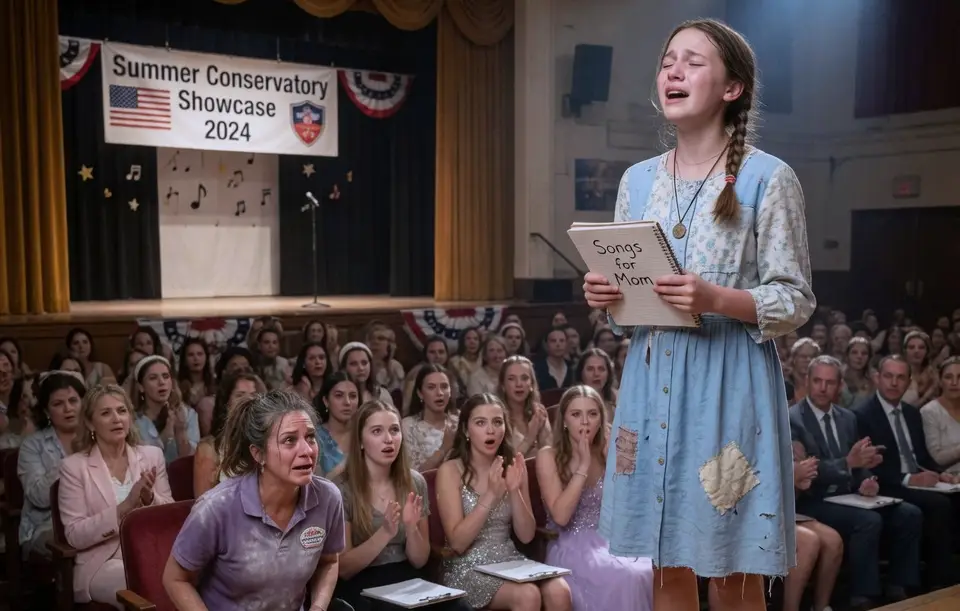
Joanne was a woman built of wire and grace, slender, perpetually exhausted, yet anchored by a quiet, immovable strength. As she wiped down the display cases, her hands red from industrial soap, she would often catch Sophie’s eye and offer a gentle, weary smile. “You don’t have to be rich to live kindly, sweetheart,” she would say, her voice a soothing balm against the harsh reality of their daily lives.
At school, that kindness was rarely returned. Sophie’s uniform, meticulously mended at the seams by her mother’s tired hands, and her badly worn shoes marked her as an easy target for the cruelty of children. She was a silent fixture in the back row of her classroom, absorbing the arithmetic and the thinly veiled taunts with equal stoicism. Yet, beneath her quiet exterior, her dark brown eyes held the profound depth of an old soul. They were eyes that harbored secret melodies, songs she only dared to hum in the safety of her own mind.
The rhythm of her invisible life shifted one mundane Monday morning. The PA system above the chalkboard crackled to life, the principal’s voice cutting through the morning chatter. “Welcome to Talent Week. If anyone would like to sign up to perform, please add your name to the list outside the office by Wednesday.”
Instantly, the classroom erupted into a hive of eager voices. Desks scraped against the linoleum as children boasted about their elaborate plans. A group of girls whispered excitedly about choreographing viral TikTok dances, while the boys argued over who would play the piano or bring their drum kits.
Sophie remained entirely still, her gaze fixed on the grain of her desk. But that evening, the air in their small trailer felt different. After the dinner dishes were washed and stacked, Sophie sat on her bed, listening to the soft hiss and warble of an old cassette tape. It was a recording of Joanne from years ago, her voice weaving through a gentle lullaby. Sophie reached for a pencil, the wood worn smooth beneath her thumb, and pulled a small slip of paper from her bedside table.
“I’ll sing that song,” she whispered into the dim room. “Mom, the one you used to sing when I was sick. Scarborough Fair.”
The following afternoon, the hallway outside the school office was deserted. Sophie stood before the bulletin board, her small hands trembling as she stared at the sign-up sheet. The list of names was already intimidatingly long, filled with confident signatures promising magic tricks and modern dance routines. She drew a slow, shuddering breath, uncapped her pen, and pressed it to the very last line. Sophie Lane, singing.
She hadn’t even made it ten minutes down the corridor before the giggles began to bounce off the metal lockers.
“Sophie signed up to sing? It has to be a comedy act.”
“Maybe she’ll sing through a rice cooker.”
The cruel words stung, but Sophie didn’t allow the tears to fall. She simply lowered her chin, clutching the little spiral notebook where she had meticulously copied the lyrics in her tilted, careful handwriting, and walked away.
That night, the trailer was filled with the sound of a fragile, trembling melody. Joanne pushed open the bedroom door with a gentle creak to find her daughter standing in the center of the room. Sophie’s voice was shaky, yet it possessed a clarity that reminded Joanne of a crisp spring wind.
Saying nothing, Joanne crossed the faded carpet and sat softly on the edge of the mattress. She listened until the final note faded, then reached out to tuck a stray lock of hair behind Sophie’s ear.
“You know,” Joanne murmured, her eyes distant with memory. “I once dreamed of standing on a stage, too. But then your grandma got sick, and I had to leave school to take care of her.” She paused, her thumb gently tracing her daughter’s cheek. “I never regretted it. Not for a second. But if I could see you walk onto that stage today, that would be the most beautiful gift I’ve ever received.”
Sophie looked up, her brown eyes finally brimming with the tears she had held back all day. “Will you come?”