


The whispers in the parlor always stopped the moment the wheels of my chair crossed the threshold. They said I would never marry, though they rarely had the courage to say it to my face. Over the course of four agonizing years, twelve different men had been invited to our estate. Twelve men had looked at the polished mahogany of my wheelchair, weighed the inconvenience of my existence against the vast wealth of my family, and walked away. But the events that followed those bitter humiliations would shock the entirety of our polite, suffocating society—and alter the course of my own heart in ways I could never have imagined.
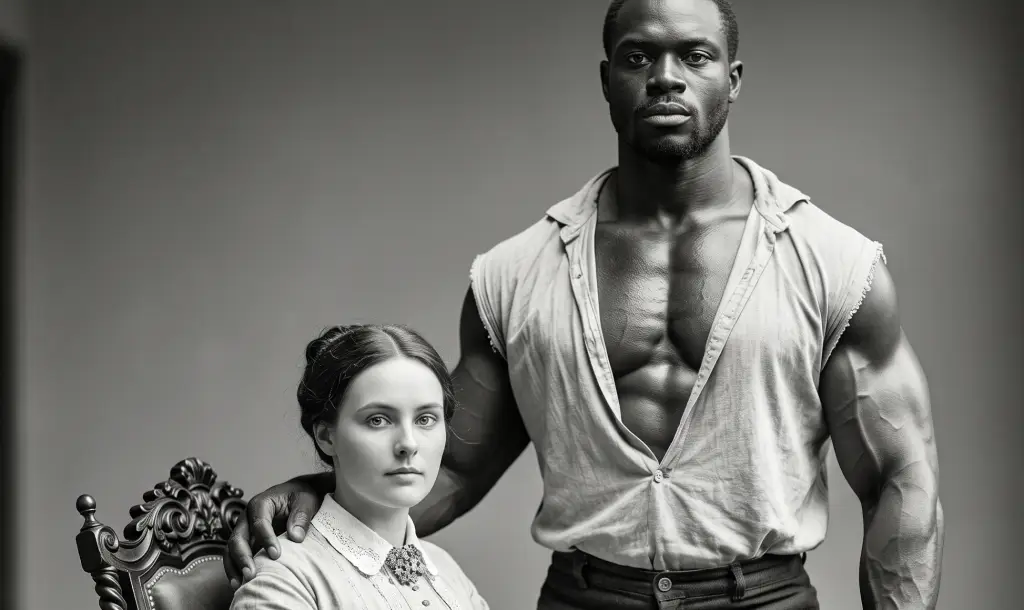
My name is Eleanor Whitmore. This is the truth of how I went from being discarded by the world to discovering a love so profound it fractured the very boundaries of history.
The year was 1856. We lived in Virginia, a place where a woman’s worth was measured entirely by her grace in a ballroom and her utility in a nursery. I was twenty-two years old, and in the eyes of my peers, I was damaged goods. My legs had been completely useless since I was eight years old. A brutal riding accident had shattered my spine, trapping me forever in a contraption of wood and brass that my father had specially commissioned. But the sheer mechanics of my paralysis were only half the problem. It was not merely the wheelchair that made me unmarriageable. It was the quiet, devastating reality of what that chair represented to the men of our social standing.
It meant a burden. It meant a wife who could not glide gracefully beside her husband at evening galas or host lavish garden parties with a light step. It meant a woman who, according to the cruel gossip of the drawing rooms, could not manage the sprawling demands of a southern household. More painfully, the whispers insisted I could not bear children. I could not fulfill a single duty expected of a Virginia wife.
My father, driven by a fierce and protective desperation, arranged twelve formal proposals. Twelve rejections followed, each one slicing deeper than the last. The excuses were polite but devastating. She cannot process down the aisle on my arm. My future children will need a mother who can chase after them in the yard. What is the point of a marriage if she cannot give me heirs? That final rumor regarding my fertility was entirely false. It had spread through the local society like a brushfire, sparked by some callous doctor who had speculated about my physical capabilities over a glass of bourbon, without ever having the decency to examine me. Overnight, I was no longer just disabled; I was deemed fundamentally defective in every category that mattered to the society of 1856 America.
The final blow came in February. William Foster—a perpetually drunk, red-faced man of fifty with a waistline that strained his waistcoats—sat in our parlor and flatly rejected me. He did this despite my father offering him a staggering one-third of our estate’s entire annual profits as a dowry. Watching that bloated, unpleasant man shake his head and refuse me was the moment I finally accepted the truth. I was going to die a spinster, entirely alone.
But my father, I would soon learn, had other plans.
They were plans so radical, so profoundly outside the bounds of every accepted social norm, that when he finally voiced them, I stared at him in utter silence, convinced the stress had caused him to lose his mind.
“I am giving you to Josiah,” he said, the words hanging heavily in the quiet of his study. “The blacksmith. He will be your husband.”
I sat frozen, gripping the armrests of my chair. I looked at Colonel Richard Whitmore, the undisputed master of five thousand acres and two hundred enslaved human beings, and tried to process the impossible sentence he had just spoken.
“Josiah?” I whispered, the name catching in my throat. “Father, Josiah is… he is enslaved.”
“Yes,” my father replied, his voice steely, though his eyes betrayed his exhaustion. “I know exactly what I am doing.”
What I did not know, and what absolutely no one could have predicted, was that this desperate, terrifying solution would blossom into the greatest love story of my life.
To understand the sheer magnitude of my father’s proposal, you must first understand Josiah. The other men on the plantation called him the Brute. He stood seven feet tall if he was an inch, carrying three hundred pounds of solid, unyielding muscle forged by years of relentless labor at the anvil. He possessed hands that could literally bend iron bars. He had a face that made grown, confident men instinctively take a step backward when he entered a barn. People were deeply terrified of him.
The enslaved and the free alike gave him a wide, respectful berth. White visitors to our estate would stop, stare, and whisper behind their hands. Did you see the sheer size of that one? The Colonel has himself a monster down in the smithy. But here is what none of those fearful gossips knew. Here is the truth I was about to uncover. Josiah was the gentlest human being I would ever have the privilege of knowing.
It was March of 1856, barely a month after William Foster had drunkenly dismissed my future, when my father called me into his study to present his ultimatum. I had already resigned myself to a life of quiet isolation.
“No white man of any standing will marry you,” my father said bluntly, pacing in front of his massive oak desk. “That is the cold reality, Eleanor. But you desperately need protection. When I die, this entire estate passes to your cousin Robert. You know him. He will liquidate everything, give you some insulting pittance to ease his conscience, and leave you entirely dependent on the charity of distant relatives who already view you as a nuisance.”
“Then leave the estate to me,” I fired back, my voice trembling with a mix of anger and sorrow, knowing full well the futility of the demand.
“Virginia law will not allow it,” he said, rubbing his temples. “Women cannot inherit independently, and especially not…” He gestured vaguely toward my wheelchair, unable to bring himself to finish the sentence.
“Then what on earth do you suggest?” I demanded, tears of sheer frustration pricking my eyes.
“Josiah is the strongest man on this property,” my father said, stopping his pacing to look me dead in the eye. “He is highly intelligent. Yes, I know he reads in secret in the barn. Do not look so surprised; very little escapes me. He is healthy, remarkably capable, and by every account I have gathered, he is gentle despite his massive size. Furthermore, he will not abandon you, because he is bound by the laws of this state to stay. He will protect you. He will provide the physical care you need.”
The logic of his argument was horrifying, yet practically airtight.
“Have you even asked him?” I asked, my heart hammering against my ribs.
“Not yet,” my father admitted. “I needed to tell you first.”
“And if I refuse?”
My father’s face seemed to age a full decade in the dim light of the study. “Then I will keep parading you in front of fortune hunters and drunkards, trying to find a white husband. And we both know I am going to fail. When I am gone, you will spend the rest of your days in drafty boarding houses, entirely at the mercy of people who despise your presence.”
He was absolutely right. I hated the world, I hated the law, and I hated that he was right.
“Can I at least meet him?” I asked, gripping the brass wheels of my chair. “Can I actually speak to the man before you finalize a decision that dictates both of our lives?”
“Of course,” my father said softly. “Tomorrow.”
They brought Josiah to the main house the very next morning. I had positioned my wheelchair perfectly by the parlor window, seeking the comfort of the morning light, when I heard the heavy, deliberate footsteps echoing in the hardwood hallway. The parlor door swung open. My father entered first, and then Josiah appeared in the frame.
He had to duck—he actually had to fold his massive frame downward—just to clear the doorway.
Dear God, the man was enormous. He was seven feet of pure sinew and power, with broad shoulders that practically filled the doorframe. His hands, resting awkwardly at his sides, were heavily scarred from years of forge burns; they looked as though they could crush river stones into dust. His face was deeply weathered, framed by a thick, dark beard, and his eyes darted cautiously around the opulent room, purposely avoiding my gaze.