


I stepped through the wooden gate of my son’s backyard, the hinges letting out a familiar, muted groan, and that was when I heard it.
“Why is she even still alive?”
I didn’t turn around. I didn’t drop the heavy glass dish of peach cobbler resting against my forearms. The heat of it was still radiating through my oven mitts, seeping into my skin. I heard the words with my own two ears, clear as church bells on a Sunday morning. The laugh that followed wasn’t particularly loud. It wasn’t a cackle. It was just a casual, breathy sound, sharp enough to slice through something fundamental and deep within my chest.
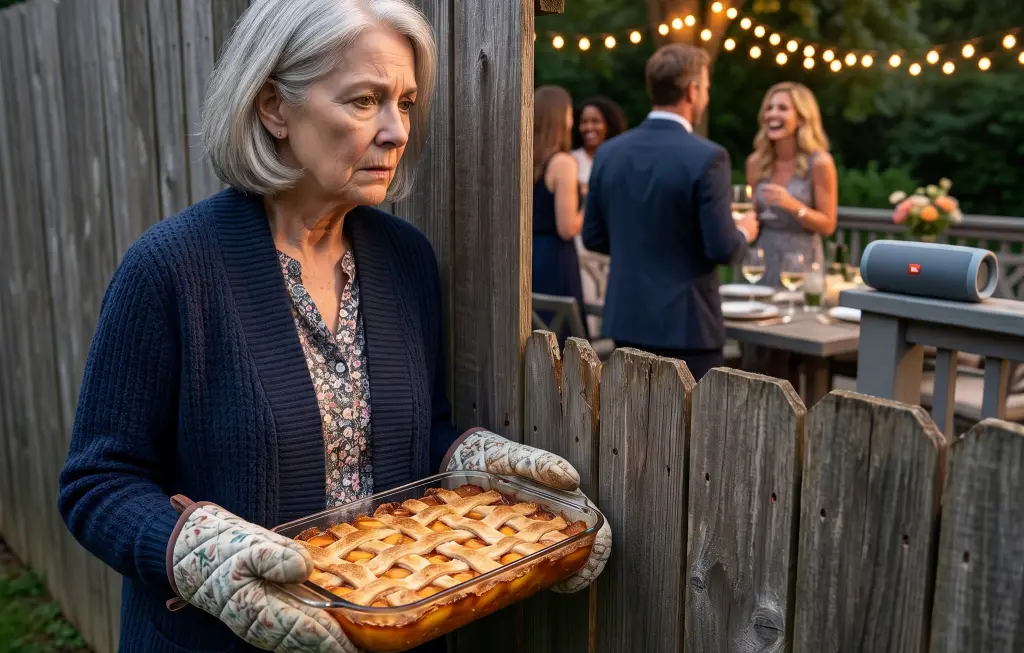
I stood there in the shadow of the fence. My hands did not tremble. Not yet. I didn’t turn back toward my car, and I didn’t flee. Instead, I straightened my spine, pasted a placid expression on my face, and walked through that sprawling backyard as though the air hadn’t just been completely pulled from my lungs.
I moved past the glowing canopy of patio string lights, past the long wooden picnic tables cluttered with half-empty plastic cups, past the faces of people who couldn’t be bothered to turn their heads in my direction. Some of the guests shared my bloodline; others were absolute strangers. Not a single one of them offered a welcoming smile.
Someone near the cooler cleared their throat. “Oh, Mabel. We didn’t know you were coming.”
It was Jodi, my son’s wife. Her voice carried that distinct, airy pitch she reserved for moments when she was caught off guard but needed to maintain appearances. It was the exact same voice I had just heard from the other side of the cedar fence.
“I brought cobbler,” I said, my tone perfectly even.
No one stepped forward to take the heavy glass dish from my hands. I stood there for a long moment, feeling the weight of the warm fruit and sugar, before I quietly navigated my way to the far end of the longest table. I set the dessert down near a stack of paper napkins. Finding an empty folding chair at the absolute edge of the gathering, I sat. The metal frame creaked in protest beneath me. A dull, familiar ache settled into my lower back, but I refused to slouch. I sat up perfectly straight.
The evening air was thick with the scent of charred meat and the sharp, chemical tang of citronella candles burning in tin buckets. Music pulsed from a wireless speaker set up on the deck—something entirely too loud, with a frantic, thumping bassline designed for people decades younger than my seventy-odd years.
They laughed. They ate ribs and potato salad. They drank cold beer from sweaty cans.
I simply watched. At one point, my son, Carl, stood up near the grill. He tapped the side of his beer can and raised it high into the fading evening light, offering a toast to the crowd. “To family,” he announced, his voice carrying over the music.
Glasses clinked. Red plastic cups collided. And through it all, not a single pair of eyes drifted to the end of the table where I sat. My own grandchildren—my blood—darted past my chair three separate times, chasing each other through the damp evening grass. Not one of them slowed their pace. Not one of them paused.
No one stopped to say, Hi, Grandma. I sat there, a ghost in my own Sunday clothes, wondering if they even possessed the ability to recognize me without a kitchen apron tied around my waist or heavy grocery bags dangling from my wrists. I used to be the woman who brought them gummy worms tucked carefully into Ziploc bags, sneaking them treats before dinner. Now, I was just part of the landscaping.
Eventually, Jodi made her way down the length of the table. She leaned in toward me, offering that tight-lipped, calculated smile she always wore when a camera was pointed in her direction.
“Did you want a plate?” she asked, her eyes darting briefly toward the buffet line.
I looked up at her, meeting her gaze steadily. “I’m fine.”
She nodded, the motion a little too hurried, and pivoted on her heel, walking away before another word could pass between us.
I stayed until the very end of the night. When the air grew chilly and the crowd began to thin, I stood up and did what I had always done. I helped stack the discarded, grease-stained plates. I folded the unused napkins. I took a damp paper towel and wiped down the sticky residue left on the picnic tables while the remaining guests slowly migrated indoors, complaining about the mosquitoes. When the yard was finally empty, I picked up my glass baking dish. The cobbler was entirely gone, the glass still faintly warm from sitting out in the afternoon sun.
And then, I left.
I didn’t drive home in a fit of rage. I wasn’t drowning in a puddle of sorrow. I drove the familiar streets back to my house carrying nothing but a cold, crystalline decision.
The next morning, the sun rose exactly as it always did. I walked into my kitchen and prepared coffee using my smallest glass pot. I brewed just enough for one single cup. Taking my mug, I sat at the small table nestled by the front window. It was the exact same table where Carl used to sit to do his middle-school math homework, his lanky legs growing too long for the wooden chair beneath him. Back in those days, he had needed me. He had relied on me to untangle the fractions and keep him steady. Now, he merely tolerated my existence. Barely.
I didn’t speak a single word to anyone that entire Sunday. I washed the cobbler dish until the glass sparkled, dried it with a flour sack towel, and put it away in the cupboard. I left the quiet confines of my house exactly once, stepping out to the porch to collect the weekend mail. I carried the stack of envelopes back inside, but I didn’t bother opening a single one. I simply wasn’t ready to pull out the electricity bill and see my son’s name glaring back at me.
That house—the sprawling property where they had gathered and eaten and laughed at my expense—had once been my salvation to offer. The down payment, a lump sum of $40,000, had come directly out of my hard-earned retirement account. I had handed it over years ago, back when I still harbored a naive belief in second chances and the sanctity of family investments.
Just to help you get started, I had told him at the time, pressing the check into his hand. No strings attached.
Apparently, there was no place for me at their table, either.
The legal paperwork detailing the transaction was still buried in the bottom drawer of my heavy metal filing cabinet in the spare room. I had never felt the need to dig it out or verify the details before. But now, in the quiet light of Sunday morning, I possessed a burning need to see it. Not for the financial figures—I had every penny of those numbers memorized. I needed to see the names. I needed to look at the ink and understand who truly owned the life I had financed.
I pulled open the drawer and lifted out a thick manila folder labeled Carl House in my own neat cursive. Opening it on the desk, I sifted through the documents. I found the original purchase agreement, the copy of the deed, and finally, the signed letter I had drafted to the bank, officially declaring the money a gift with zero expectation of repayment.
Because you’re my son, I had written at the bottom of the page.
Reading that specific line hurt in a way I hadn’t braced myself for. The pain was dull but expansive, settling heavy in my throat.
That evening, I picked up the telephone and dialed a woman named Lena. She wasn’t a close friend, not exactly, but she possessed a mind like a steel trap. She used to work in the probate courts for decades. We had met playing Bridge at the community center years ago and had maintained occasional, polite contact ever since. When she answered, I didn’t waste time with pleasantries. I told her plainly that I had several pressing questions regarding property deeds, financial gifts, and estate documents.
Lena didn’t pry. She didn’t ask me what had happened or offer empty sympathies. She just listened to the tone of my voice and said, “Come by my place tomorrow morning. Bring every piece of paper you have.”
I slept remarkably well that night. I didn’t take my usual half-dose of melatonin, and I didn’t pace the hardwood floors of the hallway. It wasn’t exactly a feeling of peace that settled over me, but rather a profound sense of internal alignment. Everything was finally moving in the same direction.
When morning arrived, I took my time getting dressed. I bypassed my usual comfortable clothes and pulled out a pair of sharply creased, ironed slacks. I put on real leather shoes instead of my soft loafers. I even took my good wool coat out of the closet, despite the fact that the mid-morning air was far too warm for it. When a woman is about to fundamentally alter the entire shape of her remaining life, she needs to wear something with buttons and structure.
Lena’s house was immaculate. As soon as she opened the front door, the air smelled sharply of fresh lemon cleaner and the soothing, herbal notes of peppermint tea. We sat at her dining table, and she systematically opened the folder. She adjusted her reading glasses, skimming her finger down the margins of the documents. After a few minutes of total silence, she let out a small, pragmatic grunt.
“There are no written expectations of repayment here, Mabel,” Lena said, tapping the gift letter. “And you have no shared title on the deed. Legally speaking, it’s theirs now. You gifted it free and clear.”
“I know,” I said, my voice steady.
“But,” Lena continued, leaning back in her chair and folding her hands, “that doesn’t mean you are a powerless woman.”
For the next hour, she carefully explained exactly what avenues of control I still possessed. She walked me through the realities of my bank accounts, my last will and testament, and my medical powers of attorney.
“You absolutely cannot take the physical house back,” Lena told me, looking me dead in the eye. “But you can damn well make sure they don’t get their hands on a single thing else.”
That was enough. It was more than enough. Lena wrote out a detailed, itemized checklist on a yellow legal pad and handed it to me. I folded the thick paper precisely in half, tucked it securely into the zipper pocket of my leather purse, and thanked her.
When I returned home that evening, I sat back down at my kitchen table. I didn’t turn on the radio for background noise, and I left the television dark. I sat in the absolute silence of the house—a silence I used to loathe and try to fill, but one I now welcomed like an old, trusted companion. I slid a blank sheet of white paper from the drawer, took my favorite pen, and wrote a single name at the top center of the page.
Carl.
Then, pressing firmly on the page, I drew one thick, solid line straight through it.
By Wednesday afternoon, the urge to occupy my hands took over. I went into the kitchen and decided to bake a pie that I had absolutely no intention of sharing with another living soul. I settled on blueberry, adding a generous grating of fresh lemon zest to brighten the filling. I didn’t use the shortcut store-bought dough; I used my good crust recipe, the labor-intensive one involving ice water and cold butter that I usually strictly reserved for milestone birthdays and grand Thanksgiving dinners.
This time, the effort was entirely for me. There was no special reason, no calendar occasion to mark. I baked it simply because I still possessed the skill and the desire to do so.
While the pie cooled on a wire rack on the counter, filling the house with the scent of bubbling berries and warm butter, I stepped out onto the front porch. I sat in my wicker chair, draping the heavy, knitted afghan over my knees—the old, beautifully patterned one that my dear friend Doris had given me a year before she passed away.
The neighborhood street was perfectly quiet. A few children were riding bicycles in slow, lazy circles near the cul-de-sac, and someone two houses down was pushing a lawnmower, the engine droning rhythmically in the distance. It was the specific kind of mundane suburban afternoon where absolutely nothing of note seemed to be happening, unless, of course, you were watching the world very closely.
Right around four o’clock, a familiar car turned the corner and pulled smoothly into the driveway of the house directly across the street. It was Jodi’s sister, Michelle. She stepped out of the driver’s seat lugging a massive canvas tote bag overflowing with expensive groceries, a sleek bottle of red wine tucked under her arm. She walked up to their front door, knocked a single time as a courtesy, and pushed her way inside without bothering to wait for an answer. She moved with the casual, breezy entitlement of someone who was completely comfortable and entirely certain of her secure place within those walls.
I sat under Doris’s afghan and watched the door click shut behind her. I hadn’t been formally invited into that house in nearly four months. The last time I had crossed their threshold was for my granddaughter Ruby’s sixteenth birthday party. Even then, my presence had been an afterthought. They had set up a folding chair for me in the corner of the patio, directly adjacent to the large plastic trash bin.
So you won’t be too close to the music, Mom, Carl had told me that afternoon.
I remember the way he had said it, his tone dripping with a sickly-sweet condescension, acting as though sticking his mother next to the garbage was a deeply thoughtful accommodation. Ruby hadn’t even bothered to open the gift I brought until long after I had quietly excused myself and driven home. It was a beautiful, vintage picture book, the binding meticulously hand-stitched. I had taken an hour to write a careful, heartfelt note inside the front cover.
To Ruby, with all the love a grandma can fit on a page. She never once mentioned receiving it. Not a call, not a text.
I had only laid eyes on them twice since that miserable birthday party. Once was a chance encounter at the local grocery store. Carl was rushing down the central aisle, staring at his phone, while Jodi became suddenly, intensely fascinated by a display of organic apples in the produce section, pretending she didn’t see my cart turning the corner. The second time was at the public library. I had been walking toward the checkout desk when Ruby came through the double doors. She walked right past my shoulder. There was no smile of recognition. She gave me a brief, blank glance, looking at me the way one might look at a substitute teacher from three years ago, or a neighborhood woman whose name they couldn’t quite place.
And yet, despite all the slights and the deafening silence, I had maintained a specific drawer in my hallway console table. For years, I had faithfully kept it stocked with holographic stickers, tiny spiral notebooks, colorful markers, and little wrapped treasures, just in case my grandchildren ever came by and needed to be spoiled.
That Wednesday afternoon, I walked back inside, opened that drawer, and emptied it.
I didn’t sort through the items. Every last sticker sheet, every piece of candy, every little notebook went straight into a brown paper grocery bag. I rolled the top of the bag down tightly and carried it out to the curb, setting it squarely next to the blue recycling bin. I went back to the porch and sat down, watching that brown bag sit there in the afternoon sun for hours. It remained entirely untouched, completely ignored. Just like me.
As evening set in, my cell phone chimed on the kitchen counter. I picked it up to see a text message from Carl.
Hey. Jodi says she might have hurt your feelings on Sunday. Didn’t mean anything by it. She was just tired. You know how family events can be.
I stood in the kitchen light and read the words twice, letting the sheer lack of accountability wash over me. Then, I pressed the screen and deleted the message.
I didn’t type out a passive-aggressive reply. I didn’t ask for clarification. I simply deleted it into the digital void. I realized in that moment that I was utterly finished archiving his weak explanations like precious museum pieces. I had spent far too many years doing exactly that—storing up their flimsy excuses like treasured mementos, carefully wrapping their cruelty in the soft, protective padding of he didn’t really mean it or she’s just under a lot of stress right now. No more.
Right at seven o’clock, a firm knock sounded at my front door. For a fleeting, foolish second, my heart jumped, thinking maybe Carl had driven over. But when I pulled the door open, it was Kay, my neighbor from next door. She was standing on the welcome mat holding a large plastic container of homemade lentil soup, looking slightly frantic as she asked if I had seen her gray tabby cat, Vernon, wandering around my bushes.
I told her I hadn’t seen the cat, but I stepped back and invited her inside anyway. We ended up sitting at my kitchen table, dividing that beautiful, lemon-scented blueberry pie straight down the middle. Kay didn’t ask me why Carl’s car hadn’t been in the driveway lately. She didn’t pry or ask why the bags under my eyes looked a little heavier and darker than usual. She simply took a bite of the dessert, closed her eyes, and declared that the pie was so spectacular it made her kneecaps hum.
We burst out laughing. It was a loud, ungraceful sound, and I realized as it echoed off the kitchen tiles just how desperately I had needed that laugh.
Much later, after Kay had gone back home to hunt for Vernon and the house was locked tight for the night, I walked down the hallway. I stopped in front of a framed photograph resting on the display shelf. It was a picture of me and Carl, taken on a summer trip in 1987. He was eight years old in the photo, missing a front tooth, his arms wrapped around my neck, smiling at the camera like I hung the moon and the stars.
I reached out, trailing a finger over the glass covering that sweet, gap-toothed boy, and I whispered to the empty hallway, “I miss you.”
I didn’t mean the man who lived across town. I meant the boy in the frame.
I picked up the silver frame and laid it gently face down on the shelf. Then, I walked into the spare room, opened the desk drawer, and removed a thick white envelope labeled Legal. Inside rested my will, my medical directives, and the durable power of attorney that Carl had eagerly signed his name onto three years ago, right after I had taken a bad fall on the porch steps. It was the exact same document he had completely ignored ever since, never once following up or asking about my health in the years that followed.
I sat in the armchair, holding that stack of paper in my lap for a very long time. Tomorrow morning, I would drive back to Lena’s house. But for that one night, I just sat perfectly still in the darkening room, quietly saying my goodbyes to a version of my family that now existed strictly in my memory.