


The parlor would always fall dead silent the second the brass wheels of my chair scuffed the threshold. It was a predictable, agonizing choreography. The gentle flutter of painted silk fans would cease, the murmured gossip would evaporate, and the eyes of polite society would inevitably drop to their porcelain teacups. They whispered that I would never take a husband, though they carefully veiled their pity behind perfectly manicured smiles.
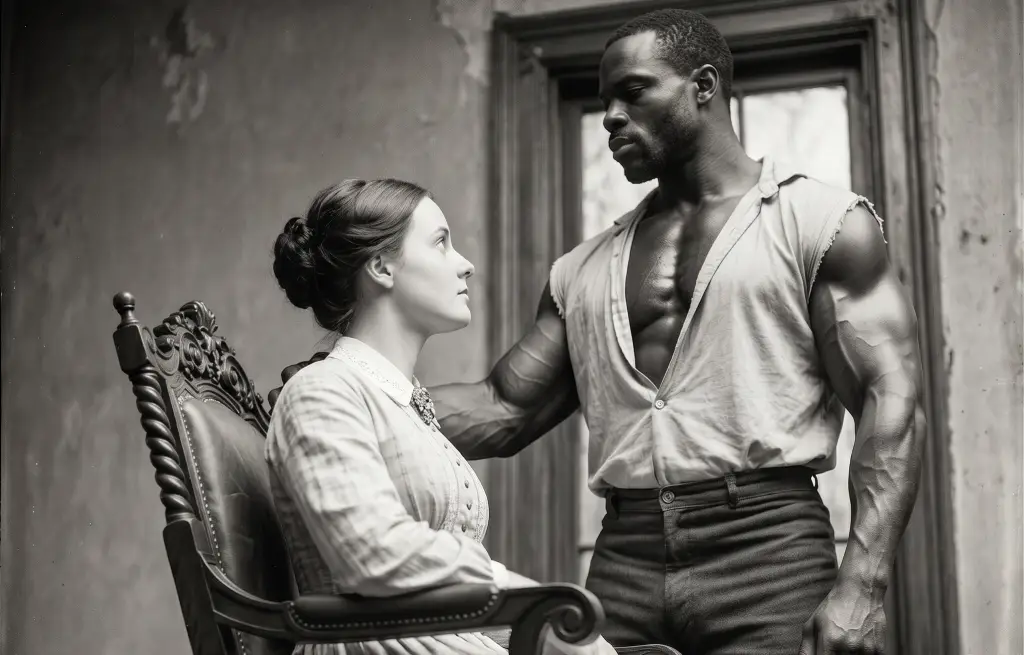
Over four excruciating years, twelve distinct men had been lured to our sprawling estate. Twelve men had calculated the vast, undeniable wealth of my family, weighed it against the inconvenience of my mahogany wheelchair, and ultimately walked out our front door. Yet, the events destined to follow those quiet humiliations would thoroughly shatter the rigid boundaries of our world, altering the landscape of my own heart in ways I could never have dared to dream.
My name is Eleanor Whitmore. This is the absolute truth of how a woman discarded by her own era found a love profound enough to rewrite history.
The year was 1856. We resided in the heart of Virginia, an opulent, suffocating world where a woman’s fundamental value was calculated by her effortless grace on a ballroom floor and her robust utility in a nursery. I was twenty-two years old, and to the glittering society of my peers, I was a tragic liability. I had not felt the ground beneath my feet since I was eight years old. A horrific riding accident had shattered my spine, binding me permanently to a heavy conveyance of polished wood and gleaming brass that my father had commissioned specifically for my survival.
But the sheer mechanical reality of my paralysis was merely a fraction of the tragedy. It was not the wood or the wheels that repelled the gentlemen of our county. It was what that chair signaled to the men who moved within our elevated social spheres.
To them, it signaled an anchor. It promised a wife who could never sweep elegantly into a dining room on her husband’s arm, nor host sprawling twilight garden parties with a buoyant, effortless step. According to the vicious, whispered consensus of the local drawing rooms, I was entirely incapable of managing the exhausting demands of a southern plantation. Far more devastatingly, the rumors insisted that my body was too broken to carry a child. I was stripped of every single duty a Virginia wife was expected to fulfill.
My father, possessed by a fierce, terrifying desperation to secure my future, engineered twelve formal introductions. Twelve swift rejections trailed in their wake, each dismissal leaving a deeper, sharper wound than the last. Their excuses were draped in southern courtesy, yet they cut like glass. They murmured about how I could not process down the church aisle. They lamented that future children required a mother who could run across the manicured lawns. They questioned the very purpose of a union that could not produce heirs.
That final, devastating rumor regarding my fertility was an absolute fabrication. It had ignited and spread through our community like a wildfire, entirely because a callous local physician had theorized about my anatomy over a heavy glass of bourbon, lacking even the basic decency to examine me first. In the span of a single evening, I transitioned from a disabled young woman to a creature deemed fundamentally defective in every category that held weight in the America of 1856.
The ultimate humiliation arrived in February. William Foster was fifty years old, perpetually flushed with liquor, and possessed a straining waistline that threatened the seams of his expensive waistcoats. He sat upon our parlor sofa, sweating lightly, and flatly refused my hand. He delivered this rejection even after my father, swallowing his formidable pride, offered a staggering dowry consisting of one-third of our estate’s entire annual profits. Sitting quietly by the window, watching that bloated, sour man shake his head and dismiss my worth, I finally surrendered to reality. I was destined to wither into an isolated spinster.
I simply did not realize that my father had quietly begun drafting a different design.
His intentions were so completely radical, so entirely detached from the sacred norms of our reality, that when he finally spoke them aloud, I simply stared at him. I was genuinely convinced the relentless stress had fractured his mind.
“I am giving you to Josiah,” he stated. The words dropped like lead weights into the absolute silence of his study. “The blacksmith. He will serve as your husband.”
My fingers tightened around the polished armrests of my chair until my knuckles burned. I looked across the room at Colonel Richard Whitmore, the absolute sovereign of five thousand acres of prime Virginia soil and two hundred enslaved human beings, desperately trying to untangle the impossible sentence he had just constructed.
“Josiah?” I breathed, the name snagging in my dry throat. “Father, Josiah is… he is an enslaved man.”
“Yes,” my father answered. His voice was made of iron, though the heavy shadows beneath his eyes betrayed a soul-crushing exhaustion. “I am entirely aware of what I am doing.”
What I could not possibly know, and what no soul on that sprawling plantation could have predicted, was that this terrifying, desperate measure would ultimately bloom into the most magnificent romance of my life.
To grasp the sheer, earth-shattering magnitude of my father’s declaration, one must first understand the man named Josiah. The other laborers on the property referred to him as the Brute. He stood a towering seven feet tall, carrying three hundred pounds of dense, uncompromising muscle built by an entire lifetime of punishing labor at the anvil. His hands were vast instruments of creation and destruction, fully capable of bending cold iron bars. He possessed a weathered, formidable face that caused confident, arrogant men to instinctively step backward when he crossed a threshold. The county was profoundly terrified of him.
Both the enslaved workers and the free white visitors granted him a wide, deeply cautious berth. Wealthy guests riding up our oak-lined driveway would pause, point discreetly, and whisper. They marveled at his sheer scale, gossiping that the Colonel harbored a living monster down in the suffocating heat of the smithy. Yet, none of those trembling gossips understood the profound truth I was about to uncover. Josiah possessed the gentlest, most intricate soul I would ever have the privilege of knowing.
It was March. Barely four weeks had passed since William Foster’s drunken dismissal of my existence when my father summoned me to his private study to deliver his ultimatum. I rolled my chair over the threshold, having already wrapped my heart in the cold comfort of isolation.
“No white man of our standing will ever marry you,” my father stated with brutal clarity. He paced the length of his massive oak desk, his hands clasped firmly behind his back. “That is the agonizing truth of our situation, Eleanor. Yet, you require permanent protection. The moment I pass away, this entire estate legally transfers to your cousin Robert. You know exactly what kind of man he is. He will liquidate this property, toss you a pathetic stipend to soothe his own conscience, and leave you entirely reliant on the strained charity of distant cousins who already view your existence as a nuisance.”
“Then change your will and leave the estate directly to me,” I countered, my voice vibrating with a bitter cocktail of sorrow and fury, acutely aware of how useless the demand truly was.
“The laws of Virginia strictly forbid it,” he sighed, pressing his fingers deeply into his temples. “Women cannot inherit independently in this manner, and especially not…” He gestured helplessly toward the wheels of my chair, lacking the cruelty required to finish the thought.
“Then what on earth do you propose?” I challenged, angry tears stinging the corners of my eyes.
“Josiah is the strongest man on this property,” my father said, halting his frantic pacing to hold my gaze. “He is also remarkably intelligent. Yes, I am fully aware that he reads stolen books by lantern light in the barn. Very little happens on this land without my knowledge. He is healthy, he is incredibly capable, and according to every overseer I have questioned, he is inherently gentle despite his terrifying scale. Most importantly, he cannot abandon you. He is bound by the brutal laws of this state to remain exactly where he is. He will shield you from harm. He will manage the physical burdens of your care.”
The stark logic of his plan was horrifying, yet it possessed an airtight, desperate brilliance.
“Have you even bothered to ask him?” I asked, feeling the frantic, panicked rhythm of my own pulse.
“Not yet,” my father conceded. “I owed it to you to speak of it first.”
“And if I simply refuse?”
My father seemed to wither in the dim, golden light of the study. “Then I will continue to parade you in front of indebted fortune hunters and aging drunkards, praying for a miracle. And we both know I will fail. When I am in the ground, you will spend your remaining decades rotting in drafty boarding houses, entirely at the mercy of strangers who despise the space you occupy.”
He was relentlessly, painfully correct. I despised the rigid society we lived in, I despised the laws that bound me, and I deeply despised that he was right.
“Can I at least look at him?” I requested, my hands trembling against the brass wheels. “Can I speak to this man before you execute a plan that dictates the remainder of both our lives?”
“Of course,” my father replied softly. “I will bring him to you tomorrow.”