


I heard it with my own ears, standing just on the other side of the cedar fence.
“Why is she even still alive?”
The laugh that followed his question wasn’t particularly loud. It was casual, careless, and just sharp enough to split something wide open deep inside my chest. I stood frozen on the damp grass, holding a heavy glass baking dish of peach cobbler. The heat of it pressed through my quilted potholders, radiating a steady, comforting warmth against my wrists. My hands did not tremble. Not yet.
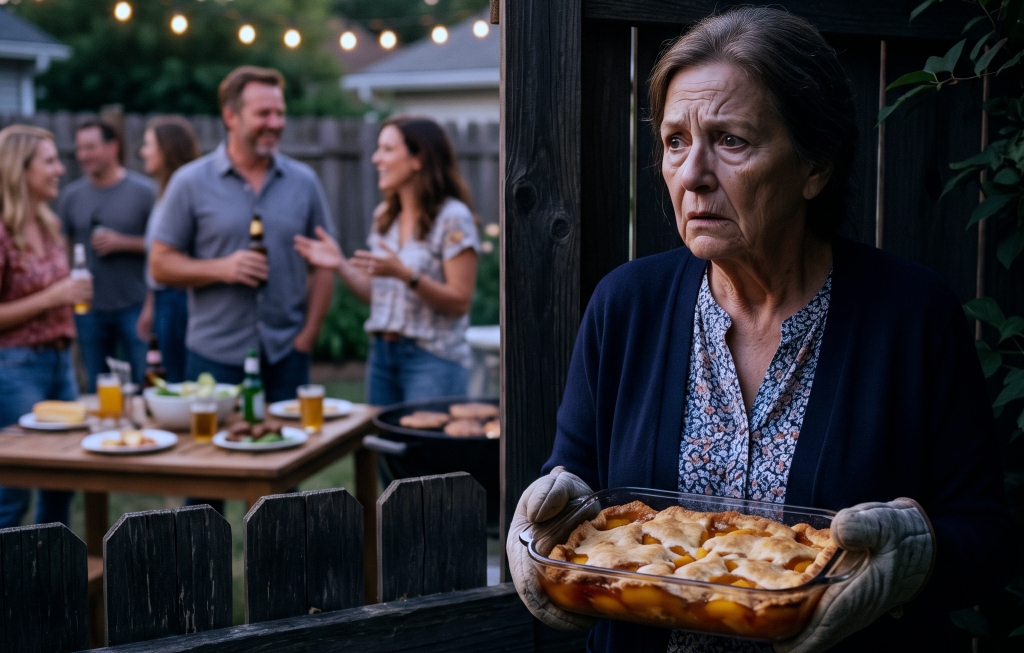
I didn’t turn around and walk away. I pushed open the wooden gate and stepped into my son’s backyard like the summer air hadn’t just been sucked from my lungs.
I navigated the patio, moving past the twinkling string lights strung elegantly through the oak branches, past the long cedar picnic tables, past a sea of faces that conspicuously failed to turn in my direction. Some of those faces belonged to people who shared my blood. Others were strangers, neighbors invited to fill out the edges of David’s perfect weekend aesthetic. Not a single person offered a smile.
Someone nearby cleared their throat, a dry, uncomfortable sound.
“Oh, Evelyn. We didn’t know you were coming.”
It was Allison, my son’s wife. She wore a pristine linen sundress, her posture rigid as she held a glass of white wine. The voice I had heard from behind the fence—David’s voice—had been speaking to her.
“I brought cobbler,” I said. My voice was remarkably even.
No one stepped forward to take the dish. Allison simply stared at it as if I were holding a relic from a forgotten era.
I made my way to the far end of the patio and found an empty spot at a secondary table. The metal folding chair creaked in protest as I lowered myself onto it. A dull ache radiated up my lower back, a familiar companion these days, but I forced my spine straight. I would not hunch.
The humid evening air was thick with the scent of charred meat, sweet barbecue glaze, and the sharp, chemical tang of citronella candles. Music thumped loudly from a sleek, waterproof speaker set on the railing. It was a chaotic, pulsing rhythm, something much too fast and frantic for anyone who had lived past forty.
Around me, they laughed. They ate ribs off paper plates. They drank their craft beers and icy cocktails.
I sat in silence and watched them. At one point, David stood up at the head of the main table. He tapped his bottle with a fork, calling for attention, and offered a wide, practiced smile to his guests.
“To family,” he announced, raising his drink high into the evening air.
Crystal and glass clinked harmoniously around the yard. Not one pair of eyes looked my way. The children—my own grandchildren, Trent and Ruby—dashed past my chair three separate times in a game of tag. Neither of them slowed down. Neither of them paused.
No one said, “Hi, Grandma.” I watched their retreating backs and genuinely wondered if they even knew how to recognize me when I wasn’t wearing an apron or carrying heavy grocery bags through their front door. I used to keep small, treasure-filled Ziploc bags of gummy worms in my purse just for them. I suppose they had outgrown gummy worms.
Eventually, Allison wandered over to my end of the table. She leaned in, flashing that tight-lipped, hollow smile she always deployed when she knew people might be looking.
“Did you want a plate?” she asked, her tone entirely devoid of hospitality.
I looked up at her perfectly applied makeup and her carefully arranged expression. “I’m fine.”
She nodded, entirely too quickly, and hurried away before I could utter another syllable.
I stayed until the very end of the party. I helped stack the discarded plates. I gathered the crumpled napkins that had blown into the flower beds. I took a damp paper towel and methodically wiped the sticky rings of condensation and spilled sauce off the folding tables while everyone else began migrating indoors to escape the mosquitoes. Finally, I picked up my untouched glass dish, the cobbler inside still faintly warm from the afternoon sun, and I walked to my car.
I left the neighborhood without feeling anger. I didn’t even feel sorrow. What I felt was the quiet, terrifying weight of a decision settling into my bones.
The next morning, the house was profoundly silent. I stood in my kitchen and made coffee using my smallest glass pot. I brewed just enough for a single cup. I took my mug and sat at the small, sturdy oak table situated by the bay window. It was the exact table where David used to sit for hours doing his middle school math homework, his legs growing too long for the rungs of the chair, his brow furrowed in frustration. Back then, he needed me. He needed my patience, my help, my presence.
Now, he simply tolerated me. Barely.
I didn’t speak a single word to anyone that entire Sunday. The cobbler dish had been washed, dried, and put back in the cabinet. I stepped out of the house only once to retrieve the mail from the box at the end of the driveway. I carried the stack of envelopes back inside, but I didn’t open a single one. I simply wasn’t ready to see his name printed on my electricity bill again.
That house, the beautiful colonial where they had hosted their barbecue, had been mine once. Or rather, the financial foundation of it had been. The down payment—a staggering forty thousand dollars pulled directly from my retirement account—had been my gift to them back when I still foolishly believed in second chances and family investments.
“Just to help you get started,” I had told him at the time, pressing the check into his hand. “No strings attached.”
Apparently, there were no strings, but there was also no reserved place for me at their table.
The official paperwork was still resting in my heavy metal filing cabinet in the spare room. I had never felt the need to look at it since the day the ink dried. But sitting in the quiet of my kitchen, I suddenly wanted to see it. I didn’t need to review the financial figures; I knew the numbers by heart. I wanted to see the names. I needed to remind myself exactly whose name was printed on the assets I had freely surrendered.
I pulled open the heavy metal drawer and extracted a thick manila folder labeled “David’s House.” Inside, I sifted through the purchase agreement, the copy of the deed, and the legally required gift letter I had signed to confirm the money was handed over with absolutely no expectation of repayment.
“Because you’re my son,” I had written at the bottom of the letter in blue ink.
Reading my own handwriting hurt. It burned in a way I hadn’t prepared myself for.
That evening, as the shadows lengthened across the living room floor, I picked up the telephone and called a woman named Diane Spector. She wasn’t a close friend, not exactly, but she was a formidable, sharp-minded woman who had spent decades working in probate and estate law. We had met at a neighborhood bridge club years ago and maintained a cordial, occasional correspondence.
I told her over the phone that I had urgent questions regarding property rights, financial gifts, and estate documentation. She didn’t press me for the emotional details. She possessed the rare grace of an experienced attorney.
“Come to my office tomorrow morning,” Diane told me. “Bring every document you have.”
I slept soundly that night. I didn’t need a sleeping pill, and I didn’t pace the hardwood floors until dawn. It wasn’t exactly peace that blanketed me, but rather a profound, structural alignment of my spirit.
When morning broke, I dressed with deliberate care. I pressed my good navy slacks until the creases were perfectly sharp. I put on real leather loafers instead of my comfortable walking shoes. I slipped into my tailored wool coat, even though the September air was far too warm to require it. When you are preparing to completely alter the shape and trajectory of your remaining years, you wear clothing with structure and buttons.
Diane’s office was situated in a renovated Victorian house, and the parlor smelled distinctly of fresh lemon cleaner and steeped peppermint tea. She sat behind a massive mahogany desk, adjusted her reading glasses, and meticulously skimmed through the contents of my folder. She let out a small, thoughtful grunt.
“There are no written expectations here, Evelyn. No shared title,” she said, tapping the paper. “It is entirely theirs now. You gifted it free and clear.”
“I know,” I replied, keeping my hands folded calmly in my lap.
“But,” Diane continued, looking up and meeting my gaze directly, “that certainly doesn’t mean you are powerless.”
She leaned back and began to outline exactly what could still be controlled. She spoke of banking authorizations, living wills, and the revocation of durable powers of attorney.
“You can’t take the physical house back,” she explained gently. “But you can absolutely ensure they never get their hands on anything else.”
That was enough for me.
She handed me a printed checklist before I left. I folded the crisp sheet of paper perfectly in half, tucked it securely into the zippered compartment of my leather purse, and drove home.
That evening, I sat back down at my kitchen table. There was no television playing in the background, no radio softly humming. Just the heavy silence that I used to desperately hate. But now, I welcomed it. I let it wrap around my shoulders like a protective shawl.
I took a blank sheet of stationery and a dark pen. I wrote a single name at the very top of the page.
“David.”
Then, pressing the pen down hard enough to indent the paper, I drew a thick, unwavering line straight through it.
On Wednesday, I decided to bake a pie that I had absolutely no intention of sharing. It was a wild blueberry pie, enhanced with a heavy dusting of fresh lemon zest. I utilized the complicated, butter-heavy crust recipe—the exact one I used to reserve strictly for family birthdays and sprawling Thanksgiving dinners.
This time, the effort was solely for me. There was no special occasion to celebrate, no apologies to bake into the fruit. I made it simply because I still possessed the skill and the desire to do so.