


The hollow, rhythmic tapping of my white cane against the polished linoleum echoed through the long, sterile corridor, announcing my arrival long before I spoke a word. For the past three years, that lightweight fiberglass stick had been my only reliable scout, sweeping back and forth through a world that had gone permanently dark. I am Ethan Walker. I used to be an Army Sergeant. I used to lead night raids, navigate treacherous ambushes, and wear a uniform decorated with medals that now sit in a drawer gathering dust. Today, however, I was just a man moving with slow, practiced caution, letting the brush of my left knuckles against a cold, painted cinderblock wall guide me forward.
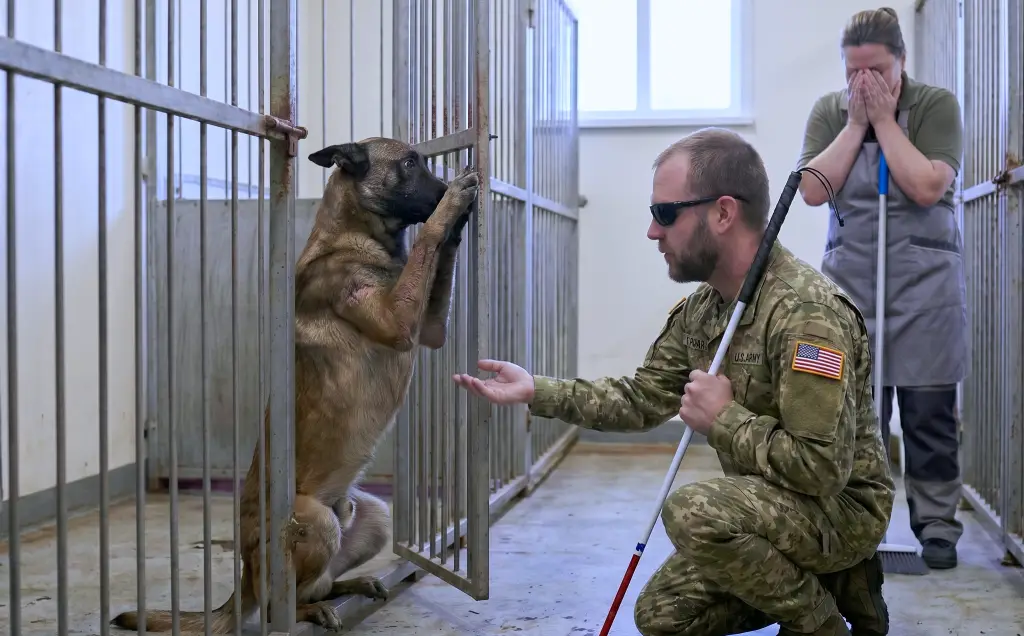
The air inside the Canine Rehabilitation and Adoption Center was heavy, thick with a complex layering of scents that painted a vivid picture in my mind. The sharp, chemical bite of industrial disinfectant battled against the undeniable musk of damp animal fur, rusted metal, and the faint, coppery tang of anxiety. I had spent weeks mentally preparing for this visit, reading through braille pamphlets and listening to audio orientations, but nothing could quite prepare a man for the sheer emotional weight of the place. My heart was knocking against my ribs, a heavy, erratic drumbeat that felt louder than my heavy boots on the floor tiles.
It was a strange realization. I had faced down hostile gunfire and navigated minefields, yet walking into this civilian building left my throat dry and my palms sweating. Perhaps it was because, for the first time in a long time, I wasn’t fighting an external enemy. I was searching for a way to fight the suffocating emptiness that had trailed me all the way home from the war.
“Mr. Walker, you made it. Welcome.”
The voice belonged to a woman. It was warm, professionally modulated, and carried the steady cadence of someone used to dealing with fragile situations. She approached from my two o’clock, her soft-soled shoes squeaking faintly against the floor.
I offered a polite, abbreviated nod, forcing a tight smile. “Please, just call me Ethan.”
“That’s perfectly fine, Ethan,” she replied smoothly, her tone relaxing just a fraction. “I’m Karen. I’ll be the one guiding you through our evaluation process today. We have quite a few calm, impeccably trained service dogs who are fully vetted and ready for pairing.”
My fingers tightened around the rubber grip of my cane. The word ‘perfect’ always rubbed me the wrong way. It felt like an impossible standard for anyone carrying invisible scars. “I’m not exactly looking for perfect, Karen,” I murmured, my voice dropping lower. “I’m just looking for someone who understands.”
I could hear the slight hesitation in her breathing, a brief pause where she likely tried to decode my meaning, before she gently prompted me to follow. As we ventured deeper into the sprawling facility, the ambient noise shifted. The isolated barks became a chorus, bouncing harshly off the heavy steel doors and raw concrete floors.
Deprived of sight, my hearing had become hyper-tuned, and I began to unconsciously catalog the emotions behind the sounds. I heard the sharp, frantic yapping of pure anxiety, the rhythmic, booming barks of territorial excitement, and the low, pitiful whimpers of profound loneliness. Animals, I had long ago realized, possessed a purity of expression. They simply vocalized the exact things that humans spent their entire lives trying to bury.
Suddenly, a massive, guttural snarl ripped through the acoustic clutter of the hallway. It was a terrifying sound, followed instantly by a barrage of explosive barking so violently intense that I could literally feel the low-frequency vibrations shuddering through the floorboards and up through the soles of my boots.
Karen’s footsteps stopped dead. “Let’s keep moving,” she instructed, a distinct thread of nervousness suddenly weaving through her professional demeanor. “That’s one of our more difficult cases.”
I tilted my head, aiming my good ear toward the echoing origin of the uproar. “What’s wrong with him?”
“He’s not available for adoption,” Karen answered quickly, her pace quickening as she tried to usher me along. “He’s a retired police canine with severe behavioral issues. We keep him in isolation. It is honestly best we just avoid that side of the wing entirely.”
But as the heavy, rumbling growl faded into a tense silence, I felt a strange, magnetic pull. That bark hadn’t just been a display of dominance; it had reached straight into my chest and rattled my ribs. There was a staggering amount of pain layered beneath that anger. It was raw, fiercely wounded, and intimately familiar. I swallowed hard, forcing down the sudden swell of battlefield memories the sound had effortlessly dragged to the surface.
“Don’t worry,” Karen added, likely noticing the tension radiating from my shoulders. “You won’t go anywhere near him. We’ll be showing you the gentler dogs, the ones specifically cultivated for guiding and companionship.”
I gave a silent nod, allowing her to lead me past the endless rows of occupied kennels. Yet, an unshakable unease lingered in my gut. I couldn’t ignore the instinctual feeling that something profoundly broken was waiting behind that violent roar, something that felt uncomfortably like staring into a mirror I could no longer see.
Karen continued to guide me down the lengthy corridor. Behind each heavy steel door we passed, a new canine narrative played out—playful huffs, restless nails clicking against concrete, sleepy sighs. But one specific kennel, the one I mentally mapped as the source of the earlier eruption, remained ominously silent as we drew closer. It was a heavy, calculated silence. The silence of a creature intensely listening to our approach.
Up ahead, I caught the muffled voices of three men. From the rustle of their stiff cotton shirts and the jingle of their utility belts, I deduced they were handlers taking a break near a supply closet. Their conversation, meant to be private, drifted easily to my heightened ears.
“Thor went completely crazy again this morning,” one of the men whispered, his voice laced with disbelief.
“He actually bent the kennel bars,” a second man replied, exhaling a sharp breath. “That dog is an absolute monster. He should have been retired strictly to a remote isolation facility, not kept anywhere near the adoptable wings.”
“Yeah, well, the director says it’s cruel to just put him down,” a third countered gruffly. “Still, you won’t catch anyone volunteering to go near him.”
Karen cleared her throat, a sharp, authoritative sound meant to cut through their gossip. “Gentlemen, please keep the volume down.”