


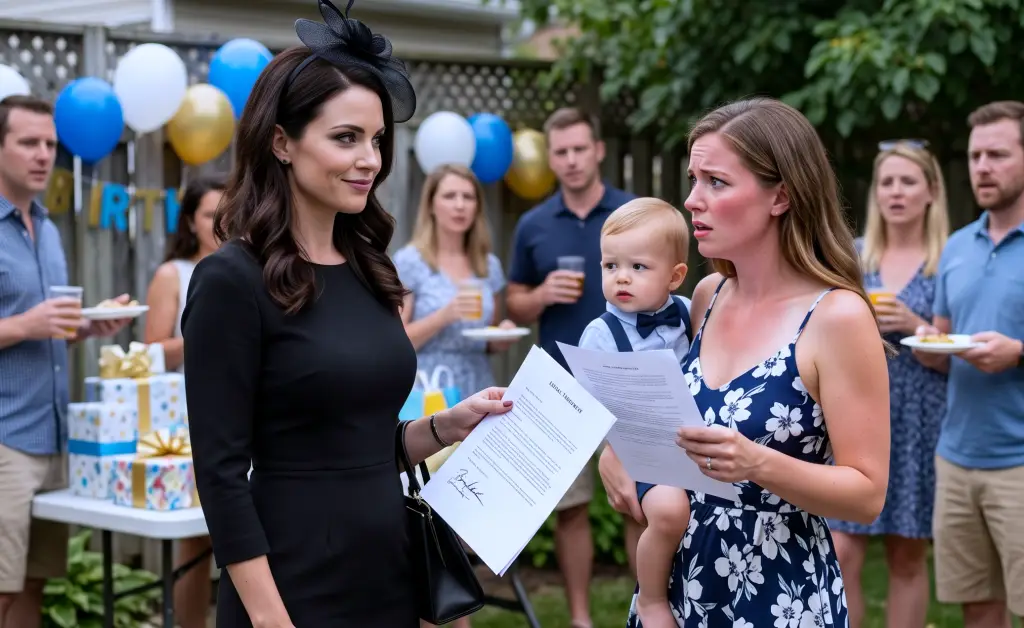
My name is Bridget. At thirty-four years old, I never fathomed that the title of widow would be permanently attached to my identity. Just three months ago, I lost Adam, my fiercely devoted husband of eleven years, to a sudden and catastrophic brain aneurysm. A mere matter of days after we laid him to rest, I forced myself to walk through the front door of my nephew Lucas’s first birthday party, a gathering where my younger sister Cassandra would drop a life-altering bomb. She stood before our family and friends to announce that Lucas was actually Adam’s biological son, triumphantly waving a piece of paper she claimed was a will entitling her child to half of my eight-hundred-thousand-dollar home. As she stood there basking in the shocked silence of the crowd, she had absolutely no idea why it took every ounce of my willpower to keep from bursting into laughter.
Adam and I crossed paths twelve years ago in a hotel ballroom bathed in the warm, dim light of a charity gala benefiting pediatric cancer research. I was a young volunteer running on fumes and lukewarm coffee, tasked with organizing the sprawling tables of the silent auction. All evening, my eyes kept drifting back to a specific piece: a vibrant watercolor capturing the Boston skyline at sunset. It was a masterpiece of bleeding hues, with fiery oranges and deep, bruised purples melting into the mirrored surface of the harbor. When the bidding finally closed, Adam had outbid a room full of deep pockets just to claim it.
I was cataloging the final bids when he walked straight over to my station and gently set the framed painting on the table between us.
“I noticed you looking at this all night,” he said. His voice had a rich, grounding timbre, and he offered a smile that made the corners of his bright blue eyes crinkle in the most disarming way. “I think it belongs with you.”
That single gesture perfectly encapsulated who Adam was. He was inherently thoughtful, deeply observant, and generous to a fault. I fell for him with a speed and intensity that left me breathless. We went on our first official date the very next evening, sharing dinner in a quiet corner booth, and by the time dessert arrived, I felt a profound certainty that my soul had known his for a lifetime.
He was a brilliant corporate attorney, yet he carried his intellect with a rare and beautiful humility. Adam was the kind of man who always remembered the names of the waitstaff, asking genuine, caring questions about their lives and actually listening to the answers. Exactly eight months after that charity gala, he walked me down to the edge of the harbor. With the actual Boston skyline painted in sunset colors that perfectly mirrored the watercolor that had brought us together, he got down on one knee and asked me to be his wife.
Shortly after our first wedding anniversary, we closed on a breathtaking Victorian home tucked away in Beacon Hill. At eight hundred thousand dollars, it was a massive financial stretch for us. However, Adam had just made partner at his law firm, and I was steadily building a solid, lucrative reputation as an independent interior designer. The house required a tremendous amount of love and elbow grease, but it had incredible bones. I fell in love with the soaring ceilings, the intricate crown molding, and a small, overgrown garden out back where I spent hours envisioning our future children running through the grass.
Those children never came. It certainly was not for a lack of trying or praying. For years, our lives were dictated by the calendar. We charted basal temperatures, meticulously planned every intimate moment, and held onto a fragile hope that shattered month after month. Then came the endless parade of specialists, the invasive tests, the clinical procedures that stripped away our dignity.
Four agonizing rounds of IVF drained not only our savings accounts but the very marrow of our spirits. The memory of our final failed attempt is permanently seared into my brain. I remember the deafening silence of the car ride home from the fertility clinic. The world outside the windshield passed by in a blur of gray. Adam reached his hand across the center console and wrapped his fingers around mine. Neither of us spoke a single word because we both already knew. We had reached the end of that heartbreaking road.
“We can still have a beautiful life,” Adam murmured later that evening. We were sitting together on our porch swing, the gentle rhythm offering a small comfort in the cool night air. “You and me, Bridget. That is enough.”
And he truly meant it. Slowly, deliberately, we gathered the broken pieces of our expectations and built new dreams. We traveled to places we had only read about. We poured our boundless energy into our respective careers. We renovated our Victorian home room by room until it transformed into the flawless showcase I had always visualized in my designer’s mind. When I made the leap to launch my own interior design firm, Adam was my biggest champion, celebrating every new client as a massive victory. Our life was incredibly full, wrapped in a quiet, abiding peace, even if it looked vastly different than the picture we had initially painted.
Throughout all of our joy and sorrow, my younger sister Cassandra remained a turbulent fixture on the periphery of our world. Four years my junior, thirty-year-old Cassandra had proudly worn the title of the family wild child since adolescence. While I was pulling all-nighters studying design and laying the groundwork for a business, she was aimlessly bouncing between dead-end jobs and dramatic, fleeting relationships. Our parents lived in a constant state of anxiety over her well-being, an anxiety that unfortunately translated into them endlessly making excuses for her reckless behavior and bailing her out of deep financial holes time and time again.
Cassandra and I had navigated a highly complex, often exhausting dynamic since childhood. She was undeniably magnetic, blessed with a striking beauty and an effortless charm that naturally drew people into her orbit. Yet, from her side, there was always a dark undercurrent of fierce competition. If I achieved a milestone, she felt a compulsive need to eclipse it. When I first brought Adam home, she suddenly developed an intense fascination with law students. When we finally bought our home in Beacon Hill, she spent months bitterly complaining about the state of her cramped apartment, shamelessly fishing for our parents to open their wallets and upgrade her living situation.
Her constant need for attention was draining, but Adam always served as the voice of grace.
“She is your only sister,” he would remind me, pressing a kiss to my temple after particularly grueling family dinners. “Family is important, Bridget. We just have to love her where she is.”
Two years ago, Cassandra introduced us to Tyler. He was a bartender she had met during a late-night outing with friends. Tyler was ruggedly handsome, his arms covered in a sleeve of intricate tattoos, and he rode a loud motorcycle that immediately sent our conservative parents into a tailspin of disapproval. Even from a distance, their relationship appeared incredibly volatile, marked by screaming breakups in restaurant parking lots followed by deeply passionate, public reconciliations.
Then came the Thanksgiving dinner the year before Adam died. The air in my dining room shifted when Cassandra stood up, tapping her wine glass. With theatrical tears streaming down her face, she announced that she was pregnant. It was a massive shock to everyone at the table. I was living my life adhering to every rule, doing everything “right” to build a stable foundation. Yet there she was, delivering tearful declarations about the miracle of life following a careless accident.
Sitting at the head of the table, I felt the sharp, familiar sting of jealousy pierce my chest. After all our clinical struggles, the needles, the heartbreak, and the immense financial toll, Cassandra had effortlessly achieved the one thing we had so desperately craved. But I swallowed the lump in my throat, pasted on a warm smile, and pushed my own grief deep down. I loved her, and I was fiercely determined to be the greatest aunt imaginable to her baby.
Lucas arrived into the world a perfectly healthy, squalling eight pounds and four ounces. I was one of the first people at the hospital, my arms loaded with expensive floral arrangements and a soft, intricately cabled blanket I had spent months knitting by hand. From the moment they brought him home, Cassandra seemed entirely consumed and overwhelmed by the demands of motherhood. My phone would ring at all hours of the night, her voice breaking with sobs over Lucas’s colic or her own bone-deep exhaustion. I stepped in without hesitation. I bought groceries, cleaned her kitchen, and frequently stayed overnight to pace the floor with a crying newborn just so my sister could get a few hours of uninterrupted sleep.
Adam, however, remained noticeably less involved with Lucas. Looking back, I assumed his distance was a protective mechanism stemming from our own painful history with infertility. I figured it was simply too painful for him to bond deeply with a baby boy that wasn’t ours. He was always perfectly polite and kind whenever Cassandra brought the baby over, but he maintained a polite, physical boundary that I never thought to question.
Then came that terrible, ordinary Tuesday morning. Adam woke up rubbing his temples, complaining of a sharp headache as he tied his silk tie in the mirror. I stood in the doorway of our bedroom, watching him.
“Why don’t you stay home today?” I suggested, stepping forward to adjust his collar. “You look exhausted.”
“It is just a migraine,” he insisted, brushing off my concern with a reassuring smile. He kissed my forehead, lingering for just a second. “I have a massive client meeting I cannot miss. I will call you the minute it is over.”
That phone call never came. Instead, my phone rang with the sterile, urgent voice of a hospital administrator. By the time I raced through the emergency room doors, my heart hammering against my ribs, he was already gone. A massive brain aneurysm, the doctors explained with devastating clinical detachment. They assured me there was absolutely nothing anyone could have done. The love of my life was thirty-six years old, and my world had officially stopped spinning.
The subsequent days passed in a suffocating, surreal fog of funeral arrangements, floral deliveries, and an endless stream of sympathetic visitors. Interestingly, Cassandra was conspicuously absent during the darkest days of my life. She sent a handful of brief text messages claiming Lucas was running a fever or that she could not track down a reliable babysitter. When she finally made an appearance at the funeral service, she kept to the back of the church, avoiding eye contact with me, and slipped out the side door before the reception even began. Wrapped in a cocoon of fresh, agonizing grief, I simply did not have the mental capacity to analyze her behavior.
Exactly one week after I stood in a cemetery and watched them lower my husband into the earth, Lucas’s first birthday arrived. The absolute last thing my shattered heart wanted to do was attend a noisy children’s party. The mere thought of making small talk made me feel physically ill. But the heavy pull of family obligation was relentless.
“Adam would want you to go,” my mother pleaded through the phone during her daily morning check-in. “You know how he was, Bridget. He always said family comes first.”
Because of those words, I found myself gripping the steering wheel of my car, navigating the streets toward Cassandra’s small, cramped rental house in a decidedly rougher part of town. Sitting on the passenger seat was a brightly wrapped gift. Staring back at me in the rearview mirror were dark, bruised circles under my eyes that the most expensive concealer in the world could not mask. I had barely slept a full hour since the morning Adam died. My nights were spent staring blankly at his empty pillow, my hand instinctively reaching across the mattress for a solid warmth that had vanished forever.
I parked my car behind a long line of vehicles on the cracked street. I closed my eyes and forced air into my tight lungs. No human being should have to fake happiness so soon after losing their entire world, I thought bitterly. But I forced the corners of my mouth up, grabbed the heavy gift box, and walked up the uneven concrete path to knock on the front door.