


Ninety-five Harley-Davidsons do not arrive quietly. At exactly six forty-seven in the morning, the synchronized roar of nearly a hundred American V-twin engines hit the cracked concrete courtyard of Martinez’s Auto Repair like a rolling artillery barrage.
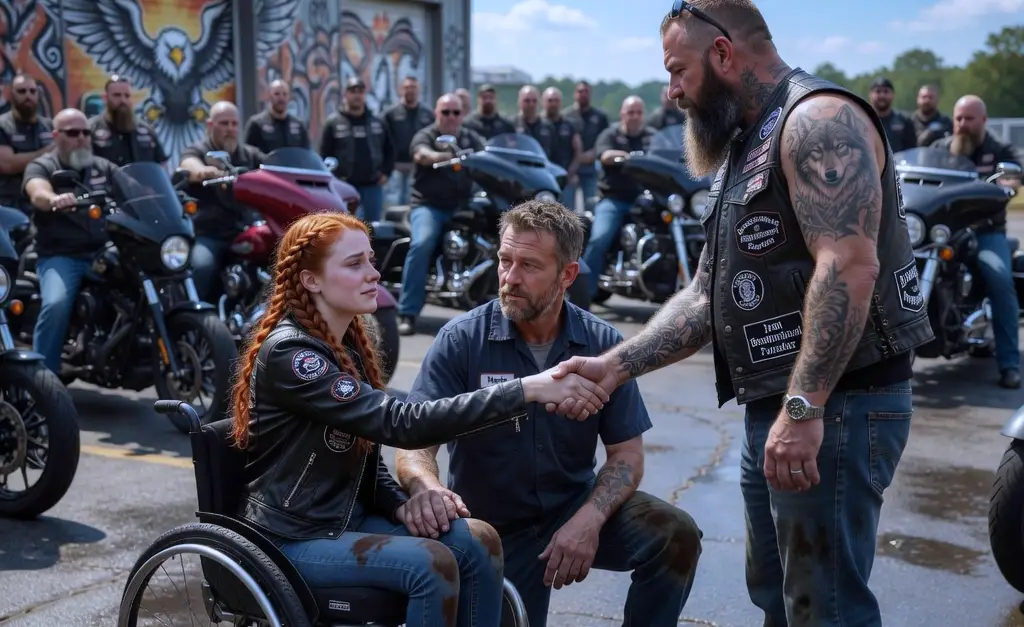
Jake stood in the center of his failing garage, grease permanently worked into the whorls of his fingerprints, watching the leather-clad tide encircle his livelihood. He was thirty-four years old, and he was fairly certain he was about to die.
Just fourteen hours earlier, he had committed an act that defied every instinct of self-preservation he possessed. He had laid his hands on the teenage daughter of a Hells Angels vice president. He hadn’t asked for permission. He had simply acted, driven by a sudden, undeniable compulsion to fix a marvel of engineering—a custom wheelchair that cost more than Jake’s entire business—that was quietly torturing the young woman trapped inside it.
The noise outside swelled from a low, storm-front vibration rolling across the Mesa, Arizona landscape into a bone-rattling cacophony. It shook the single-pane glass of his small office. First one bike had crested the horizon, then a cluster of five, then twenty, pouring into the lot until he stopped counting at ninety-five. Chrome glinted viciously in the harsh, early sunlight. They boxed him in, a mechanical wolf pack tightening the noose around a wounded animal. The patches on their heavy leather vests were a silent testament to a brotherhood forged in violence, unyielding loyalty, and bonds that could not be broken.
The pack leader cut his engine. Reaper. The man stood a towering six-foot-three, his face an impenetrable fortress behind dark aviator sunglasses and a salt-and-pepper beard. He dismounted with the slow, terrifying deliberation of a man who owned whatever earth he stepped upon. Jake’s heart hammered a frantic, bruised rhythm against his ribs. His hands, though gripping a heavy wrench until his knuckles turned the color of old bone, trembled.
He was no stranger to the bitter taste of adrenaline. As a former vehicle mechanic with the 101st Airborne, Jake had survived the blinding sandstorms of Kandahar. He had lived through vicious firefights and the earth-shattering concussions of improvised explosive devices. But the dust of Afghanistan was a lifetime ago, and this was not a foreign battlefield. This was his home, and he had directly challenged the authority of a father who commanded an army.
How a broke mechanic with a ruined leg became the sole barrier between a young woman’s pain and a biker gang’s wrath was a question of quiet, agonizing clarity. It was rooted in the very foundation of who Jake was. Martinez’s Auto Repair, perched on the forgotten, sun-baked fringes of Mesa, was more than just a business hemorrhaging money. It was his sanctuary. It was the only thing standing between him and the abyss of his own memories. The building itself was a monument to stubborn survival, held together by peeling paint that had baked to the shade of a bleached skull, and a rolling metal door that shrieked its protest against the desert scrub pushing through the pavement.
Inside, however, a different truth reigned. The concrete floor was an intricate web of cracks, yet the workspace was immaculate. Tools worn smooth by years of labor were arranged with absolute military exactness. Every wrench rested in its designated home; every socket sat aligned by size. It was the central contradiction of his existence. He was financially drowning, but his spirit—the part of him that mattered—remained fiercely ordered.
Eight years in the Army had drilled that precision into his marrow. Over two deployments, he had kept Humvees and transport trucks breathing through the worst conditions imaginable. His platoon used to swear Jake could feel an engine’s misalignment deep in his own joints. “Mechanics keep soldiers alive,” his old sergeant had barked into the desert wind. “Every bolt you tighten is someone’s child coming home.”
Jake had swallowed that creed whole, perhaps to his own detriment. His ex-wife had certainly thought so. She used to look at him with a mixture of pity and profound exhaustion, claiming he would happily bleed out six hours diagnosing a transmission slip, yet couldn’t spare six minutes to navigate the emotional wreckage of their fading marriage. She wasn’t entirely wrong. Machines made sense to him. They followed the laws of physics. When they broke, there was a root cause and a tangible remedy. People, on the other hand, were beautifully, terrifyingly messy. They lied. They harbored secret pain. And eventually, they left.
The Thursday morning that started this chain of events had been entirely ordinary in its quiet desperation. Jake had been subsisting on bitter gas-station coffee and whatever fragile optimism he could scavenge. Past-due rent notices, stamped in a glaring, accusatory red, littered his small desk. His left leg—a daily, throbbing reminder of the IED that had abruptly ended his military career—ached with the changing temperature, but his hands had remained perfectly steady. His mind was still a steel trap.
He had just wrapped up a brake replacement on a rusted Honda belonging to Mrs. Chin, a seventy-six-year-old widow surviving on the meager scraps of Social Security. When she had tried to press a wad of worn bills into his palm, attempting to pay the full shop rate, Jake had gently pushed her hands back. He charged her exactly half. He was practically destitute, his bank account a bleak landscape of negative numbers, but he possessed a deep-seated belief that poverty was no excuse to abandon your decency. Taking grocery money from a grandmother was a line he simply would not cross.
After she drove away, he had stood before his workbench, his eyes drifting up to the solitary photograph pinned to the drywall. Five young men in desert fatigues, their arms slung over each other’s shoulders, squinting brightly into the unforgiving Afghan sun. Jake was on the far left, standing tall on two fully functional legs, wearing a smile untouched by the heavy burdens of the world. Three of the men in that faded image had returned home in flag-draped caskets.
On the long, breathless nights when the desert wind whistled through the gaps in his garage door, Jake often wondered why he had been spared. Had he survived the fire and the blood just to fade into obscurity in a forgotten corner of Arizona? Then he would look at his meticulously organized tools. He would look at the weathered sign out front that read: Martinez’s Auto Repair. We fix what others can’t. And he would remember that surviving had to mean something. The expertise he had carved out of his own suffering held value. Sometimes, a microscopic mechanical flaw was the only thing standing between a person and catastrophe.
The rumble had announced them before Jake saw a thing. Not the full convoy. Just one bike. A custom-built Harley-Davidson, dripping in liquid-mercury chrome and tuned to a low, aggressive purr, rolled smoothly to a halt right outside his open bay door.
As the rider stepped off, Jake’s survival instincts redlined. The man was a monolith. At least six-foot-three, with shoulders suggesting he didn’t just ride motorcycles; he could likely bench press them. His salt-and-pepper hair was pulled back, and his heavy leather vest bore patches that commanded instant, silent respect. Hells Angels. Vice President.
The stranger stopped ten feet from the garage entrance, scanning the humble shop with a predatory, unreadable expression.
“You Jake Martinez?” The man’s voice sounded like gravel grinding beneath heavy tires. “Heard you’re the best transmission guy in Mesa.”
It wasn’t a question. Behind the massive biker, a sleek, ominous black van pulled into the lot. The side door slid open with a heavy thud, and a wheelchair lift began to descend. The mechanical whine of the motor cut sharply through the quiet morning air.
That was when Jake saw her.
Sophie was sixteen years old, dressed in a faded band t-shirt and jeans—the universal uniform of an ordinary teenager. Yet, her bright hazel eyes held a profound, quiet weariness that belonged to someone much older. There was nothing ordinary about the wheelchair she occupied. It looked like a piece of aerospace technology, a sleek titanium frame outfitted with complex joint systems and glowing diagnostic LED panels.
The chair descended smoothly, and Sophie maneuvered it toward the garage with practiced efficiency. But Jake, trained to see what others glossed over, caught it immediately. With every tiny adjustment of the joystick, a micro-expression of sharp pain tightened the corners of her mouth.
“My daughter,” the towering man grunted. Suddenly, the dangerous edge to his presence shifted into something fiercely protective. “She needs an oil change on the chair. Bearings have been squeaking.”
Jake hesitated, his gaze flicking to the sign above his door. “I work on engines, not medical equipment. I wouldn’t want to—”
The man stepped closer, his shadow swallowing the morning light. “You work on anything mechanical. Says so right on your sign. We fix what others can’t.”
Jake looked past the imposing figure to Sophie. She had stopped her chair just outside the bay, watching him with a fascinating mix of curiosity and weary amusement.
“He’s not going to hurt you,” she said, a ghost of a smile playing on her pale lips. “Probably.”