


On the fourteenth of March, 1849, the stone and timber of the Lowndes County courthouse surrendered to an inferno. Officials in the Alabama county seat were quick to declare the blaze an unfortunate accident, the tragic consequence of a single overturned oil lamp. Yet, when the smoke cleared and the embers cooled, investigators sifting through the waterlogged ash discovered a grim reality that shattered the official narrative. Deep in the subterranean dark of the basement, they found three sets of human remains. The bones were bound to the foundational stone, secured by heavy iron rings embedded directly into the masonry.
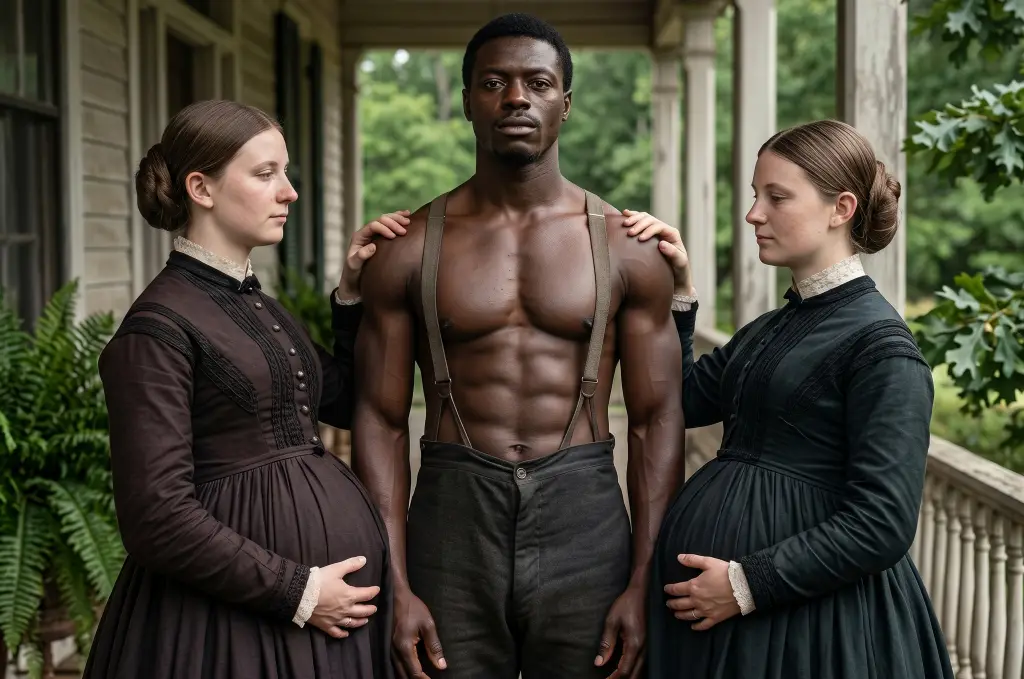
The fire consumed more than architecture. The county clerk’s archives spanning from 1847 to 1849 were reduced to gray dust. Property deeds, marriage certificates, and, most suspiciously, the exhaustive probate documents concerning the sprawling Sutton estate were entirely obliterated. For over a century since that night, the descendants of Lowndes County’s founding families have traded hushed speculations regarding the true history of Bell River Plantation during those missing two years.
They whispered of Colonel Nathaniel Sutton’s isolated twin daughters, and of an enslaved man named Marcus who had meticulously chronicled a nightmare before seemingly evaporating into the southern air. The genuine history of those years, painstakingly reconstructed from fragmentary surviving letters, medical archives recovered from Mobile, and sworn testimonies secured by a Northern abolitionist society—records that remained strictly sealed under lock and key until 1963—reveals a narrative infinitely darker than the local folklore.
The truth of Bell River Plantation did not ignite with the courthouse fire. It began to spark two years earlier, rooted in the lives of two young women who had been systematically conditioned to believe that survival required absolute, unyielding control.
In 1847, Lowndes County sprawled across the most fertile, unforgiving cotton-growing soil in the state of Alabama. It was a dark, nutrient-rich earth that minted fortunes and carved the wild landscape into sovereign kingdoms, marked by white-columned mansions and endless, manicured fields stretching toward the horizon. At the heart of this agrarian empire sat Hayneville, a modest but powerful county seat.
It was a rigid grid of brick facades and sun-baked dirt avenues where wealthy planters brokered human lives and crop yields, while their wives cultivated an elegant ignorance regarding the brutal currency of their privilege. Bell River Plantation sat eight miles south of this hub, isolated by geography and intention. It could be reached only by a singular, deeply rutted private road winding through dense, shadowy stands of water oak and crossing two slow-moving tributaries of the Alabama River.
Colonel Nathaniel Sutton constructed the main residence in 1828. It was an imposing three-story manor boasting twelve expansive rooms, flanked by a separate kitchen structure tethered to the house by a covered wooden walkway. A quarter of a mile behind the grand residence sat the quarters, twenty-four rough-hewn cabins arranged in two mathematically precise rows. They were situated just close enough for the inhabitants to be summoned at a moment’s notice, yet far enough removed that the Colonel was never forced to hear the ambient sounds of the humanity he owned. Sutton had amassed immense wealth through cotton, but his true reputation among his peers was rooted in a far more sinister intellectual pursuit.
He had marched in the Creek War under the command of Andrew Jackson. He returned from the bloodshed possessing a chilling conviction that human beings could be systematically improved through calculated, forced lineage, utilizing the identical principles applied to the breeding of agricultural livestock. His private study was a shrine to this ideology. The mahogany shelves groaned under the weight of anatomical texts imported from Philadelphia and agrarian journals shipped from Virginia.
His desk drawers bulged with active correspondence from university academics who validated and shared his grim theories regarding biological destiny and absolute racial hierarchy. The Colonel kept obsessive, flawless records. He logged physical measurements, behavioral observations, and meticulously charted genealogies tracking three generations of the people he held in bondage.
To the neighboring planters, he was an eccentric genius. To the people enslaved on his land, he was an architect of daily terror, a truth spoken only in the deepest shadows of the quarters.
Colonel Sutton never took a wife. Instead, in the sweltering summer of 1824, he attended a Charleston market and purchased a woman named Ruth. The surviving bill of sale detailed her as possessing an uncommonly fair complexion and a genteel, refined bearing. The following year, Ruth delivered twin daughters, Sarah and Catherine. Sutton raised the girls within the walls of the main house. He hired private tutors from Mobile to construct their intellects and ordered tailored silk garments from the finest dressmakers in New Orleans.
Yet, he never offered them the grace of legal emancipation. He never signed a single document acknowledging them as his legitimate blood. In the eyes of the law, and in the ledgers of Bell River, Sarah and Catherine remained his physical property. This calculated legal arrangement granted him total, inescapable jurisdiction over every breath they drew.
The twins matured in a suffocating, peculiar isolation. They mastered the fluid strokes of watercolor painting and the intricate melodies of the pianoforte. They absorbed French, advanced mathematics, geography, and classical literature. However, they were practically forbidden from stepping beyond the plantation boundaries. Their father orchestrated their entire reality, aggressively screening every potential visitor through his own paranoid metrics.
He lectured them endlessly, insisting they were exceptional beings granted advantages that elevated them far above their ordained station. He warned them, with a terrifying intensity, that the outside world would forever view them with hostility and disgust. Sutton hammered into their young minds that safety existed solely within seclusion. He taught them that trust was a fatal flaw, and that holding power over others was the only reliable mechanism for survival.
Sarah and Catherine absorbed these bitter lessons entirely. Retreating inward, they forged a silent, impenetrable language of microscopic gestures and fleeting glances. They routinely finished each other’s sentences, or entirely abandoned spoken words for days at a time, communicating exclusively through hastily scribbled notes slid beneath heavy porcelain dinner plates.
They presented themselves to the house as mirror images, wearing identically tailored dresses in complementary hues, Sarah perpetually draped in deep forest green, Catherine cloaked in midnight blue. They shared literature, one twin reading from the prologue, the other from the epilogue, exchanging the volume when they met at the center spine. They shared jewelry, hairbrushes, whispered fears, and, as the years passed, they began to share a dark, silent fury.
In 1839, Ruth succumbed to what the plantation records classified as severe pneumonia. In the damp confines of the cabins, however, voices murmured of the fading yellow bruises mapped across her arms and the profound, desperate terror that had occupied her eyes during her final, agonizing weeks. Following her burial, the Colonel’s grip on his daughters tightened into a psychological stranglehold. He retrofitted their bedroom doors with heavy iron locks mechanisms that could be engaged only from the hallway.
He demanded they compose exhaustive weekly essays detailing their daily activities, their private conversations, and the very nature of their dreams. He engineered cruel loyalty tests, leaving expensive silver or loose currency in plain sight to gauge their honesty, or abruptly introducing them to male associates solely to dissect their physical reactions. Every element of their existence was a trial designed to unearth any seed of rebellion.
Through all of this, Bell River prospered with a chilling efficiency. By the dawn of 1847, the Colonel laid claim to sixty-three enslaved souls whose forced labor yielded an astonishing one hundred and forty-two heavy bales of cotton each harvest. He funneled the vast profits through his factors in Mobile, immediately reinvesting the capital into more acreage, more human lives, and more medical volumes for his library. The demographic makeup of the Bell River quarters was distinctly unnatural. There was a profoundly disproportionate number of light-skinned residents, a volume of young children that far exceeded the natural birth rate, and a devastating, calculated pattern of families being ruthlessly fractured and sold off the exact moment the children reached early adolescence.
This brutal machinery was overseen by Jonas Pritchett, a hardened man who had walked the fields of Bell River for fifteen years. Residing in a modest cottage positioned strategically near the quarters, Pritchett executed the Colonel’s mandates with a blank, mechanical ruthlessness. He maintained his own parallel set of ledgers. Written in a cramped, hurried script, Pritchett’s notebooks cataloged daily atrocities with the mundane cadence of a weather report. He recorded which women were forcibly relocated to specific cabins, which men were mandated to sire children, and which pregnancies were abruptly terminated, alongside the harsh methods utilized.
Inside the quiet elegance of the main house, Sarah and Catherine were not the ignorant dependents their father believed them to be. When the Colonel traveled to Mobile to meet with his factors, the twins breached his study and scoured his private journals. They pressed their ears against the heavy oak doors, capturing the hushed, transactional conversations between their father and Pritchett. They possessed a complete, horrifying understanding of the nighttime economy of the quarters.
They knew exactly which faces in the fields belonged to their half-siblings. They understood that the man who raised them viewed human life as nothing more than raw material for his personal laboratory of racial architecture. In the silence of their locked room, they cultivated a cold, infinitely patient hatred for him, a hatred so absolute it would have shattered his mind had he possessed the capacity to see it.
The third of February, 1847, broke with an unseasonable, suffocating warmth, the Alabama air pushing into the low sixties long before the sun hit its zenith. Colonel Sutton had spent the entirety of the previous evening sequestered in his study, laboring by the flickering light of an oil lamp over a complex correspondence destined for a prominent professor at the Medical College of South Carolina. The domestic staff paid no mind when he failed to ring for his morning meal; it was his custom to work until dawn and sleep well past breakfast.
It was Jonas Pritchett who finally breached the study at half-past ten. He found the Colonel slouched awkwardly in his heavy leather armchair, a sea of papers cascaded across the mahogany desk. The patriarch’s face was painted in a ghastly, ashen gray. When the overseer reached out to shake his shoulder, the flesh beneath his fingers felt impossibly cold and possessed the stiff, waxy texture of a church candle.
Doctor Amos Grayfield was summoned from Hayneville and arrived two hours later. He stood over the body, checked for a pulse that had long since vanished, and officially pronounced Colonel Nathaniel Sutton dead, estimating the cessation of life had occurred somewhere in the quiet hours between midnight and dawn.
“Massive heart seizure,” Doctor Grayfield announced to the room, scarcely giving the corpse a second glance. “The man was fifty-six years of age and worked himself into the ground. I warned him on multiple occasions about his choleric temperament and the dangers of excessive mental strain. The heart simply surrenders. It is as simple as that.”
Yet, the quiet atmosphere of the room held details that violently rejected the physician’s tidy conclusion. The Colonel’s dinner tray, delivered promptly at eight o’clock the night prior, rested on a side table, the roasted meat and vegetables entirely untouched. Beside it sat a delicate porcelain cup of coffee, the dark liquid long since turned cold and stagnant. At the very bottom of the cup, barely visible, rested a peculiar, fine sediment that caught the lamplight with a faint, unnatural glitter.
Furthermore, the Colonel’s final piece of correspondence, directed to his legal counsel in Mobile, sat abandoned mid-thought. The ink slashed across the page: I have made certain arrangements regarding the future of my daughters, which must be executed precisely as stipulated, for their own protection and for the preservation of my life’s work. Should any person attempt to— The sentence bled into nothingness, the nib of the pen having dragged lazily off the edge of the heavy cotton paper, capturing the exact second the strength had abandoned his hand forever.
Out in the wide corridor, Sarah and Catherine stood shoulder to shoulder. They were already draped in identical, immaculate black mourning dresses, garments they had mysteriously procured and donned despite having had no prior notification of their father’s demise. Their pale faces were perfectly dry. There was no tremor of shock, no desperate gasp of grief. They simply stood with their fingers tightly interlaced, watching the men in the study with identical expressions of cold, watchful anticipation.