


In the sweltering heart of Georgia’s cotton empire, the year 1842 brought a suffocating heat and a profound silence to the Whitfield estate. The plantation stretched out like an endless sea of white against the red clay, a sprawling testament to wealth and dominion. At its center stood the main house, a grand structure flanked by imposing columns and shaded by ancient weeping willows. It was a place of polite Sunday smiles and starched linen, but beneath the veneer of Southern gentility, Eleanor Whitfield harbored a conviction that would ultimately rot her family’s legacy from the inside out.
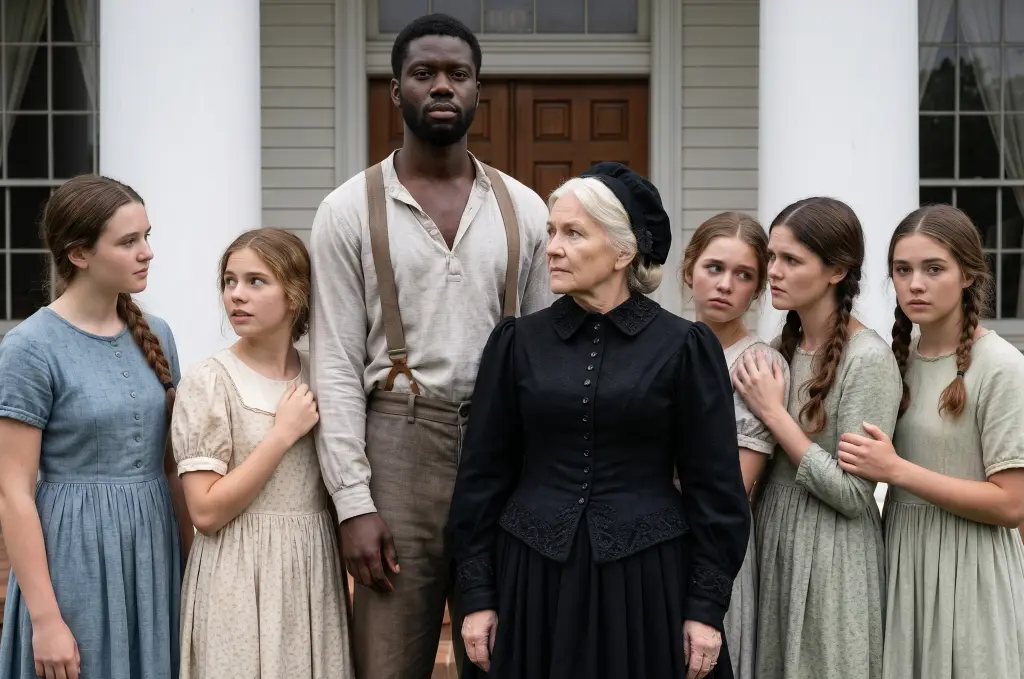
When her husband, Thomas Whitfield, succumbed to a sudden, violent fever, the earth had barely settled over his grave before Eleanor took the reins of the empire. She inherited every acre of the sprawling land, the staggering fortune hidden in the ledgers, and the lives of over two hundred enslaved men, women, and children. The neighboring planters gathered on their wide porches, sipping sweet tea and whispering behind their fans that no woman was equipped to run such a vast and demanding estate alone. Eleanor let them whisper. She possessed a terrifying clarity of purpose, a cold ambition that left no room for doubt.
She genuinely believed that the Whitfield bloodline was anointed, chosen by a higher power for greatness. Yet, every evening, as she sat alone in her late husband’s mahogany-paneled study, she would stare intently at his meticulously kept ledgers and the cracked oil portrait of their five daughters. Mary Ann, Louise, Clara, and the two youngest were undeniably beautiful. They were tall, impossibly pale, and delicate as spun glass. But to Eleanor’s discerning eye, they lacked the vital, brutal force required to maintain an empire.
“They have my grace,” she would whisper to the empty room, her fingers tracing the canvas. “But not his strength.”
To Eleanor Whitfield, strength was not merely physical endurance. It was absolute control, unyielding dominance, and the power to bend the world to one’s will. This realization slowly warped into a quiet, consuming obsession. She became fixated on the idea of fortifying her bloodline, willing to tear down every boundary of nature and decency to achieve a twisted perfection.
On the surface, life on the plantation maintained its grueling rhythm. The enslaved workers toiled from the first light of dawn until the cicadas finally ceased their deafening hum at dusk. The sharp shouts of the overseers cut through the humid air, harmonizing with the rhythmic, mechanical clatter of the cotton gins. High above it all, Eleanor would stand on her balcony, her posture as rigid and unfeeling as carved marble, watching the sea of humanity below.
It was during these long watches that one man caught her eye. His name was Josiah. He moved through the endless rows of cotton with an imposing presence, a head taller than any other man in the fields. His shoulders were broad, his movements deliberate and efficient. But it was his silence that truly set him apart. He possessed a profound, unsettling calm and a piercing gaze that seemed capable of cutting right through solid stone.
Josiah had been sold down from Virginia years prior. He carried the deep, unhealed wounds of a man who had been ripped away from his wife and child, a sorrow he buried beneath a stoic exterior. He was educated just enough to read the Bible, a rare and dangerous skill that, combined with his quiet dignity, made the overseers deeply uneasy. When Eleanor first laid eyes on him, her stare held no trace of lust, nor a single ounce of pity. It was pure, icy calculation. She did not speak a word that afternoon, but her gaze lingered on his broad back far longer than it should have.
By nightfall, the air in the cramped servant quarters was thick with whispered speculation.
“Miss Eleanor been asking about that tall one,” an old woman named Ruth muttered, stirring a battered iron pot over the fire.
Another woman sitting nearby shook her head, her eyes wide with apprehension. “Ain’t no good come when a lady stares too long at one of us.”
Despite the hushed warnings, the wheels of Eleanor’s plan were already turning. Within a month, she issued strict orders to the head overseer. Josiah was to be moved from the brutal labor of the far fields to the grounds immediately surrounding the main house. He was assigned lighter work, tasks that kept him visible from the veranda. Eleanor claimed it was simply because the man had proven himself reliable, but there was not a single soul on the Whitfield estate who believed her. Everyone knew the widow never made a move without a profound, underlying reason.
Late one evening, long after the great house had fallen into a heavy slumber, Eleanor stood before her vanity mirror. The flickering candlelight cast deep shadows across her face, highlighting the subtle fading of her once-renowned beauty. Her eldest daughter, Mary Ann, was on the precipice of turning seventeen, the exact age Eleanor had been when she was wed to Thomas.
“The Whitfield name must not fade,” she whispered to her reflection, the sound barely carrying over the distant rumble of a summer storm. “I will build a stronger line. A perfect line.”
She reached across the vanity to retrieve a small, framed portrait of Thomas, tracing the painted lines of his face with trembling, obsessive fingers.
“You failed to give me a son,” she murmured, her voice laced with a bitter resentment. “But I will finish what you started.”
The following morning, the oppressive heat of the Georgia sun was already baking the earth when Josiah was summoned to the main house. He stood on the polished wooden floor of the veranda, sweat glistening on his dark skin after a morning of labor. Eleanor sat in her high-backed wicker chair, looking him over with a quiet, terrifying intensity.
“From now on, you will work under my direct supervision,” she stated, her voice flat and authoritative. “The overseer will report to me regarding your tasks.”
Josiah offered a slow, measured nod, but kept his mouth firmly shut. Behind the impenetrable calm of his dark eyes, a flicker of something sharp briefly surfaced, perhaps suspicion, or a deep-seated dread.
As the days bled into weeks, the summer of 1843 descended upon the county, recorded as the hottest season anyone in Georgia could recall. The air itself felt impossibly heavy, settling over the plantation like a suffocating woolen blanket. On a particularly humid morning, Eleanor called Josiah to the veranda once more. She sat perfectly still, a delicate lace fan moving with agonizing slowness in her hand. From behind the heavy velvet curtains of the parlor window, her daughters watched the exchange in breathless silence.
“You are Josiah,” she said softly, though it was not a question.
“Yes, ma’am,” he answered, his gaze respectfully lowered to the floorboards.
“I have heard you are strong. Obedient. Capable of hard work.”
He nodded once, a sharp, solitary movement.
Eleanor leaned forward, the lace fan pausing its rhythmic sweep. Her voice grew sharp, yet remained perfectly composed. “From today, you will be working exclusively near the house. I will have tasks for you personally. You will execute them exactly as I say.”
To an outsider, the reassignment might have sounded like a stroke of luck, a rare promotion out of the grueling fields. But as Josiah walked away, a cold knot tightened in his stomach. It felt like a trap closing.
That evening, as the cicadas screamed their deafening chorus from the darkening fields, Josiah sat on a wooden stump outside the small, dilapidated cabin he shared with three other men. He was a man of few words, but tonight, his silence carried a crushing weight. Ruth, the older house servant, hobbled over with a wooden bowl of leftover stew from the main kitchen.
“They say mistress got plans for you,” she whispered, handing him the warm bowl. She cast a nervous glance toward the glowing windows of the mansion. “You best be careful, boy. Ain’t no safety in a white woman’s favor.”
Josiah stared into the stew and said nothing. His mind, however, was miles away, dragged back to the agonizing memory of Virginia. He remembered the auction block, the tear of being separated from his wife, the frantic cries of his child. He had sworn to the heavens that he would never allow himself to be used as a mere instrument again. Yet here he was, singled out and chosen by the widow. He knew it was not out of kindness, even if he could not yet fathom the true depths of her dark intentions.
A week later, Eleanor ordered Josiah to repair a section of the slate roof directly above the parlor. She stood on her balcony, her eyes tracking his every movement as he climbed the heavy wooden ladder, the midday sun turning the sweat on his back into a brilliant sheen. Mary Ann stepped out onto the balcony, pausing beside her mother.
“Mama, why are you always watching him?” the young girl asked, her brow furrowed in genuine confusion.
Eleanor did not bother to turn her head. Her gaze remained locked on the man above them. “A mother must choose carefully, my dear. The future of this house depends on strength, not softness.”
Mary Ann’s face tightened. She was young, but she was not foolish. She did not fully grasp the mechanics of her mother’s twisted vision, but the chilling certainty in Eleanor’s tone made the hairs on the back of her neck stand on end. That night, lying awake in the suffocating heat, she heard the muffled whispers of the older servants drifting up from the kitchen below. When the fragments of gossip finally clicked together in her mind, forming the horrifying picture of her mother’s true intent, Mary Ann buried her face in her pillow and wept until dawn.
Another week passed, and the suffocating tension in the house continued to mount. Eleanor made an unprecedented demand: Josiah was to serve the wine at the family dinner. The dining room was silent save for the clinking of silverware. The five daughters sat rigidly at the long table, watching as the tall man moved gracefully around them, filling their crystal glasses. Eleanor’s eyes tracked his hands with an unsettling hunger.
“Strong hands,” Eleanor remarked aloud, the words slicing through the quiet room as she watched him pour a deep red vintage. “Hands that could shape destiny.”
The heavy silver spoon slipped from Mary Ann’s trembling fingers, clattering loudly against her porcelain bowl. Beside her, little Clara stared wide-eyed at their mother, terrified by the strange, breathless quality of her voice.
When the meal concluded, Eleanor dismissed her daughters and the rest of the household staff. She demanded that only Josiah remain behind. The grand hallway fell into a deathly silence. Mary Ann and Louise, huddled together on the darkened landing of the grand staircase, listened intently. They heard the heavy, measured tread of Josiah’s footsteps, followed by the distinct, final creak of the heavy oak door to the study closing shut. Then, absolute silence.
From that night onward, Josiah became a permanent, imposing shadow within the great house. He was tasked with repairing hinges, carrying heavy loads of firewood, and patching the plaster walls. He was always kept in close proximity to the mistress, never permitted to stray far from her watchful eye. The atmosphere in the home grew toxic. The daughters ceased their quiet chatter during meals. The servants stopped their hushed laughter in the kitchen. Even the head overseer found reasons to avoid approaching the veranda.
Every evening, as the house slept, Eleanor would retreat to her late husband’s heavy leather chair. She would pull a thick, black leather-bound journal from the desk drawer and uncap her fountain pen. On one of the crisp, white pages, she wrote in beautiful, flowing cursive: The new Whitfield line will rise from strength. My daughters will bear greatness.
The pressure became too much for a man who had sworn never to be broken again. One evening, as the shadows lengthened across the study floor, Josiah finally broke his silence.
“Ma’am, I mean no disrespect,” he said, his deep voice rumbling quietly in the enclosed space. “But this, whatever it is you are asking of me. It is not right.”
Eleanor slowly lowered her pen. The polite mask of the Southern widow vanished, replaced by something hard and terrifying. “You will do exactly as I say, Josiah. You owe your very life to this house. You belong to it. Every single part of you.”
Josiah raised his head. He looked at her not as an enslaved man addressing his owner, but as a human being who had been systematically stripped of everything except his core, unshakeable will.
“No, ma’am,” he said, his voice dropping to a quiet, dangerous register. “No one owns my soul.”
That single sentence hung in the stifling air between them, heavy and ominous as a thunderclap. From that moment forward, Eleanor no longer looked at him with calculating curiosity. She looked at him with a cold, unyielding fury.
The very next morning, the head overseer received strict instructions to keep Josiah under constant, unrelenting watch. But the widow’s desperate attempts at control were failing. The whispers had grown wings, flying beyond the borders of the plantation and spreading like wildfire across the county. The tale of a wealthy widow, an enslaved man, and a plan so morally repugnant that even the most hardened planters pretended not to hear it, became the dark secret of the region. As the brutal heat of the summer finally began to wane, every soul bound to the Whitfield estate knew with horrifying certainty that something terrible was on the horizon.