


Looking back on that afternoon, it wasn’t the sheer cruelty of the man’s laughter that paralyzed me; it was the casual, effortless nature of it. It was the sound of an adult who had moved through the world for a very long time believing that his assumptions were the absolute center of gravity.
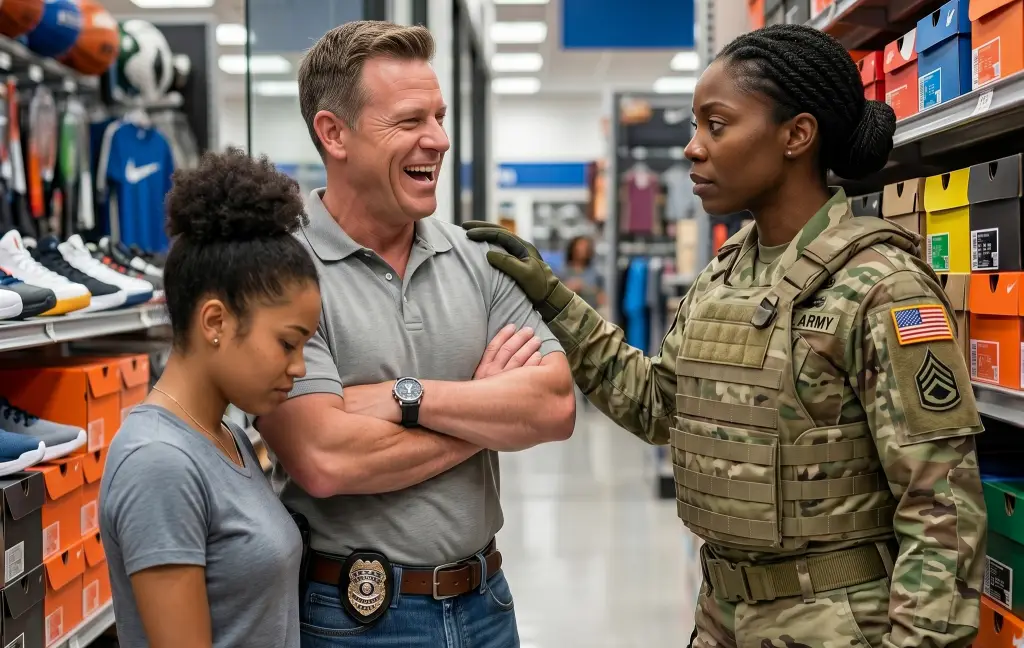
I was twelve years old, navigating that fragile, awkward bridge between childhood and adolescence. My best friend, Kaylin Torres, and I were standing in the cavernous footwear department of a Dick’s Sporting Goods inside South Park Mall in Charlotte. The air around us smelled sharply of vulcanized rubber, fresh cardboard, and the synthetic crispness of brand-new athletic gear. We were deeply engrossed in the kind of urgent, fast-paced conversation only middle-school girls can sustain, dissecting the trials of our classes, the social dynamics of the cafeteria, and, most importantly, how desperately I needed a specific pair of Nikes for the upcoming semester.
“I just don’t know if we’ll have time to get them today,” I said, tracing the bright orange swoosh on the cardboard lid of a shoebox. I let the lid drop shut with a soft, hollow thud. “My mom’s not picking me up until she’s done at Fort Bragg, so sometimes her schedule gets completely crazy.”
Kaylin blinked, her dark eyes widening in genuine surprise. She paused, a pair of running shoes dangling loosely from her hands. “Wait, your mom is in the Army? Like, actually doing the fighting part?”
“Yeah,” I replied, my voice carrying the easy, unbothered cadence of a kid talking about her favorite brand of breakfast cereal. To me, it was just a simple fact of my existence. “She’s Sergeant Major Nicole Richardson. She actually just got back from a mission overseas. She’s in Special Forces.”
It was a quiet statement, a mundane exchange of biographical trivia that children raised in military towns toss around without a second thought. But that was the precise moment the heavy atmosphere of the store was cut by a sharp, barking laugh.
It wasn’t a warm sound, nor was it the gentle chuckle of someone who found a child’s innocence endearing. It was harsh, dismissive, and explicitly designed to shrink the person it was aimed at.
Standing just a few feet away, lazily flipping through a circular rack of Under Armour hoodies, was a man who I would later learn was Officer Colton Reeves. He was off-duty, dressed down in faded denim jeans and a Carolina Panthers t-shirt that stretched tightly across his chest. He looked like any other suburban weekend shopper killing time in a mall, save for the heavy, silver police badge clipped aggressively to his leather belt, worn less like a tool of his profession and more like a flashy, intimidating accessory.
“Special Forces?” Reeves echoed, turning his body toward us. He shook his head, a wide, deeply condescending grin spreading across his face. The sheer volume of his voice immediately caused a ripple of movement in our aisle; heads began to turn. “Come on, kid. I’ve been in law enforcement for twenty years, and I can tell you right now, there is absolutely no way your mother is running around out there with the Green Berets.”
He paused, letting his eyes drag over me, his gaze narrowing as he took in my twelve-year-old face. “Especially not… someone like her.”
The words struck me like a physical blow, but the patronizing, arrogant tone behind them stung far worse. A sudden, searing heat rushed into my cheeks. I pressed my lips together into a thin, tight line, my heart suddenly hammering a frantic rhythm against my ribs.
All around us, the ambient noise of the sporting goods store seemed to dial down. A mother pushing a toddler in a metal shopping cart lingered near an endcap display, pretending to meticulously sort through packages of athletic socks while quite obviously eavesdropping. A few feet away, a pair of teenagers paused their own conversation, whispering to each other behind cupped hands.
Kaylin leaned in close to me, her shoulder bumping mine. “Just ignore him, Amaya,” she whispered, her voice trembling slightly. “He doesn’t know anything.”
But ignoring him felt impossible. The space between us had become a stage, and the officer had no intention of relinquishing his audience.
Reeves chuckled again, a wet, rattling sound in the back of his throat. “Look, sweetheart, I get it,” he said, taking a half-step toward us. “Kids like to make up stories to feel important. My own boy used to run around the neighborhood telling everybody his dad was Spider-Man. It’s the same kind of thing. It’s cute, but it’s not real.”
The heat of embarrassment clawed its way up my neck. I desperately wanted to open my mouth, to loudly defend the woman who anchored my entire world, but the words bottlenecked in my throat. My hands were shaking so visibly that I quickly shoved the Nike shoebox back onto the metal shelving unit. The cardboard scraped loudly against the rack, the abrasive sound echoing awkwardly in the quiet aisle.
“Why would you say that out loud in front of everybody?” Kaylin whispered to me, her eyes darting nervously toward the growing circle of onlookers.
I swallowed the heavy, dry lump in my throat. I lifted my chin, forcing myself to look the grown man in the eye. “Because it’s true,” I said.
That quiet, trembling defiance only seemed to entertain him further. It drew another loud burst of laughter from Reeves. He tilted his head back, openly addressing the small perimeter of strangers who were now abandoning the pretense of shopping to watch the spectacle.
“See, folks? That’s exactly what I’m talking about,” Reeves announced, gesturing loosely in my direction with a heavy hand. “A cute kid making up a fantasy life.” He looked back at me, his eyes devoid of any actual warmth. “Look, sweetheart, there is absolutely nothing wrong with wanting your mom to be a big hero. But you don’t have to stand here in public and invent fairy tales.”
Fairy tales.
The phrase landed against my skin like a slap. My mother was the furthest thing from a fictional character. She was flesh, blood, and iron—the strongest human being I had ever known. She was a woman who could be gently tucking the blankets around my shoulders one week, smelling of vanilla and laundry detergent, and flying halfway across the globe into hostile territory the next. But standing there, trapped under the buzzing fluorescent lights of a retail store, I had no physical proof to offer. And Reeves knew it.
His smug, self-satisfied grin radiated the triumphant energy of a man who believed he had just won an argument against a child. “Tell you what,” he said, tapping the silver face of his badge with a thick index finger. “If your mom is really out there doing black-ops with the Special Forces, maybe she should come by the station sometime. We could all use a good laugh.”
My chest contracted violently. In my mind’s eye, I saw my mother’s hands—rough and deeply calloused from years of gripping rifles and climbing ropes. I thought of the heavy, velvet-lined shadow box displayed proudly in our living room, housing rows of hard-earned medals. I thought of the sheer, unspoken gravity she carried into any room she entered, a quiet authority that intuitively made strangers step aside in crowded airports. She had risked her life for her country more times than I could comprehend, and here was a bored, off-duty cop tearing her legacy down for cheap entertainment in front of an audience of weekend mall-goers.
When I finally managed to force the words past my teeth, my voice cracked, betraying my youth. “You don’t know anything about her.”
The sentence hung suspended in the chilled, air-conditioned air. For a fraction of a second, the mocking smile on Reeves’s face faltered. But he was a man accustomed to having the last word, and he recovered his footing almost instantly, clapping his large hands together as if formally adjourning a meeting.
“Sure, kid. Whatever you say,” he replied dismissively.
Around us, the captive audience of shoppers exchanged loaded glances. I saw amusement in a few eyes, deep discomfort in others, but a paralyzing inertia held them all. Not a single adult stepped forward. Not one person intervened to say, Leave the girls alone, or, She’s telling the truth. That collective silence functioned as a vacuum, magnifying my humiliation until it felt like a physical weight pressing down on my shoulders.
Kaylin shifted her weight from foot to foot, the rubber soles of her sneakers squeaking nervously against the linoleum. “Amaya, come on. Maybe we should just go wait by the doors outside.”
But my legs refused to obey. My sneakers felt as though they had been set into freshly poured concrete. This was no longer just about the acute embarrassment of being mocked in public. It was about my mother. It was about my absolute truth, my deepest source of pride, being dragged through the mud for sport. Yet, I lowered my gaze to the scuffed white floor tiles, completely overwhelmed by my own powerlessness. I was, after all, only twelve.
What I couldn’t possibly have known in that agonizing moment, as I silently prayed for the floor to open up and swallow me whole, was that my mother was already walking through the sliding glass doors of the mall’s main entrance, dressed in full military uniform, and heading straight for us.