


The morning the illusion of my safety shattered began just like any other. The first bell tore through the long, brightly lit corridors of Westbrook High, a shrill command that sent a rush of bodies scrambling toward their first-period classrooms. It was a symphony of ordinary chaos: the squeak of rubber-soled sneakers against freshly buffed linoleum, the metallic slam of locker doors, and the loud, overlapping chatter of a hundred overlapping conversations. Faded, unevenly taped posters clung to the cinderblock walls, broadcasting bright, hollow slogans about friendship, tolerance, and community respect. They were part of the wallpaper, invisible to the very students they were meant to inspire. To me, they always felt less like a promise and more like a cruel joke.
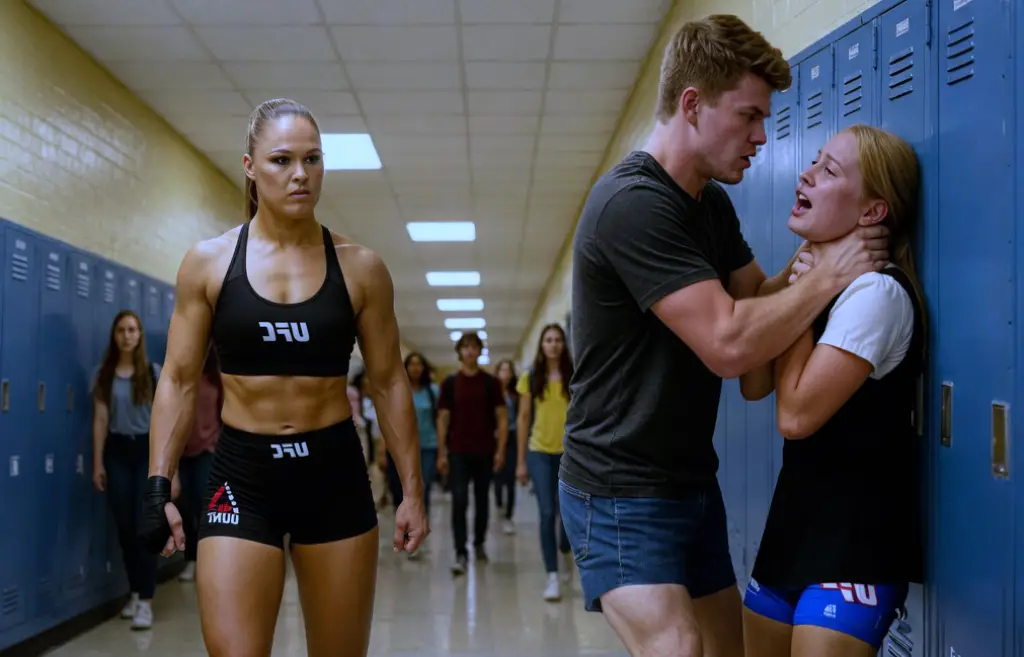
I navigated the edges of the crowd, keeping my head down. My name is La’akea. Most days, I was just a quiet girl with dark hair tied back in a sensible, tight ponytail, hugging a heavy stack of textbooks against my chest like a shield. But I carried a heavier weight than just my course load: I was the daughter of Ronda Rousey.
It was a fact I rarely spoke of, a truth I tried to keep neatly folded away. I didn’t want the whispers, the stares, or the impossible expectations. Where my mother was a tempest—fierce, unapologetically outspoken, and entirely unafraid of the fires of confrontation—I was a quiet harbor. I felt most at home in the dusty, silent corners of the school library, losing myself in the margins of my sketchbooks. I preferred observing the world rather than dominating it, writing my truths down in careful cursive rather than shouting them for everyone to hear.
But in the brutal ecosystem of an American high school, silence is rarely interpreted as peace. It is read as weakness. The way I lowered my eyes to avoid a stare, the soft cadence of my voice when I was forced to speak, my desperate avoidance of conflict—it all painted a target squarely on my back. To the apex predators of Westbrook High, I wasn’t a thinker or an observer. I was prey.
The hallway always seemed to sense him before he even appeared. The ambient noise of teenagers shifting from class to class began to dull, peeling back from loud laughter to anxious whispers, and finally, to an oppressive, suffocating silence. All that remained was the heavy thud of oversized sneakers and the metallic scrape of a heavy belt buckle deliberately dragged along the bank of lockers.
Trevor Hayes.
He materialized at the far end of the corridor. He was entirely too large for a high school boy, his shoulders broadened by hours in the weight room and padded by the raw, unchecked arrogance of someone who genuinely believed the world belonged to him. A small flock of followers trailed behind him, orbiting his cruelty like desperate satellites. They laughed on cue at his muttered remarks, eager to see who would be offered up for his amusement today. The sea of students parted for him naturally. Some suddenly found the insides of their lockers fascinating; others simply dropped their chins to their chests, praying that a lack of eye contact would grant them invisibility.
I was too lost in my own head to notice the shift in the atmospheric pressure. I was standing perfectly still, mentally outlining the thesis for an upcoming history essay, balancing my tower of textbooks. By the time the sudden hush washed over my section of the hallway, it was too late. My stomach plummeted, twisting into a tight knot of dread. I knew that silence.
Trevor’s eyes locked onto me, and a slow, cruel grin stretched across his face. He didn’t even pause to think; he changed his trajectory instantly, his shadows falling into step behind him. His gaze dropped to the books clutched desperately to my chest, taking in the rigid, panicked posture I was failing to disguise. He didn’t need a valid reason to come after me. My existence, my silence, my lineage—it was all the justification he required.
“Well, well, look who we’ve got here,” Trevor drawled. He projected his voice, ensuring it bounced off the lockers and carried down the corridor.
The hallway froze. Students stopped in their tracks. I could see the subtle movements in the periphery of my vision—hands dipping into pockets, the sleek glass of smartphones being quietly raised to capture the moment.
“Ronda Rousey’s little princess,” he mocked, stepping into my personal space. “Do you punch as hard as your mommy, or are you just good at hiding behind her name?”
My heart hammered a frantic rhythm against my ribs, a trapped bird looking for an exit. I tightened my grip on my books until my knuckles turned a sharp white. I had promised myself, over and over, that I would never give him the satisfaction of seeing me break. I lowered my head, attempting to slide my history notebook deeper into the stack, and took a tentative step to the side, praying I could just walk past him in silence.
Trevor was faster. He shifted his weight and delivered a brutal shoulder-check as I moved.
The impact jarred my teeth. The stack of books tumbled from my arms, hitting the polished floor with a series of loud, humiliating smacks. Loose papers and assignments scattered like snow across the tiles. A sharp, ugly ripple of laughter erupted from his friends, echoing through the corridor and burning my cheeks with shame.
I dropped to my knees immediately, my hands trembling as I scrambled to gather my things. I stared at the linoleum, absolutely refusing to look up into his triumphant face.
“Oops,” Trevor sneered, leaning over me so that his shadow swallowed me whole. “Didn’t mean to do that. Guess you’re just clumsy.”
My shaking fingers brushed against the edge of a piece of looseleaf paper. It was a private sketch, framed by a small, carefully written phrase of encouragement I had jotted down during a particularly hard night: Stand tall, even in the storm.
Panic spiked in my chest. I grabbed the paper, moving to crumple it and hide it away in my bag, but Trevor’s eyes were too quick. He caught the movement and the cursive script.
“What’s this? Little speeches?” he laughed, straightening up and gesturing to his audience. “You gonna be a lawyer one day? Defend people in court with your little diary entries?”
The chorus of laughter swelled, thicker and crueler this time.
I swallowed hard around the thick lump forming in my throat. I wanted to scream at him. I wanted to tell him that he knew absolutely nothing about me, and even less about my mother. But the words were trapped, suffocated by my own fear. I kept my head bowed and reached for my thickest textbook.
Before my fingers could grace the cover, Trevor’s heavy sneaker slammed down onto it, pinning it violently to the floor.
I froze, still on my knees. Slowly, agonizingly, I raised my chin and met his eyes.
His grin widened into something feral. He had won, and he knew it. All around us, the corridor was packed with my peers. Phones were out in plain sight now, red recording lights blinking like tiny, judgmental eyes. Faces were pale with nervous curiosity, but not a single person stepped forward. Not a single voice was raised in my defense.
“Come on,” Trevor said, leaning down close. His voice dropped to a menacing, intimate whisper meant only for me. “Say something. Tell me to stop. Show me that famous Rousey fire.”